

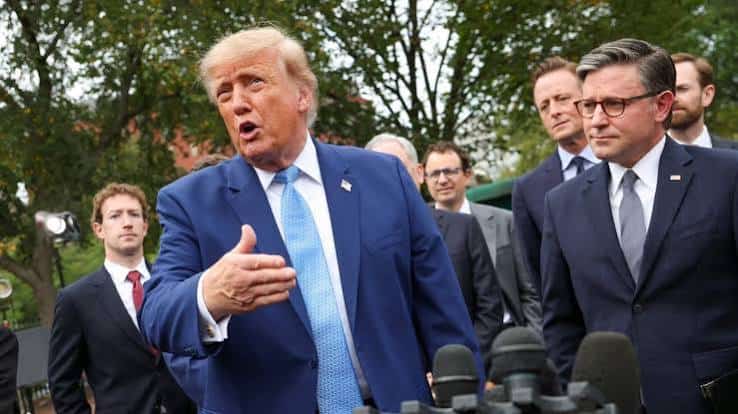
US President Donald Trump has signed an executive order directing federal agencies to replace the terms “Artificial Intelligence” and “AI” with “Super Intelligence” and “SI” in official government communications.
The order, signed on September 29, directs executive departments and agencies to use the new terminology in official correspondence, public communications, websites, reports, policy documents and other non-statutory materials, to the maximum extent permitted by law.
The White House said the change is intended to reflect what it describes as the rapidly advancing capabilities of modern AI systems.
Under the order, “Super Intelligence” and “SI” will initially refer to the technologies and systems already covered by the existing federal statutory definition of artificial intelligence.
The administration has also instructed the Assistant to the President for Science and Technology to prepare proposed legislation establishing a federal definition of “Super Intelligence” and “SI” within 60 days.
The proposed definition will consider whether the new terminology should modify or replace the existing statutory definition of artificial intelligence. It will also examine any changes required to existing federal laws that refer to AI.
The executive order does not require government agencies to rewrite previously issued regulations, presidential actions, contracts, grants or historical documents.
Trump first raised the proposed terminology change publicly during his address to the United Nations General Assembly in September. He argued that the word “artificial” made the technology sound less capable than it is and said US government documents would use “Super Intelligence” instead.
The move was subsequently formalised through the executive order.
The White House said modern AI systems now go beyond simply imitating or automating individual aspects of human intelligence. It argued that these technologies increasingly amplify human capabilities and enable new applications across areas such as science and medicine.
Related
- Trump Orders US Federal Agencies to Halt Use of Anthropic AI
- 10 Common Nigerians’ Worries About AI Explained
- What is Physical AI?
The terminology change applies specifically to the US executive branch. It does not automatically change how universities, technology companies, other governments, international organisations, or the wider technology industry refer to AI.
The order also does not establish that existing AI systems are technically classified as artificial general intelligence or superintelligence in the scientific sense. Instead, it instructs the US executive branch to use “Super Intelligence” as the government’s preferred terminology for technologies currently covered by the existing federal definition of AI.
The announcement comes as the Trump administration continues to place artificial intelligence at the centre of US technology and economic policy.
The White House has also highlighted major federal investments in AI-related initiatives, including the Genesis Mission, which aims to use advanced AI technologies to accelerate research in areas including science, medicine, energy and manufacturing.
The terminology change has already attracted attention from technology and AI researchers because “superintelligence” has a distinct meaning in much of the scientific and AI research community. The term generally describes a hypothetical form of AI that would substantially exceed human intellectual capabilities across a broad range of tasks.
The White House executive order, however, uses “Super Intelligence” as a replacement term for technologies already covered by the federal definition of artificial intelligence.
The change therefore represents a federal government terminology policy rather than a scientific reclassification of the technology itself.
For now, US federal agencies have been instructed to adopt the new terminology where the law allows, while the administration considers whether Congress should establish a separate statutory definition for “Super Intelligence.”

Senior AI Writer
Bio: Okikiola is a writer and AI enthusiast with a background in Office Technology and Management from the Federal Polytechnic Offa. She went further to study an MSc in International Business at De Montfort University (DMU). With extensive work experience across administrative and business roles, she now focuses on exploring how artificial intelligence can transform work, innovation, and everyday life.