
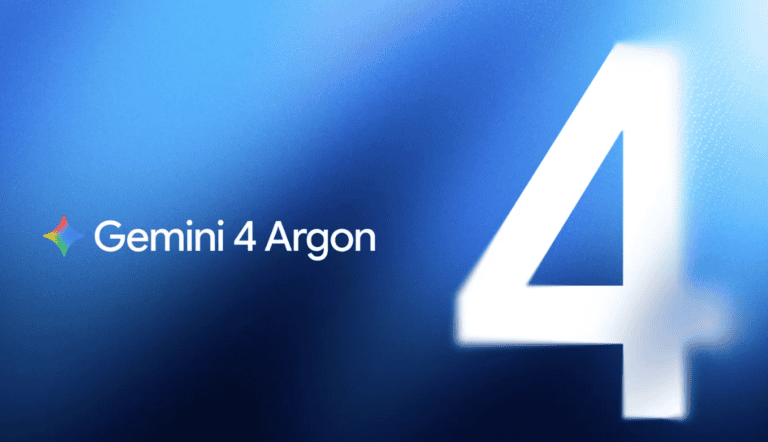
Google has unveiled Gemini 4 Argon, a new artificial intelligence model designed to handle complex, multi-step tasks across software engineering, enterprise work and cybersecurity.
Google announced the model on September 30, 2026, calling it a frontier model built to sustain deep reasoning across long, demanding workflows.
One of Gemini 4 Argon’s most notable features is its 1 million-token output limit. Google says this increases from the previous 64,000-token limit and gives the model significantly more room to work through complex problems and generate lengthy responses in a single task.
The company says thousands of Google employees already use Argon internally for specialised coding, research and writing tasks.
Google highlighted several examples of how the model is being used across its operations. Its quantum computing researchers have used Argon to optimise algorithms, while other teams have used AI agents powered by the model to analyse data-centre performance and identify memory-saving opportunities.
Google said one of these projects identified potential memory savings of between 500 tebibytes and 1 pebibyte, with more than 300 tebibytes expected to be freed once the identified optimisations are fully deployed.
Argon is also being used for large-scale software migration projects. Google said its agents are helping migrate C and C++ codebases to Rust, including projects ranging from tens of thousands of lines of code to more than 800,000 lines.
Related
- What You Can Do with Gemini AI Pro Free Trial as a Student in Nigeria
- Google Gemini vs ChatGPT: Which AI Assistant Is Better?
- Working and Living with AI from a Nigerian Perspective
- What You Can Do with Gemini AI Pro Free Trial as a Student in Nigeria
- Google Considers Allowing Websites to Opt Out of AI Search Features.
In one example involving Google’s open-source libgav1 video decoder, Argon agents replaced 32,000 lines of SIMD code with Rust. Google said the resulting Rust implementation runs 2.7 times faster than the previous Rust version while producing identical video output.
Beyond software development, Google says Gemini 4 Argon is designed for professional knowledge work, including financial research, legal research and drafting, and other enterprise workflows.
The company said Argon scored 77.9 per cent on DeepSWE v1.1, a benchmark that evaluates performance on real-world, long-horizon software engineering tasks.
Google also reported strong results on several other evaluations. On AutomationBench, which measures end-to-end execution across business functions, Argon recorded a score of 51.3 per cent. The company also reported a 91.7 per cent score on LVBench, a benchmark for long-video understanding.
Cybersecurity is another major focus of the new model.
Google said Gemini 4 Argon can autonomously identify, validate and patch software vulnerabilities. Google is making the model available to trusted cyber defenders through its Fairwind Program as it gathers additional feedback before wider deployment.
Google also said cybersecurity company Wiz is using Argon through its Scan for Good initiative, which focuses on identifying and remediating high-risk exposures affecting critical public infrastructure.
In an early demonstration, Google said Argon identified a critical vulnerability involving software used by hospitals that exposed sensitive personal information. According to Google, previous frontier models had not identified the vulnerability.
On the CWE-bench v1 evaluation, which measures a model’s ability to remediate cybersecurity vulnerabilities, Google said Argon tied for first place with a score of 68 per cent.
Despite the model’s capabilities, Google is taking a phased approach to its release.
The company said it is continuing to strengthen safeguards against potential misuse, including cyberattacks and harmful applications involving chemical, biological, radiological and nuclear technologies. Google is also testing the model’s resistance to indirect prompt injection attacks, in which malicious instructions can attempt to manipulate an AI system through external content.
Google said it has introduced additional monitoring systems designed to detect when the model’s behaviour may move beyond a user’s intended instructions and stop execution when necessary.
Gemini 4 Argon is currently being rolled out to a limited group of trusted testers and cyber defenders. Google said wider access will begin with paid API customers and Google AI Ultra subscribers before expanding further to developers, enterprises and consumers.
The model will initially be offered at an introductory price of $2 per million input tokens and $10 per million output tokens. Google said the standard price after the introductory period will be $4 per million input tokens and $20 per million output tokens.
With Gemini 4 Argon, Google is expanding its focus from AI that responds to individual prompts to systems capable of sustained reasoning and execution across longer, more complex workflows. The company says the model is intended to support developers, professionals and enterprises working on some of their most demanding tasks.

AI Writer
Bio: Joseph Michael is an MBA graduate in Marketing from Ladoke Akintola University of Technology and a passionate tech enthusiast. As a professional writer and author at AIbase.ng, he simplifies complex AI concepts, explores digital innovation, and creates practical guides for Nigerian learners and businesses. With a background in marketing and brand communication, Joseph brings clarity, insight, and real-world relevance to every article he writes.