

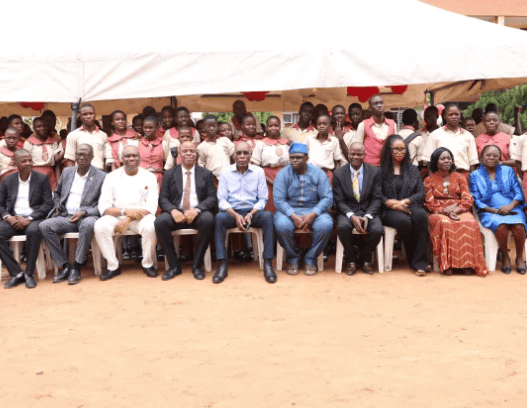
The founder and Chairman of Zinox Group, Leo Stan Ekeh, has inaugurated artificial intelligence (AI) technology centres in two secondary schools in Lagos to improve digital education and prepare young Nigerians for emerging opportunities in the technology sector.
The facilities, located at Gbagada Senior Grammar School and Lanre Awolokun High School in Gbagada, Lagos, were established by the Leo Stan Ekeh Foundation in collaboration with companies within the Zinox Group, including Task Systems, TD Africa, Zinox Technologies Limited and Konga Group.
The initiative seeks to provide students and teachers with access to modern computing infrastructure, AI-enabled learning tools and reliable internet connectivity, enabling schools to integrate digital technology into everyday teaching and learning.
Each newly commissioned centre features Zinox all-in-one desktop computers, interactive AI-enabled screens, and renewable energy systems supplied by iPower.
The facilities also have two years of Starlink satellite internet connectivity, providing students and teachers with access to online educational resources and digital learning platforms.
The renewable energy systems are designed to provide electricity around the clock, addressing one of the infrastructure challenges affecting technology-enabled education in Nigerian schools.
By combining computing equipment, internet connectivity and renewable energy, the initiative aims to create an environment where students can develop digital skills and become familiar with emerging technologies, including artificial intelligence.
Speaking during the commissioning, Ekeh encouraged students to take advantage of the facilities and acquire skills that would enable them to compete in the global digital economy.
He urged students to approach their education with discipline, patience and hard work while exploring opportunities to use technology to develop solutions and create economic value.
The Zinox founder also called on federal and state governments to prioritise education and improve teachers’ remuneration, stressing that educators require adequate support to deliver quality learning.
“An angry or hungry teacher cannot deliver quality content to students. We must consciously raise the quality of education to save this nation,” Ekeh said.
Beyond establishing AI centres, the Leo Stan Ekeh Foundation is pursuing a broader initiative to develop 1,000 technology-skilled young Nigerians with internationally recognised qualifications.
According to the foundation’s Director of Studies, Dr George Emetuche, the programme will give academically outstanding students from disadvantaged backgrounds access to full university scholarships and advanced technology training.
He disclosed that the first group of scholarship beneficiaries had already secured admission to study computer science and computer engineering at universities across Nigeria.
The foundation plans to formally announce the beneficiaries later.
Students from the newly inaugurated AI centres who demonstrate exceptional academic performance may also qualify for full university scholarships and specialised technology training.
The latest AI centres form part of the Leo Stan Ekeh Foundation’s longstanding investment in education and technology infrastructure across Nigeria.
Related
- Expert Calls for Urgent Integration of AI in Nigerian Schools
- Musk’s xAI Reaches Out to Nigerian AI Startup Founder After Startup Went Viral
- AI and the Future of Education in Nigeria
- Assessing the Significance of Leo Stan Ekeh’s ₦500m AI-Tech Centre Donation
According to the foundation, it has undertaken 123 educational and technology projects over the past 38 years, supporting institutions at primary, secondary and tertiary levels.
Its previous interventions include digital ICT centres at Imo State University, St. Augustine University in Epe, Lagos, Federal University Birnin Kebbi, Bakambara Day Secondary School in Kebbi State and Holy Ghost College in Owerri, Imo State.
Earlier in 2026, the foundation also inaugurated an AI technology centre at Holy Ghost College, Ekeh’s former school, providing students with computers, interactive learning equipment and internet connectivity.
The two new Lagos centres extend these efforts by introducing AI-enabled learning infrastructure at secondary school level, potentially allowing students to develop foundational digital skills before progressing to higher education and specialised technology training.
The initiative also highlights the growing role of private-sector investment in expanding access to artificial intelligence education in Nigeria, particularly in schools where access to modern computing equipment, reliable electricity and high-speed internet remains a challenge.
Bio: An (HND, BA, MBA, MSc) is a tech-savvy digital marketing professional, writing on artificial intelligence, digital tools, and emerging technologies. He holds an HND in Marketing, is a Chartered Marketer, earned an MBA in Marketing Management from LAUTECH, a BA in Marketing Management and Web Technologies from York St John University, and an MSc in Social Business and Marketing Management from the University of Salford, Manchester.
He has professional experience across sales, hospitality, healthcare, digital marketing, and business development, and has worked with Sheraton Hotels, A24 Group, and Kendal Nutricare. A skilled editor and web designer, He focuses on simplifying complex technologies and highlighting AI-driven opportunities for businesses and professionals.
LinkedIn