
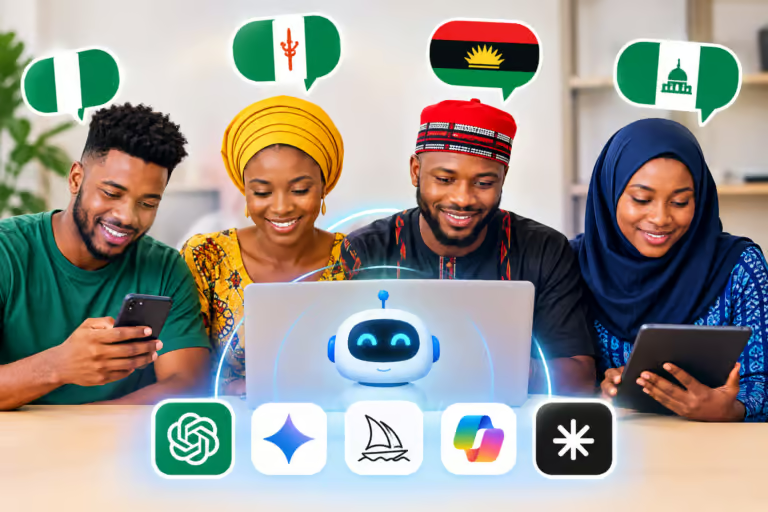
Today, I want to share some of the AI tools you can actually use with Nigerian languages, including Yoruba, Igbo, Hausa, and Nigerian Pidgin.
If you’ve ever tried using AI in a Nigerian language, you probably know that the experience can be hit or miss. Some tools understand simple sentences quite well, while others start struggling when you add slang, proverbs, local expressions, or everyday Nigerian speech.
In this article, we’ll look at what these tools can actually do, where they perform well, and where you may still need a native speaker to check the results.
6 Best AI Tools That Work in Pidgin, Yoruba, Igbo, and Hausa
1. Google Gemini + Google AI Search
Google Gemini is probably the easiest AI tool to start with if you want to use Nigerian languages. You don’t need a specialised platform or technical knowledge. You can simply open Gemini and start asking questions.
Google has also expanded AI Search to support Yorùbá and Hausa in AI Overviews and AI Mode. So you can search in these languages and get AI-generated answers instead of translating everything into English first.
Google Translate also supports Yoruba, Igbo and Hausa, including downloadable offline language packs.
You can use it for questions, summaries, translations and even voice search without building anything.
Gemini can handle Yoruba, Hausa and Igbo, and it can generate Nigerian Pidgin too. But the quality can change depending on the prompt. Proverbs, slang, cultural expressions, and sentences that mix English with a Nigerian language can quickly expose its weaknesses.
Its weak point is deeper cultural understanding, tone, proverbs, and natural code-switching.
2. YarnGPT
YarnGPT is different from Gemini because it is built around Nigerian voices and speech.
You can use it for voiceovers, audiobooks, pronunciation, and other content where the voice matters. The Lagos-based platform supports Yoruba, Igbo, Hausa, Nigerian English and Pidgin.
This is especially interesting if you create content.
Think about a YouTube video. Getting an AI to translate your script into Yoruba is one thing. Getting that Yoruba script to sound natural when spoken is another problem entirely.
That is where YarnGPT becomes useful.
Bluechip Technologies also acquired YarnGPT in 2026, which means this is no longer just another small AI demo sitting on the internet.
The weak point is this: it is speech-first. It struggles with deep research or complex reasoning.
Related:
How to Use AI Tools for Beginners in Nigeria: A Practical Starter Guide
10 Free AI Tools Nigerian Creators Can Use to Make Short Films
3. 9jaLingo
9jaLingo is another Nigerian-focused AI voice platform, and it’s particularly interesting if you are building an app or AI product.
It supports text-to-speech and speech-to-text for Yoruba, Igbo, Hausa and Pidgin. It also offers 240+ voices and a developer API.
So you could build an app where someone sends a voice note in Hausa, the system understands what they said, and then responds with Hausa audio.
That is the kind of use case where 9jaLingo makes sense.
You can also use it for WhatsApp tools, customer-service systems, call centres, educational apps and voice assistants.
Note: It is not a full ChatGPT-style AI brain.
4. AfricanGPT
AfricanGPT is built specifically for African languages.
The platform supports more than 30 African languages, including Yoruba, Hausa, Igbo and Naijá, which is Nigerian Pidgin.
You can use it to chat, translate short texts, learn languages and practise conversations.
This makes it useful if your main goal is simply to use AI in an African language rather than English.
But keep one thing in mind.
Supporting 30+ languages does not mean the AI will perform equally well in every language.
So I would use AfricanGPT for language practice, everyday conversations and short translations. For medical, legal, or other important information, you should still have someone who understands the language properly check the output.
Weak Spot: High-stakes translations and complicated cultural context.
5. Intron Sahara
Intron Sahara is probably one of the most interesting tools on this list because it is not really trying to compete with Gemini as a chatbot.
Its main job is speech recognition.
In simple terms, Sahara is designed to listen to African speech and turn it into text.
That sounds simple until you think about how Nigerians actually speak.
People switch between English and Pidgin. They mix Yoruba with English. There are different accents, slang, names, background noise and different ways of pronouncing the same words.
Sahara was built around these challenges and supports Hausa, Yoruba, Igbo, and Pidgin.
It is designed for real-world applications such as healthcare, legal services, finance and call centres.
Use it for: Transcription, speech recognition, call centres, medical documentation and legal records.
Weakness: This is more of an AI infrastructure tool than a consumer chatbot.
6. N-ATLaS
N-ATLaS is one of the projects I would pay attention to if you are interested in the future of Nigerian AI.
It was developed through Nigeria’s AI ecosystem and focuses on Yoruba, Hausa and Igbo, alongside Nigerian-accented English.
The idea is simple: instead of relying entirely on models built around English and other major global languages, build a model that pays much more attention to Nigerian languages and local use cases.
N-ATLaS is available on Hugging Face and can be used for chatbots, education tools, and other applications that need Nigerian-language text.
Its performance can vary between Yoruba, Hausa and Igbo, and Pidgin is not its main focus compared with those three languages.
Use it for: Nigerian-language chatbots, education, civic technology and development.
The weak part: Performance varies across Nigerian languages, and Pidgin support is more limited.
Final Thought On Generative AI Tools That Understand Nigerian Languages…
The biggest takeaway is that no single “best AI tool for Nigerian languages” does everything. It really depends on what you want to do.
If you want everyday questions, translation and general AI help, Gemini is probably the easiest place to start. If you need natural Nigerian voices, YarnGPT and 9jaLingo are more focused on speech.
AfricanGPT is useful for chatting and practising African languages, while Intron Sahara is built more for understanding real Nigerian speech. N-ATLaS is especially interesting if you are looking at Nigerian-focused AI models and building your own applications.
The technology is improving quickly, though. The more these models are trained on how Nigerians actually speak, the more useful AI will become for people who don’t want to rely on English for everything.

Lawrence Orjime is an AI and technology writer at AIBase.ng, covering the latest developments in artificial intelligence, emerging technologies, and the companies shaping the future of AI.
With a background in content strategy, SEO, and digital media, Lawrence Orjime combines technology reporting with a strong understanding of what makes information useful and discoverable online.