

OpenAI has launched GPT-6 in ChatGPT, marking its latest major step in the rapidly evolving artificial intelligence race.
The new model began rolling out globally to ChatGPT Plus, Pro, Business and Enterprise users on 7 October, with Free and Go users following from 8 October. OpenAI says GPT-6 is designed to deliver a more capable, interactive experience to the more than 1.2 billion people who use ChatGPT each week.
The release comes as technology companies compete to develop increasingly capable AI systems, with improvements in reasoning, speed and usability becoming central to the next stage of the market.
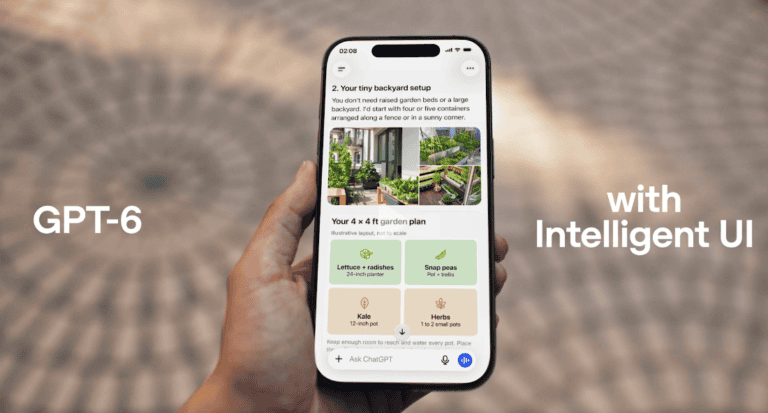
One of the most significant features accompanying GPT-6 is what OpenAI calls Intelligent UI.
Rather than limiting responses to blocks of text, ChatGPT can now combine written answers with visuals and interactive elements where appropriate. These can include charts, diagrams, forms, tappable buttons and interactive experiences.
The idea is to let ChatGPT adapt how it presents information to the task.
For example, a complex explanation could include an interactive diagram, while a practical request could produce a small tool within the conversation. OpenAI says users don’t need to learn a special command to activate the feature; GPT-6 decides when an interactive format would be useful.
Traditional text responses remain available when they are the most appropriate format.
GPT-6 is not being offered as a single model across every ChatGPT subscription.
OpenAI says Plus, Pro, Business and Enterprise users receive GPT-6 Sol in the standard Chat experience. Free and Go users are being given GPT-6 Luna as the rollout expands to those plans. GPT-6 Pro, powered by GPT-6 Astra, is available to eligible Pro, Business and Enterprise users.
The rollout is also staged. OpenAI says Enterprise availability can depend on workplace administrator settings, meaning some organisations may not see the new model immediately.
OpenAI is also highlighting improvements in how quickly GPT-6 can deliver useful information.
The company says GPT-6 can start responding while it continues processing a request, letting users see an initial answer before it finishes adding detail. The model has also been designed to improve how ChatGPT handles web search and complex requests.
For everyday users, the practical difference may therefore be less about a new model name and more about how quickly and naturally ChatGPT can help complete a task.
Alongside the new capabilities, OpenAI says it aligned GPT-6 during training.
The company says the model has improved at recognising and communicating the limits of its capabilities, including when it lacks the information or tools needed to answer a question. OpenAI has also published additional safety information alongside the release.
That focus is increasingly important as AI systems handle more complex tasks and produce increasingly sophisticated outputs.
Related
- ChatGPT Adds Interactive Virtual Capability to Help Users Understand Maths and Science Concepts
- What You Can Do with Gemini AI Pro Free Trial as a Student in Nigeria
- Top 10 Best Free AI Research Tools for Nigerian Students
- UI Final-Year Student Goes Viral for Using AI to Prepare for Exams
The arrival of GPT-6 adds another significant development to an already crowded AI market.
OpenAI is competing with companies including Google, Anthropic and Meta, all of which are investing heavily in increasingly capable AI models and products.
What makes the GPT-6 launch notable is not simply the arrival of another generation of language model. OpenAI is also trying to change how people interact with AI by letting the interface adapt to the task.
OpenAI says its longer-term ambition is for software to adapt to people, rather than forcing people to learn fixed interfaces for different tasks. Intelligent UI is being presented as an early step towards that vision.
For users, the immediate question is whether those changes translate into genuinely more useful AI in everyday life.
GPT-6’s rollout will provide the first large-scale test.
As the technology becomes available to more users, competition among leading AI companies will likely shift from simply producing convincing answers to building the most useful, reliable, and intuitive AI assistant.

Senior AI Writer
Bio: Okikiola is a writer and AI enthusiast with a background in Office Technology and Management from the Federal Polytechnic Offa. She went further to study an MSc in International Business at De Montfort University (DMU). With extensive work experience across administrative and business roles, she now focuses on exploring how artificial intelligence can transform work, innovation, and everyday life.