

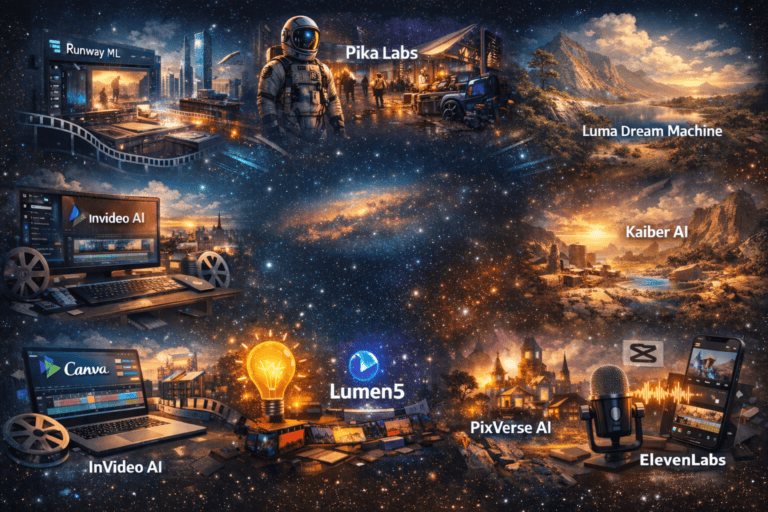
What once required expensive equipment, large production teams, and complex editing software can now be done with AI-powered tools. From generating cinematic scenes and animations to producing realistic voiceovers and automatically editing footage, AI is opening new opportunities for creators globally.
For emerging filmmakers, content creators, and digital storytellers, these technologies are significantly lowering the barriers to entry in video production. With the right AI platforms, a single creator can write a script, generate visuals, edit footage, and add narration without a full studio setup, making it easier to build a sustainable creative career.
Below are 10 powerful AI tools creators can use to produce short films, social media videos, and visual stories more efficiently.
1. Runway ML
What it is:
Runway ML is an AI-powered video editing and creative platform that helps creators generate, manipulate, and enhance video content using machine learning.
Best Use Cases:
- Adding visual effects or motion tracking to videos.
- Removing or replacing backgrounds in footage.
- Enhancing video quality and style for professional short films.
Key Functionalities / Best Features:
- AI-assisted video editing and effects.
- Motion tracking and automated background removal.
- Tools for style transfer and visual enhancements.
- Integration with other editing software for workflow flexibility.
2. Pika Labs
What it is:
Pika Labs is an AI tool that transforms text prompts into animated sequences, helping creators visualise ideas before actual production.
Best Use Cases:
- Creating storyboards and animated prototypes.
- Generating short animated sequences for concept pitches.
- Visualising scenes to plan camera angles and storytelling.
Key Functionalities / Best Features:
- Text-to-animation conversion.
- Rapid storyboard generation.
- Motion graphics and scene visualisation.
3. Kaiber AI
What it is:
Kaiber AI is a creative AI platform that enables filmmakers to generate AI-assisted video sequences and experiment with styles and effects during pre-production.
Best Use Cases:
- Pre-visualising scenes and cinematic styles.
- Creating dynamic video content for social media or short films.
- Rapid experimentation with video aesthetics.
Key Functionalities / Best Features:
- AI scene generation and style transfer.
- Dynamic editing and creative video manipulation.
- Ability to combine multiple visual elements seamlessly.
4. Luma AI Dream Machine
What it is:
Luma AI Dream Machine is an AI tool for generating photorealistic 3D scenes and immersive environments from simple inputs.
Best Use Cases:
- Creating cinematic backgrounds without physical locations.
- Generating virtual environments for storytelling or animation.
- Designing realistic 3D settings for short films or game cinematics.
Key Functionalities / Best Features:
- Photorealistic 3D scene generation.
- AI-assisted environmental and lighting adjustments.
- Fast prototyping of cinematic visuals.
5. InVideo AI
What it is:
InVideo AI is a user-friendly AI video editor that helps creators quickly produce high-quality videos from templates or scripts.
Best Use Cases:
- Editing short films and social media videos quickly.
- Converting scripts or articles into video content.
- Adding stock footage, transitions, and effects efficiently.
Key Functionalities / Best Features:
- Text-to-video conversion.
- Ready-made templates and automatic transitions.
- Stock media library integration.
- AI-assisted video enhancement tools.
6. Canva
What it is:
Canva is a popular design platform that also offers AI video editing tools, allowing creators to combine animations, graphics, and clips in a simple drag-and-drop interface.
Best Use Cases:
- Creating visually appealing short films and video content.
- Adding animated overlays, graphics, and text to videos.
- Producing promotional videos for social media.
Key Functionalities / Best Features:
- AI-assisted video editing and animation.
- Drag-and-drop templates for quick production.
- Extensive library of stock footage and graphics.
- Easy export for multiple platforms.
7. Lumen5
What it is:
Lumen5 is an AI tool that converts scripts or articles into video narratives, automatically matching visuals, music, and pacing.
Best Use Cases:
- Turning short stories or scripts into videos.
- Producing explainer or educational content.
- Creating narrative-driven short films efficiently.
Key Functionalities / Best Features:
- AI script-to-video conversion.
- Auto-suggested visuals, music, and scene pacing.
- Customizable templates for storytelling.
8. PixVerse AI
What it is:
PixVerse AI generates unique visual assets for films, including props, textures, backgrounds, and special effects.
Best Use Cases:
- Enhancing short films with original visual elements.
- Creating unique backgrounds, textures, or props.
- Experimenting with creative visual styles.
Key Functionalities / Best Features:
- AI-generated visuals and textures.
- Customizable props and environmental elements.
- Supports a wide range of artistic and cinematic styles.
9. CapCut
What it is:
CapCut is a mobile-friendly AI video editor that lets creators produce polished videos directly on their phones, ideal for social media or short films.
Best Use Cases:
- Editing and producing short films on mobile devices.
- Adding automated effects, text-to-speech, and transitions.
- Creating social media-ready content quickly.
Key Functionalities / Best Features:
- AI-assisted video cutting and trimming.
- Text-to-speech voiceovers and dialogue generation.
- Automated transitions, filters, and effects.
- Mobile-first workflow for convenience.
10. ElevenLabs
What it is:
ElevenLabs is an AI-powered text-to-speech platform that generates realistic voiceovers and character dialogue from text.
Best Use Cases:
- Narration for short films or documentaries.
- Character voices for animation or AI-generated films.
- Producing podcasts, explainer videos, or social media content.
Key Functionalities / Best Features:
- Natural-sounding voice generation.
- Multiple voices, accents, and languages.
- Adjustable tone, pacing, and emotion.
- Seamless integration with video editing tools.
Closing Insights
As artificial intelligence continues to reshape the creative industry, video production is becoming more accessible to creators everywhere. With the help of AI tools, filmmakers, content creators, and digital storytellers can now generate scenes, animate ideas, edit footage, and produce professional-quality videos with far fewer resources than before.
For emerging creators, particularly those with limited budgets, these platforms provide an opportunity to experiment and bring ideas to life. By combining tools for scene generation, animation, editing, and voice narration, creators can produce complete video projects from concept to final output, while gaining a competitive edge in the rapidly growing digital media economy.

Senior Reporter/Editor
Bio: Ugochukwu is a freelance journalist and Editor at AIbase.ng, with a strong professional focus on investigative reporting. He holds a degree in Mass Communication and brings extensive experience in news gathering, reporting, and editorial writing. With over a decade of active engagement across diverse news outlets, he contributes in-depth analytical, practical, and expository articles exploring artificial intelligence and its real-world impact. His seasoned newsroom experience and well-established information networks provide AIbase.ng with credible, timely, and high-quality coverage of emerging AI developments.