

Imagine finding a pair of sneakers on Instagram for ₦45,000, only to discover later that the same product was selling for ₦35,000 elsewhere. Or spending hours comparing dozens of listings on Jumia and Konga, trying to figure out which seller is offering the best deal.
Online shopping offers convenience, but it also comes with challenges: inconsistent pricing, fake reviews, misleading product descriptions, and unreliable sellers.
The good news? You don’t have to do all the research yourself anymore.
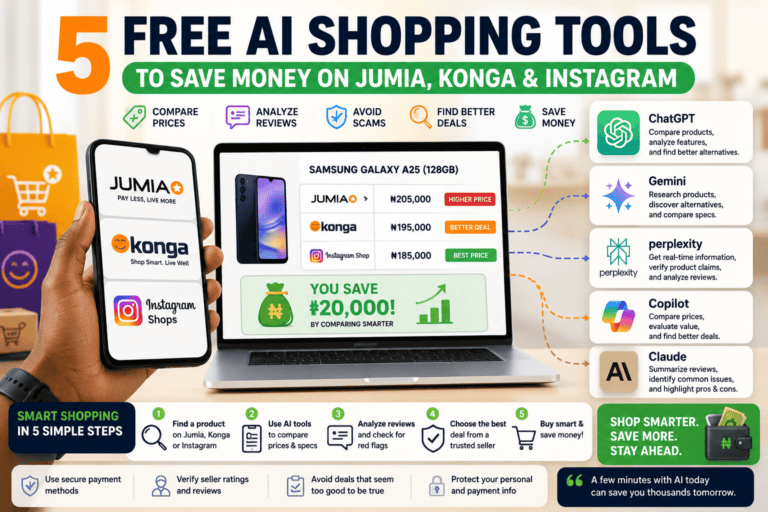
Artificial intelligence (AI) tools can help you compare prices, analyze reviews, evaluate products, and make smarter buying decisions before you spend your money.
Here are five free AI tools that can help shoppers like you save money, avoid costly mistakes, and shop with greater confidence.
Why More Shoppers Are Turning to AI
Nigeria’s e-commerce sector continues to expand as more consumers embrace online shopping. Yet concerns about counterfeit products, exaggerated marketing claims, unreliable sellers, and fluctuating prices remain common.
Traditionally, shoppers had to spend hours researching products across multiple platforms. AI tools now make that process faster by helping users compare products, summarize reviews, identify better alternatives, and evaluate whether a product truly offers value for money.
Think of AI as a personal shopping assistant available 24/7, one that never gets tired of comparing options.
1. ChatGPT
What It Does
ChatGPT functions as a personal shopping assistant that can compare products, explain specifications, summarize reviews, and recommend alternatives within your budget.
How It Saves You Money
Instead of buying the first product you see, ChatGPT can help you:
- Compare competing products
- Identify unnecessary features
- Find cheaper alternatives
- Understand whether a product is actually worth the asking price
Example
You can paste product descriptions from Jumia, Konga, or Instagram and ask:
“Which of these wireless earbuds offers better value for under ₦30,000?”
Within seconds, you’ll receive a side-by-side analysis.
Best For
- Electronics
- Home appliances
- Fashion purchases
- Product comparisons
2. Google Gemini
What It Does
Gemini excels at research and product discovery, helping users gather information from multiple sources quickly.
How It Saves You Money
It can help you:
- Compare specifications
- Evaluate competing brands
- Discover alternatives
- Research product strengths and weaknesses
For instance, suppose you’re considering a smartphone selling for ₦250,000.
Ask:
“What are the best alternatives to this phone under ₦250,000?”
You may discover options with better battery life, cameras, or performance at the same price point.
Best For
- Smartphones
- Laptops
- Consumer electronics
- Product research
3. Perplexity AI
What It Does
Perplexity combines AI-generated answers with web-based sources, making it useful for product verification and research.
How It Saves You Money
Perplexity helps shoppers:
- Verify product claims
- Research unfamiliar brands
- Compare products
- Analyze review trends
Example
Before purchasing from an Instagram seller, ask:
“What are the most common complaints about this product?”
This can reveal recurring issues that may not be obvious from seller descriptions.
Best For
- Product verification
- Review analysis
- Research before purchase
4. Microsoft Copilot
What It Does
Copilot combines AI assistance with online search capabilities.
How It Saves You Money
It can help identify:
- Better-priced alternatives
- Similar products with stronger reviews
- Better value-for-money options
- Product strengths and weaknesses
Example
If you find a television on Jumia, ask:
“Is this TV overpriced compared to similar models?”
The AI can help assess whether you’re getting a fair deal.
Best For
- Home appliances
- Electronics
- Price-to-performance comparisons
5. Claude AI
What It Does
Claude excels at processing large amounts of text, making it especially useful for reviewing customer feedback.
How It Saves You Money
Instead of reading hundreds of reviews yourself, Claude can:
- Summarise customer experiences
- Identify recurring complaints
- Highlight common defects
- Reveal hidden strengths and weaknesses
Example
Paste dozens of customer reviews and ask:
“Summarise the most common complaints customers have about this product.”
Within moments, you’ll know whether buyers are reporting issues such as poor durability, misleading specifications, or disappointing performance.
Best For
- Review analysis
- Expensive purchases
- High-consideration buying decisions
6 Red Flags AI Can Help You Spot
AI won’t eliminate every shopping risk, but it can help identify warning signs before you make a purchase.
Be cautious if:
- A product is dramatically cheaper than similar listings.
- Product photos appear generic or copied.
- The seller has little or no verifiable feedback.
- Reviews contain repeated complaints.
- The seller insists on unusual payment arrangements.
- Product descriptions seem inconsistent or exaggerated.
A useful prompt is:
“Based on these reviews and product details, what warning signs should concern a buyer?”
Sometimes, that simple question can save you from an expensive mistake.
10 AI Prompts Every Online Shopper Should Save
One of the easiest ways to get value from AI is to ask better questions. Here are ten prompts worth bookmarking:
Product Comparison
Compare these two products and tell me which offers better value for money.
Budget Shopping
Recommend the best products I can buy within a budget of ₦100,000.
Review Analysis
Summarise the most common complaints in these customer reviews.
Alternative Search
Suggest three better alternatives within the same budget.
Price Evaluation
Is this product fairly priced based on its specifications and features?
Seller Assessment
What risks should I consider before buying from this seller?
Hidden Costs
Are there any potential maintenance or replacement costs I should know about?
Feature Analysis
Which features genuinely matter, and which ones are mostly marketing?
Best Value Option
Which of these options offers the highest value for the money?
Final Buying Decision
If you were shopping on a budget, which of these products would you choose and why?
Case Study: Saving Money on a Smartphone Purchase
Consider a shopper who finds a smartphone advertised on Instagram for ₦220,000.
Rather than purchasing immediately, the shopper spends 15 minutes using AI tools.
- ChatGPT compares the phone with competing models.
- Gemini identifies alternatives in the same price range.
- Claude summarises customer reviews and reveals frequent battery complaints.
- Perplexity uncovers better-rated options from other sellers.
- Copilot evaluates overall value for money.
The result?
The shopper discovers a comparable device with stronger reviews and better battery performance selling for ₦200,000 elsewhere.
The savings amount to ₦20,000, but perhaps more importantly, the shopper avoids buying a product associated with recurring customer complaints.
What AI Cannot Do
While AI can make you a smarter shopper, it is not a guarantee against fraud or disappointment.
AI cannot:
- Confirm a seller’s legitimacy with absolute certainty.
- Verify real-time inventory levels.
- Guarantee delivery timelines.
- Ensure product quality after purchase.
- Eliminate all online shopping risks.
Always conduct your own due diligence and use secure payment methods whenever possible.
Smart Shopping Is No Longer About Finding the Cheapest Price
The cheapest product is not always the best deal.
A product that costs slightly more but lasts twice as long often delivers greater value. Likewise, a seller with a stronger reputation may be worth choosing over the lowest-priced option.
Today’s smartest shoppers don’t rely on a single marketplace or a handful of reviews. They use AI to compare alternatives, evaluate feedback, verify claims, and make informed purchasing decisions.
Before your next online purchase, especially one worth more than ₦ 20,000, spend five minutes with one of these free AI tools. Compare prices, analyse reviews, and explore alternatives.
You may save money. More importantly, you may avoid buyer’s remorse.

Senior Reporter/Editor
Bio: Ugochukwu is a freelance journalist and Editor at AIbase.ng, with a strong professional focus on investigative reporting. He holds a degree in Mass Communication and brings extensive experience in news gathering, reporting, and editorial writing. With over a decade of active engagement across diverse news outlets, he contributes in-depth analytical, practical, and expository articles exploring artificial intelligence and its real-world impact. His seasoned newsroom experience and well-established information networks provide AIbase.ng with credible, timely, and high-quality coverage of emerging AI developments.