

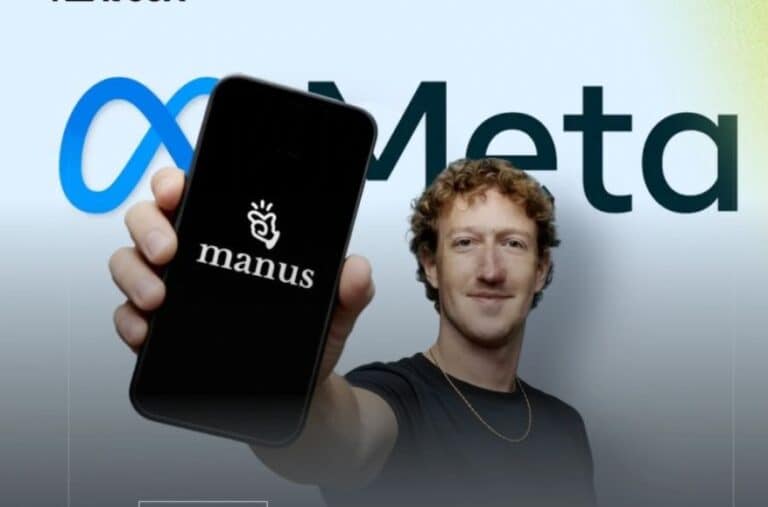
Meta’s latest AI acquisition, Manus, marks a major shift beyond traditional chatbots, introducing fully autonomous AI agents capable of executing complex digital tasks independently. Here’s everything you need to know.
As an Autonomous AI Agent
Manus AI is an autonomous artificial intelligence agent designed to take high-level goals and complete multi-step tasks on its own. Unlike standard AI chatbots that simply respond to prompts, Manus can plan, execute, and deliver results by interacting with software, browsing the web, running code, and analysing data.
How Manus AI Works
Manus operates using a multi-agent architecture that breaks down user requests into smaller, manageable subtasks. Each subtask is assigned to a specialised AI module responsible for planning, data collection, execution, and synthesis. This structure allows Manus to produce actionable results without constant human supervision. It also runs in cloud or sandboxed environments, meaning tasks can continue even when users are offline.
What Sets Manus Apart
Traditional large language models are reactive, generating responses only when prompted. Manus, however, is proactive and capable of executing full workflows such as:
- Automating reports — generating structured reports from raw data with minimal input
- Coding and debugging — writing, testing, and refining software automatically
- Website and application development — building functional digital products end-to-end
- Managing integrations between tools — connecting and automating workflows across platforms
This evolution shifts AI from an “assistive” tool to an “executive” system capable of acting independently.
Origins and Timeline
- Developer: Butterfly Effect Pte Ltd, a Singapore-based AI startup with Chinese roots
- Launch: Publicly introduced in March 2025 as one of the first widely accessible autonomous AI agents
- Meta Acquisition: In December 2025, Meta acquired Manus for over $2 billion, signalling a strategic move toward embedding autonomous agents into its ecosystem
Strategic Importance
Manus represents a significant shift in how AI is applied:
- For Meta: Enables automation across Ads Manager, messaging, and broader AI services
- For the industry: Strengthens Meta’s position in the race for autonomous AI agents
- For users: Reduces manual effort while improving efficiency in complex digital tasks
Key Capabilities
Manus AI can perform a wide range of functions, turning high-level instructions into completed outcomes:
- Browse the internet and compile research — independently gathers, analyses, and summarises information from multiple sources
- Write, execute, and debug software code — functions as a virtual developer by generating and refining code automatically
- Analyse and report on complex datasets — processes large volumes of data, identifies patterns, and delivers actionable insights
- Generate documents and presentations — creates professional reports, proposals, and slide decks with clear structure
- Build web applications autonomously — designs, develops, and deploys web apps with minimal human input
- Integrate with multiple tools and services — connects different platforms and automates workflows seamlessly
These capabilities highlight how Manus transforms abstract goals into real, usable outputs.
Comparison with Other AI Systems
| Feature | Manus AI | Traditional Chatbots | Open-Source AI Agents |
| Task Autonomy | ✔ Fully autonomous | ❌ No | Varies |
| Multi-Step Execution | ✔ Yes | ❌ No | Limited |
| Human Guidance | ❌ Minimal | ✔ Required | Mixed |
| Tool Integration | ✔ Advanced | ❌ No | Depends |
Availability
Initially available through invite-only beta access, Manus is now being integrated into Meta’s platforms, enhancing functionality across its ecosystem rather than existing as a standalone product.
Challenges and Criticisms
Autonomous agents like Manus introduce important concerns:
- Reliability — complex tasks may fail or produce inaccurate results
- Safety — independent execution can lead to unintended outcomes without oversight
- Data governance — handling sensitive data within Meta’s systems raises privacy and security issues
Conclusion
Manus AI represents a shift from AI systems that simply respond to queries to those that can act independently and complete tasks end-to-end. Its acquisition by Meta underscores the growing importance of autonomous agents in shaping the future of digital automation, workflow efficiency, and AI-driven productivity.

Contributor
Bio: Mieba Gogo-Abite, popularly known as MIEBAGA, is an AI freelance writer and contributor at aibase.ng. A chartered accountant with experience in the oil sector and hospitality industry, he brings strong analytical insight, strategic thinking, and professional discipline to his writing. Mieba is known for his results-driven approach, integrity, and commitment to delivering clear, insightful, and impactful content on artificial intelligence and emerging technologies.