

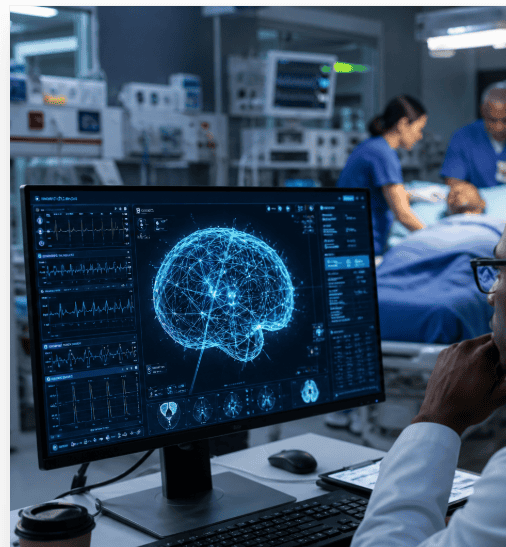
A new study led by researchers at Harvard Medical School has found that advanced artificial intelligence systems can deliver more accurate emergency room diagnoses than human doctors under controlled testing conditions, marking a significant milestone in the evolution of AI in clinical medicine.
The research evaluated the performance of advanced AI models against physicians using real patient cases drawn from an emergency department setting in Boston. Both the AI system and the doctors were provided with identical clinical information, including patient symptoms, medical histories, and initial test results, with their outputs subsequently assessed by independent reviewers.
The study found that the AI system delivered more accurate or near-correct diagnoses at a higher rate than the doctors involved. In some instances, the AI outperformed two physicians assessing the same case, suggesting a growing capability for machine learning systems to process complex clinical data and identify patterns that may be less immediately apparent to human practitioners.
Beyond diagnosis, the AI was also assessed on its ability to recommend appropriate tests, prioritise patients through triage decisions, and propose treatment pathways. Researchers reported that the system performed strongly across these areas, particularly in rapidly synthesising large volumes of information, an increasingly critical requirement in emergency medicine, where decisions are often made under significant time pressure.
Emergency departments are widely regarded as one of the most challenging environments in healthcare, requiring clinicians to make rapid, high-stakes decisions, often with incomplete information. The use of real-world patient cases in the study is therefore seen as a notable step forward compared with earlier research that relied on hypothetical or textbook scenarios.
Despite the findings, the researchers cautioned that the results should not be interpreted as evidence that AI can replace doctors. The study was conducted under controlled conditions and does not fully replicate the dynamic and unpredictable nature of live clinical environments.
They emphasised that human judgement, patient interaction, and clinical accountability remain essential components of medical care. As such, AI is more likely to be deployed as a decision-support tool, assisting clinicians rather than substituting them.
Related: The Role of AI in Genomics: Unlocking the Power of Genetic Data
The study adds to a growing body of evidence demonstrating the expanding capabilities of AI in healthcare, particularly in areas such as diagnostics and clinical decision support. However, experts note that further large-scale trials and real-world testing will be required before such systems can be safely integrated into routine medical practice.
The findings are expected to have global implications, particularly for healthcare systems facing shortages of skilled medical professionals. In such contexts, AI-assisted tools could help improve diagnostic accuracy and support frontline clinicians, although challenges around regulation, infrastructure, and trust remain.
The study marks a significant moment in the ongoing development of artificial intelligence in medicine, highlighting both its potential and the need for careful, evidence-based adoption.

Bio: An (HND, BA, MBA, MSc) is a tech-savvy digital marketing professional, writing on artificial intelligence, digital tools, and emerging technologies. He holds an HND in Marketing, is a Chartered Marketer, earned an MBA in Marketing Management from LAUTECH, a BA in Marketing Management and Web Technologies from York St John University, and an MSc in Social Business and Marketing Management from the University of Salford, Manchester.
He has professional experience across sales, hospitality, healthcare, digital marketing, and business development, and has worked with Sheraton Hotels, A24 Group, and Kendal Nutricare. A skilled editor and web designer, He focuses on simplifying complex technologies and highlighting AI-driven opportunities for businesses and professionals.
LinkedIn