

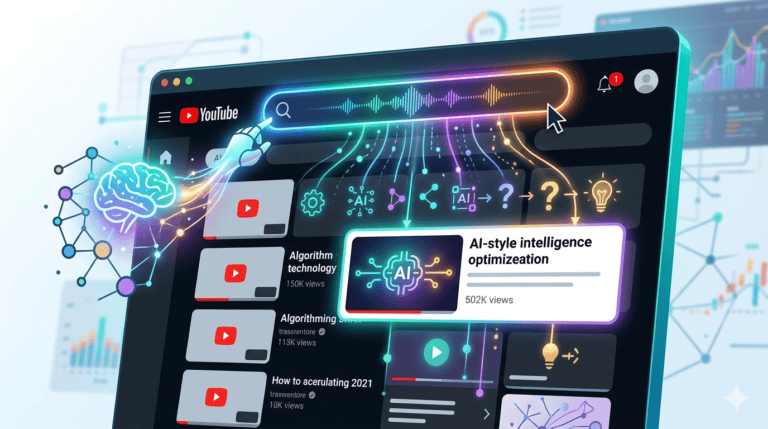
Google is expanding its artificial intelligence capabilities by integrating an AI-powered search experience into YouTube, marking a significant step in the company’s broader push to reshape how users discover content online.
The move will see Google introduce a more conversational search mode to YouTube, allowing users to ask detailed questions rather than relying on traditional keyword-based queries. The feature is designed to deliver more precise and context-aware results, including summarised answers, recommended video segments, and guided suggestions.
The new system builds on Google’s wider rollout of AI-driven search tools, often referred to as “AI mode”, which aims to transform search into a more interactive experience. On YouTube, this means users could, for example, ask complex questions about a topic and receive curated responses drawn from multiple videos, rather than scrolling through a list of results.
At present, the feature is being tested with a limited number of users, including some YouTube Premium subscribers. It is not yet clear when or if the AI search mode will be rolled out more widely.
Industry analysts say the development reflects intensifying competition among technology firms to embed generative AI across their platforms. By incorporating AI into YouTube’s search function, Google is seeking to improve content discovery while keeping users within its ecosystem for longer.
However, the introduction of AI-generated summaries and recommendations may also raise questions about accuracy, content attribution, and the impact on creators. Some experts have cautioned that AI-curated results could reduce direct engagement with individual videos, potentially affecting viewership patterns.
Google has not provided detailed information on how the system selects or prioritises content, though it is expected to rely on the company’s existing AI models alongside YouTube’s vast data library.
Related news
The experiment signals a broader shift in how online platforms are evolving, with AI increasingly positioned as a central tool for navigating large volumes of content. If rolled out more widely, the feature could significantly change how audiences interact with video search in the years ahead.

Bio: An (HND, BA, MBA, MSc) is a tech-savvy digital marketing professional, writing on artificial intelligence, digital tools, and emerging technologies. He holds an HND in Marketing, is a Chartered Marketer, earned an MBA in Marketing Management from LAUTECH, a BA in Marketing Management and Web Technologies from York St John University, and an MSc in Social Business and Marketing Management from the University of Salford, Manchester.
He has professional experience across sales, hospitality, healthcare, digital marketing, and business development, and has worked with Sheraton Hotels, A24 Group, and Kendal Nutricare. A skilled editor and web designer, He focuses on simplifying complex technologies and highlighting AI-driven opportunities for businesses and professionals.
LinkedIn