

China has announced plans to provide 5,000 artificial intelligence (AI) training opportunities to developing countries over the next five years, marking one of its biggest international AI capacity-building initiatives to date.
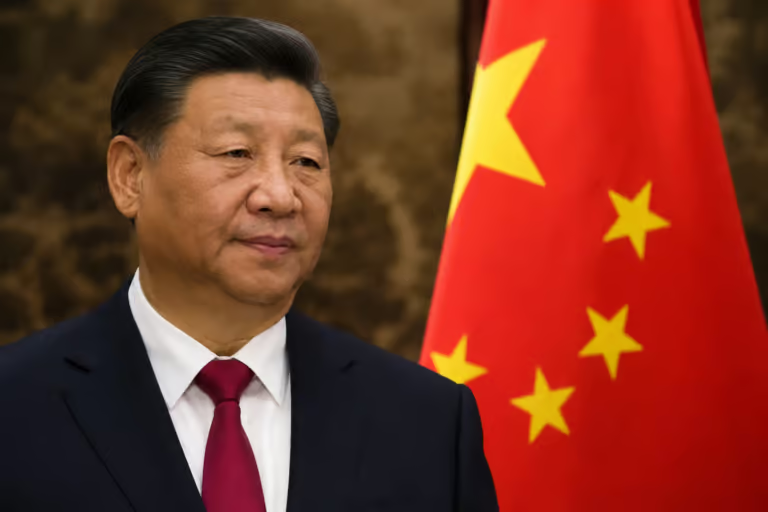
Chinese President Xi Jinping announced the opening ceremony of the 2026 World Artificial Intelligence Conference (WAIC) and the High-Level Meeting on Global AI Governance in Shanghai on 17 July. The move forms part of China’s broader effort to strengthen AI cooperation with developing nations while promoting a more inclusive approach to global AI governance.
For countries across Africa, including Nigeria, the announcement could present new opportunities for AI skills development, although many details of the programme are yet to be disclosed.
What China Has Announced
According to Xi Jinping, China will provide 5,000 opportunities for AI training and seminars for participants from developing countries over the next five years.
The initiative is part of a wider package of international AI cooperation measures that includes:
- 5,000 AI training and seminar opportunities for developing countries over five years.
- Plans to establish international AI application cooperation centres with regional organisations including the African Union (AU), ASEAN, BRICS, the League of Arab States, the Shanghai Cooperation Organisation (SCO), and the Community of Latin American and Caribbean States (CELAC).
- Support for 30 countries to adopt China’s AI-powered MAZU meteorological early warning system, designed to improve disaster preparedness and protect lives and property.
- The launch of the World AI Cooperation Organisation (WAICO), a China-backed international organisation aimed at strengthening global cooperation on AI governance.
What We Know About the Training Programme
While the headline announcement has attracted global attention, China has not yet released detailed information about how the 5,000 training opportunities will be delivered.
As of publication, the Chinese government has not announced:
- How participants will apply.
- Which countries will receive allocations.
- Whether the training will be delivered online, in person or through a hybrid model.
- The eligibility criteria.
- The curriculum or AI topics to be covered.
- Whether scholarships, travel or accommodation will be provided.
- The institutions that will deliver the training.
The only confirmed information is that the opportunities will consist of AI training and seminars delivered over five years for participants from developing countries.
Why This Matters for Nigeria
Nigeria has emerged as one of Africa’s fastest-growing AI ecosystems, with increasing government interest, a growing number of AI startups, expanding university research and rising demand for AI skills across industries.
Although Nigeria has not been specifically named as a beneficiary, China’s commitment to working with the African Union suggests that African countries could play an important role in the initiative.
If Nigerian professionals, researchers and students become eligible, the programme could help strengthen expertise in areas such as:
- Machine learning and generative AI.
- AI research and innovation.
- AI applications in healthcare, agriculture and education.
- AI policy and governance.
- Responsible AI development.
However, until further details are released, it remains unclear how participation will be organised or how many places may eventually be available to Nigerians.
Part of China’s Broader AI Strategy
The training initiative is not an isolated announcement.
It forms part of China’s wider strategy to expand its influence in global AI development while presenting itself as a partner for developing economies.
During his speech, Xi Jinping argued that AI should remain accessible to all countries and warned against technological monopolies and restrictions that could widen the digital divide. He also promoted greater international cooperation and called for a global AI governance framework that is fair, inclusive and coordinated through international institutions.
The announcement comes at a time when competition between China and the United States over AI leadership continues to intensify, with both countries seeking to shape international AI standards and partnerships.
Read also:
- China Launches Global AI Education Service Platform
- SA and China Expand Cooperation on Digital Education and AI
What Happens Next?
For now, interested individuals and organisations will need to wait for additional announcements from the Chinese government or participating institutions.
Key questions still awaiting answers include:
- When applications will open.
- Which countries will participate.
- Who can apply.
- How training providers will be selected.
- What qualifications, if any, applicants will need.
These details are expected to emerge as China begins implementing the programme over the coming months and years.
Let’s Recap
China’s pledge to provide 5,000 AI training opportunities represents one of the largest international AI capacity-building commitments announced so far for developing countries.
While many operational details remain unknown, the initiative signals China’s intention to play a larger role in developing AI talent across Africa, Asia, Latin America and other emerging regions.
For Nigeria, the announcement is significant because it could create new pathways for AI education, international collaboration and technical skills development. However, Nigerians hoping to participate should note that no application process, eligibility requirements, or country allocations have yet to be announced. China Offers 5000 AI Training Opportunities

AI Writer
Bio: Joseph Michael is an MBA graduate in Marketing from Ladoke Akintola University of Technology and a passionate tech enthusiast. As a professional writer and author at AIbase.ng, he simplifies complex AI concepts, explores digital innovation, and creates practical guides for Nigerian learners and businesses. With a background in marketing and brand communication, Joseph brings clarity, insight, and real-world relevance to every article he writes.