
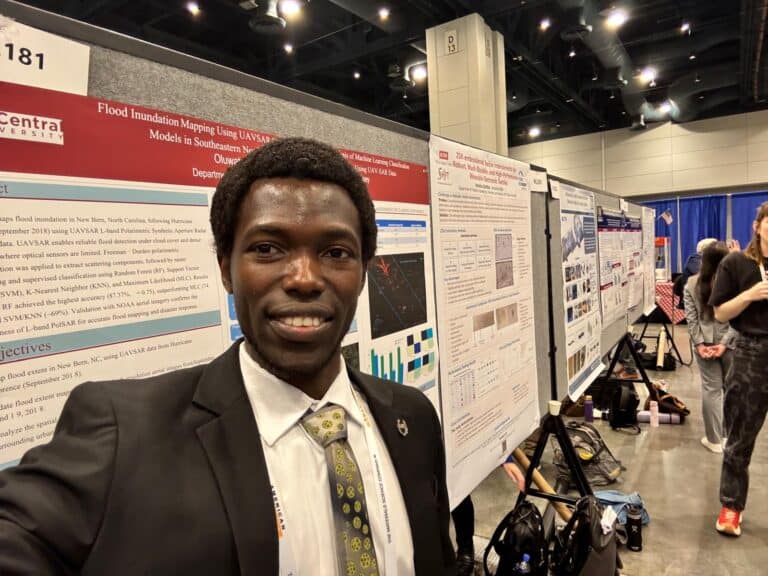
A Nigerian scientist has developed an artificial intelligence-powered flood prediction system designed to improve early warning capabilities and help communities prepare for devastating floods before they occur.
The new platform, known as the HydroSense AI Flood Prediction System, uses machine learning algorithms to analyse multiple environmental data sources, including rainfall patterns, river water levels, weather conditions and historical flood records.
The goal is to generate more accurate flood forecasts that enable authorities and residents to respond before disasters unfold.
Flooding remains one of Nigeria’s most destructive natural disasters, affecting thousands of people every year.
Heavy rainfall, overflowing rivers, poor drainage infrastructure, and rapid urbanisation have contributed to recurring floods that damage homes, farmland, roads, and other critical infrastructure across several states.
The scientist behind the innovation said the AI-powered system is designed to support emergency management agencies, local governments and disaster response organisations by providing timely flood risk assessments.
By identifying areas that are likely to experience flooding, the technology could help authorities issue earlier evacuation notices and deploy emergency resources more effectively.
Unlike conventional forecasting methods that often rely on a limited number of environmental indicators, the HydroSense AI Flood Prediction System continuously processes large volumes of data in real time.
This allows the platform to detect changing conditions more quickly and improve the accuracy of flood predictions over time as additional data becomes available.
Experts have increasingly highlighted the importance of artificial intelligence in disaster risk management.
AI technologies can rapidly process complex datasets, identify hidden patterns and generate predictive models that would be difficult to produce using traditional analytical techniques alone.
In Nigeria, the need for more effective flood forecasting has become increasingly urgent. Seasonal flooding has repeatedly displaced communities, disrupted agricultural production and caused significant economic losses.
Climate change has also contributed to more frequent and intense rainfall events, placing additional pressure on existing disaster preparedness systems.
If adopted by government agencies and emergency responders, the HydroSense AI Flood Prediction System could complement existing meteorological forecasting tools by providing another layer of predictive intelligence.
Such systems can also support urban planning, infrastructure development and environmental monitoring by identifying long-term flood-prone areas.
Related
- Lagos Deploys AI to Detect Early Signs of Flooding
- Tanzania Deploys AI to Strengthen National Disaster Management
- AI in Football: The Complete Guide for Nigerian Fans
- AI tool for currency recognition developed by Nigerian researcher
- NiMet, AIM Partner to Deliver AI Weather Forecasts To Nigerian Farmers
Artificial intelligence is increasingly being deployed across Africa to address environmental challenges, from weather forecasting and precision agriculture to wildfire detection and water resource management.
The latest innovation demonstrates how locally developed AI solutions can be tailored to solve challenges unique to Nigerian communities.
Although further validation, large-scale testing and collaboration with relevant government agencies will be required before nationwide deployment, the development represents another milestone for Nigeria’s growing artificial intelligence ecosystem.
It also highlights the increasing role Nigerian researchers are playing in applying AI to address pressing societal and environmental challenges.
As climate-related disasters become more frequent, innovations such as the HydroSense AI Flood Prediction System could become valuable tools for strengthening disaster preparedness, protecting lives and reducing the long-term impact of flooding across Nigeria.
Bio: An (HND, BA, MBA, MSc) is a tech-savvy digital marketing professional, writing on artificial intelligence, digital tools, and emerging technologies. He holds an HND in Marketing, is a Chartered Marketer, earned an MBA in Marketing Management from LAUTECH, a BA in Marketing Management and Web Technologies from York St John University, and an MSc in Social Business and Marketing Management from the University of Salford, Manchester.
He has professional experience across sales, hospitality, healthcare, digital marketing, and business development, and has worked with Sheraton Hotels, A24 Group, and Kendal Nutricare. A skilled editor and web designer, He focuses on simplifying complex technologies and highlighting AI-driven opportunities for businesses and professionals.
LinkedIn