

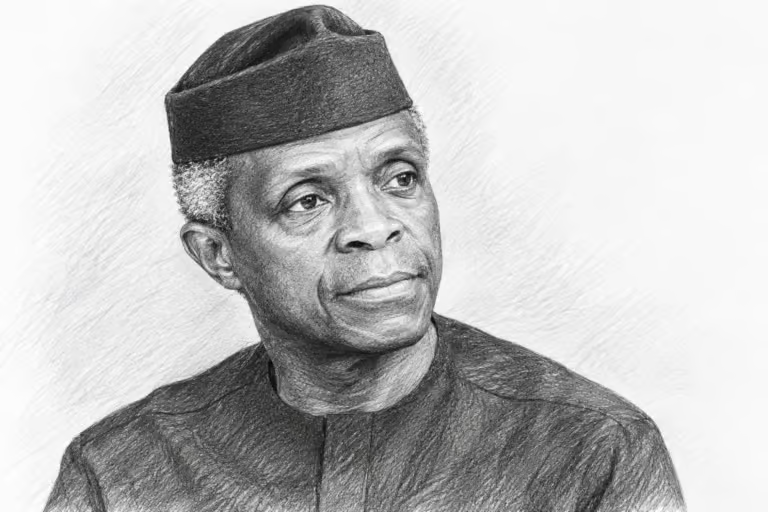
Former Vice-President Yemi Osinbajo has proposed a 10-year development blueprint to transform Ikenne, Ogun State, into a centre for artificial intelligence, robotics, and technological innovation in Africa.
The proposal, tagged the Ikenne 2036 Plan, seeks to build on the town’s educational heritage, particularly the legacy of late Chief Obafemi Awolowo, by prioritising technology-driven education, skills development and innovation.
Osinbajo made the proposal on Friday while delivering a lecture titled “Ikenne, a Small Town, a Great Inheritance and an Even Greater Future” at the 50th Ereke Day anniversary organised by the Ikenne Development Association.
According to the former vice-president, residents were urged to look beyond physical infrastructure and invest in knowledge, technology, and the development of young people.
He argued that Ikenne’s relatively small size should not limit its ambition or its capacity to contribute to national and continental development.
“Ikenne occupies a small place on the map, but a great place in our national story. Our geographical size has never defined the reach of our possibilities,” he said.
Awo’s educational legacy as a model
Osinbajo cited Awolowo’s free and compulsory education policy in the defunct Western Region as an example of how visionary leadership and investment in human capital could transform society.
He recalled that nearly one million children were reportedly enrolled in schools across the region by 1959, while about 41 per cent of its budget was devoted to education.
He also highlighted the establishment of Western Nigeria Television in 1959, describing it as evidence of the region’s early recognition of the importance of technological advancement.
Awolowo, who was born in Ikenne, played a significant role in shaping the educational and political development of the former Western Region.
Osinbajo said the principles behind Awolowo’s achievements should inspire the community to pursue ambitious development goals suited to the present era’s challenges and opportunities.
“The next 50 years will be shaped by artificial intelligence. We can be the village in Africa that trains the best minds and develops the most transformative AI tools,” he said.
Technology-driven education at the centre
The proposed Ikenne 2036 Plan would require clear development priorities, defined responsibilities, measurable annual targets and a framework for monitoring progress.
Osinbajo said the community should adopt a long-term development approach, with greater emphasis on education, innovation, and technological capacity rather than focusing mainly on buildings and other physical projects.
He also drew lessons from the educational philosophy of late educationist Tai Solarin, who founded Mayflower School in Ikenne in 1956.
According to Osinbajo, Solarin’s emphasis on independent thinking, character development and the dignity of labour demonstrated that education should equip young people with practical abilities and a sense of responsibility, rather than focus solely on academic qualifications.
The proposed plan places Ikenne’s educational heritage at the heart of its ambition to prepare young people for a future increasingly influenced by artificial intelligence and robotics.
However, the proposal remains a vision requiring further planning and implementation. The report did not establish that the plan had been formally adopted or that a dedicated implementation structure had been put in place.
Related
- Ogun State Unveils AI-Driven Learning Platform to Enhance Education
- AI and the Future of Education in Nigeria
- FG Unveils AI-Powered National Cancer Control Plan 2026–2030
Aligning local ambitions with Nigeria’s digital education drive
The proposal comes amid broader efforts to strengthen digital education and artificial intelligence skills in Nigeria.
In July 2026, the Federal Ministry of Education announced a nationwide expansion of its Artificial Intelligence Teacher Capacity Development Programme across Federal Unity Colleges. The ministry said the initiative was expected to benefit approximately 11,700 teachers.
Nigeria’s National EdTech Strategy for 2025–2030 also identifies digital infrastructure, teacher capacity, inclusive access to technology and the responsible use of artificial intelligence as priorities for improving education.
These initiatives provide a broader policy context for the technology-focused development Osinbajo has proposed for Ikenne. However, the reports reviewed found no formal partnership between the national programmes and the proposed Ikenne 2036 Plan.
For the Ogun community, translating the proposal into practical outcomes would require sustained investment, access to digital infrastructure, teacher training and opportunities for young people to acquire relevant skills.
Community development and the road ahead
Speaking earlier at the event, the Chairman of the Ikenne Development Association, Otunba Femi Allen, commended residents for their contributions to community development.
He reaffirmed the association’s commitment to promoting unity, supporting self-help projects, preserving the town’s cultural heritage and building a prosperous future for coming generations.
The anniversary also featured awards recognising individuals for their contributions to Ikenne, Ogun State and Nigeria.
Osinbajo’s proposal presents the community with a long-term development ambition rooted in its educational history but directed towards emerging technologies.
Whether Ikenne can establish itself as a leading African centre for artificial intelligence will depend on how the proposed vision translates into funded programmes, measurable targets, and sustained action over the next decade.

AI Writer
Bio: Joseph Michael is an MBA graduate in Marketing from Ladoke Akintola University of Technology and a passionate tech enthusiast. As a professional writer and author at AIbase.ng, he simplifies complex AI concepts, explores digital innovation, and creates practical guides for Nigerian learners and businesses. With a background in marketing and brand communication, Joseph brings clarity, insight, and real-world relevance to every article he writes.