

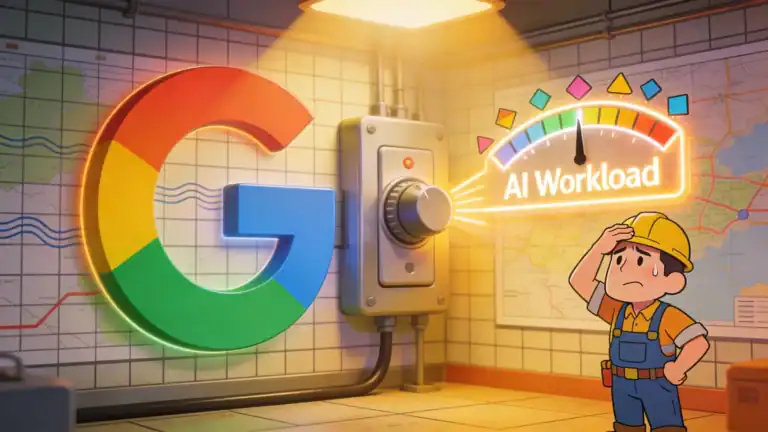
Google has reached a major energy milestone, securing 1 gigawatt (GW) of data centre demand response capacity across its United States operations, the company confirmed on Tuesday. The achievement comes as artificial intelligence workloads, particularly large-scale model training and inference, drive rapidly increasing electricity consumption.
The milestone reflects Google’s demand-response strategy, which allows its data centres to adjust or temporarily reduce electricity use during peak periods, helping stabilise the power grid. Michael Terrell, Head of Advanced Energy at Google, said, “We’ve signed 1 GW of data centre demand response with utility partners, supporting smart, affordable electricity growth.”
AI-optimised data centres consume significantly more electricity than traditional facilities, with some racks drawing up to ten times more power due to high-performance processors. Analysts have described this rising energy demand as a potential bottleneck for AI scaling, making Google’s milestone critical for managing grid stress while continuing to expand AI services.
The milestone also underscores the challenge of balancing AI growth with sustainability goals. Google continues to invest in renewable energy, but the pace of AI-driven demand is outstripping the deployment of clean energy infrastructure.
By embedding energy responsiveness into its operations, Google aims to scale AI services efficiently while mitigating grid strain. The company’s approach is increasingly seen as a blueprint for the future of hyperscale AI infrastructure, where computing power and energy management are closely integrated.

Senior Reporter/Editor
Bio: Ugochukwu is a freelance journalist and Editor at AIbase.ng, with a strong professional focus on investigative reporting. He holds a degree in Mass Communication and brings extensive experience in news gathering, reporting, and editorial writing. With over a decade of active engagement across diverse news outlets, he contributes in-depth analytical, practical, and expository articles exploring artificial intelligence and its real-world impact. His seasoned newsroom experience and well-established information networks provide AIbase.ng with credible, timely, and high-quality coverage of emerging AI developments.