

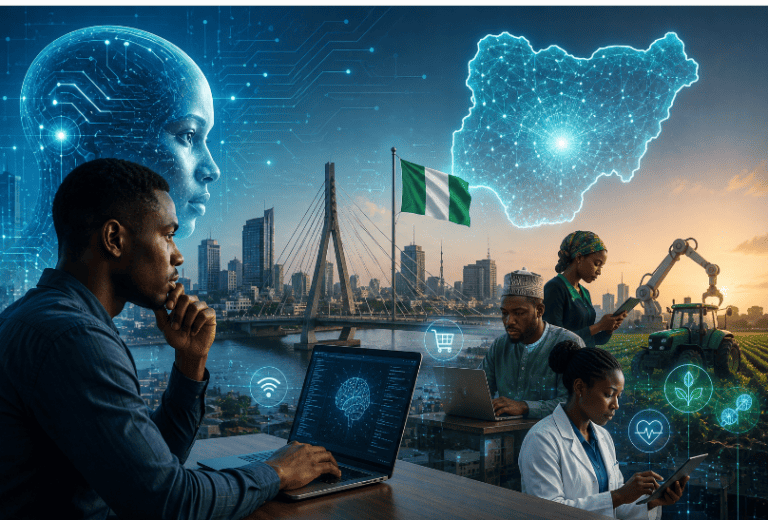
Artificial intelligence is already influencing how businesses operate, how students learn, how financial services are delivered, and how governments design public services. In Nigeria, this shift is increasingly visible across banking halls, fintech platforms, university classrooms, media organisations and small businesses.
AI disruption refers to the significant change in established systems, jobs, industries and processes caused by the adoption of artificial intelligence technologies. This disruption is not limited to automation alone. It also includes the ability of AI systems to generate text, analyse data, make predictions, and support decision-making at a scale that was previously not possible.
In Nigeria, this transformation is still in its early stages, but its impact is already becoming clear. Businesses are beginning to automate customer service. Students are using AI tools for research and writing support. Financial institutions are deploying machine learning systems for fraud detection. At the same time, concerns are growing about job displacement, inequality in digital access, and the readiness of infrastructure to support widespread adoption.
Understanding AI disruption in Nigeria is essential because it will shape the country’s economic competitiveness, labour market structure and long-term development trajectory.
What does AI disruption mean
AI disruption describes the process by which artificial intelligence changes how value is created and delivered across industries. It often replaces manual or repetitive tasks, but more importantly, it enhances decision-making and productivity in ways that fundamentally alter existing workflows.
For example, in traditional customer service environments, human agents respond to every enquiry manually. With AI-powered chatbots, many of these enquiries are now handled automatically. In banking, fraud detection systems no longer rely solely on human review; instead, algorithms analyse millions of transactions in real time to identify unusual patterns.
In Nigeria, this is particularly relevant because many sectors rely heavily on manual processes. Administrative bottlenecks, paper-based systems and limited automation mean that AI can introduce significant efficiency gains.
It is important to distinguish between digital transformation and AI disruption. Digital transformation involves moving from manual to digital systems, such as replacing paper records with electronic databases. AI disruption goes further by enabling systems to learn from data, predict outcomes and perform tasks that previously required human intelligence.
Why AI is growing rapidly in Nigeria
Several factors are driving the adoption of artificial intelligence in Nigeria.
First, internet penetration and smartphone usage continue to increase, enabling more people to access AI-powered tools and services. Even though connectivity challenges remain in rural areas, urban centres such as Lagos, Abuja and Port Harcourt have seen substantial improvements in digital access.
Second, Nigeria has a rapidly expanding technology ecosystem. Fintech companies such as digital banks and payment platforms are already using machine learning for credit scoring, fraud prevention and customer personalisation. This creates a foundation for wider AI adoption.
Third, global AI tools have become more accessible. Platforms such as ChatGPT, Google Gemini and Microsoft Copilot are now widely available and do not require advanced technical knowledge to use. This lowers the barrier to entry for individuals and small businesses.
Fourth, economic pressures are encouraging efficiency. Inflation, currency volatility and operational costs have pushed businesses to look for ways to reduce expenses while maintaining productivity. AI offers a practical solution in many cases.
Finally, there is growing interest from government and policy institutions in digital innovation. Agencies such as the National Information Technology Development Agency (NITDA) are increasingly focused on emerging technologies and digital skills development.
Opportunities created by AI disruption in Nigeria
1. New job categories and economic opportunities
One of the most common misconceptions about AI is that it only destroys jobs. In reality, it also creates new roles that did not previously exist. In Nigeria, emerging roles include AI content specialists, prompt engineers, data annotators, automation consultants and AI ethics advisors.
For example, marketing agencies in Lagos are now hiring professionals who can use AI tools to generate campaign content, analyse audience engagement and optimise advertising performance. These roles require creativity and strategic thinking rather than advanced programming skills.
Similarly, small businesses are employing freelancers who specialise in AI-assisted content creation for social media, allowing them to maintain an online presence at lower cost.
2. Business growth and productivity improvements
AI is helping Nigerian businesses improve productivity in practical ways. A small retail business in Abuja can now use AI-powered tools to forecast demand based on historical sales data, reducing waste and improving stock management.
In customer service, WhatsApp-based chatbots are increasingly used by SMEs to respond to enquiries instantly. This is particularly important in Nigeria, where many customers prefer messaging platforms over email or formal web portals.
In accounting and finance, AI tools can automate invoicing, track expenses and generate financial summaries, reducing reliance on manual bookkeeping.
3. Education and learning transformation
AI is also influencing education in Nigeria. Students increasingly use AI tools to summarise textbooks, explain complex concepts and assist with essay writing. While this raises concerns about academic integrity, it also provides opportunities for personalised learning.
For example, a secondary school student preparing for examinations such as WAEC or NECO can use AI tools to practise essay questions and receive feedback on structure and grammar. University students can use AI to assist with literature reviews and research organisation.
However, this requires careful guidance to ensure that students do not become overly dependent on AI-generated content.
4. Healthcare improvements
Nigeria’s healthcare system faces challenges such as limited access to specialists and uneven distribution of medical resources. AI can help address some of these gaps.
For example, AI-assisted diagnostic tools can support radiologists by analysing medical images and highlighting potential abnormalities. Telemedicine platforms can use AI chatbots to triage patients before they see a doctor, reducing waiting times.
Although these systems are not a replacement for medical professionals, they can improve efficiency and support decision-making in under-resourced environments.
5. Agriculture and food security
Agriculture remains a major employer in Nigeria, and AI can significantly improve productivity in this sector. Farmers can use AI-driven mobile applications to monitor weather patterns, predict rainfall and detect crop diseases.
For example, an agricultural cooperative in northern Nigeria could use AI tools to identify pest infestations early, reducing crop losses and improving yields. This kind of intervention can have a direct impact on food security and rural incomes.
6. Financial services and fintech innovation
Nigeria’s fintech sector is one of the most advanced in Africa, and AI is already deeply embedded in its operations. Banks and digital payment platforms use AI for fraud detection, credit scoring and customer service automation.
For example, AI systems can analyse transaction behaviour to detect unusual activity, such as unexpected large transfers or login attempts from unfamiliar devices. This helps reduce financial fraud, which remains a significant issue in the country.
AI is also being used to expand access to credit for individuals without traditional credit histories by analysing alternative data sources.
Challenges of AI disruption in Nigeria
1. Job displacement and labour market pressure
While AI creates new opportunities, it also poses risks to certain categories of employment. Routine administrative roles, basic data entry jobs and some customer service positions are particularly vulnerable to automation.
In Nigeria, where youth unemployment is already a significant concern, this raises important policy challenges. Without adequate retraining programmes, some workers may struggle to transition into new roles created by AI.
2. Skills gap and education limitations
A major barrier to AI adoption in Nigeria is the shortage of digital and technical skills. Many workers lack exposure to data analysis, automation tools and AI systems.
Although interest in technology is growing, access to structured training remains limited, particularly outside major cities. This creates a divide between those who can participate in the AI economy and those who cannot.
3. Infrastructure constraints
Reliable electricity and internet connectivity remain inconsistent in many parts of Nigeria. AI systems often require stable power and cloud access, which can limit their usability in certain regions.
This infrastructure gap means that the benefits of AI may be concentrated in urban areas unless addressed through broader investment.
4. Data privacy and cybersecurity risks
As AI systems become more widespread, concerns about data privacy and cybercrime are increasing. AI can be used to generate deepfakes, automate phishing attacks or manipulate digital content.
Nigeria already faces significant cybersecurity challenges, and AI may amplify these risks if not properly regulated.
5. Regulatory and ethical considerations
There is currently no comprehensive AI regulatory framework in Nigeria. This creates uncertainty around data protection, algorithmic accountability and ethical use of AI systems.
Government agencies such as NITDA are working towards digital policy development, but the pace of technological change is faster than regulatory adaptation.
Industries most affected by AI disruption in Nigeria
Several sectors are likely to experience significant transformation:
Banking and fintech will see continued automation of customer service and fraud detection.
Media and content creation will increasingly rely on AI-assisted writing and editing tools.
Education will adopt personalised learning platforms.
Healthcare will integrate diagnostic support systems.
Agriculture will use predictive analytics and monitoring tools.
Retail and e-commerce will rely on recommendation engines and demand forecasting.
How Nigerians can prepare for continuous AI disruption
Preparation is essential to ensure that individuals and organisations benefit from AI rather than being negatively affected by it.
Workers should focus on developing digital literacy and learning how to use AI tools effectively. Businesses should begin integrating AI into small, manageable processes such as customer service or data analysis. Educational institutions should incorporate AI awareness into curricula.
Government and private sector collaboration will also be important in creating training programmes and improving infrastructure.
What does the future bring?
AI disruption in Nigeria is still in its early stages, but its trajectory is clear. Over the next decade, AI is likely to become embedded in most aspects of economic and social life.
The most successful individuals and organisations will be those that adapt early, invest in skills development and embrace AI as a productivity tool rather than viewing it solely as a threat.
Nigeria has a significant opportunity to leverage AI for economic growth, particularly in sectors such as fintech, agriculture and creative industries. However, this will depend on how effectively challenges such as infrastructure gaps and skills shortages are addressed.
Take away
AI disruption in Nigeria represents both an opportunity and a challenge. It has the potential to improve productivity, create new industries and expand access to services. At the same time, it introduces risks related to employment, inequality and cybersecurity.
The outcome will depend largely on preparedness. Individuals, businesses and policymakers who invest in skills, infrastructure and responsible governance will be better positioned to benefit from this transformation.
Artificial intelligence is not a distant future development in Nigeria. It is already here, shaping how people work, learn and interact with technology.

AI Writer
Bio: Joseph Michael is an MBA graduate in Marketing from Ladoke Akintola University of Technology and a passionate tech enthusiast. As a professional writer and author at AIbase.ng, he simplifies complex AI concepts, explores digital innovation, and creates practical guides for Nigerian learners and businesses. With a background in marketing and brand communication, Joseph brings clarity, insight, and real-world relevance to every article he writes.