

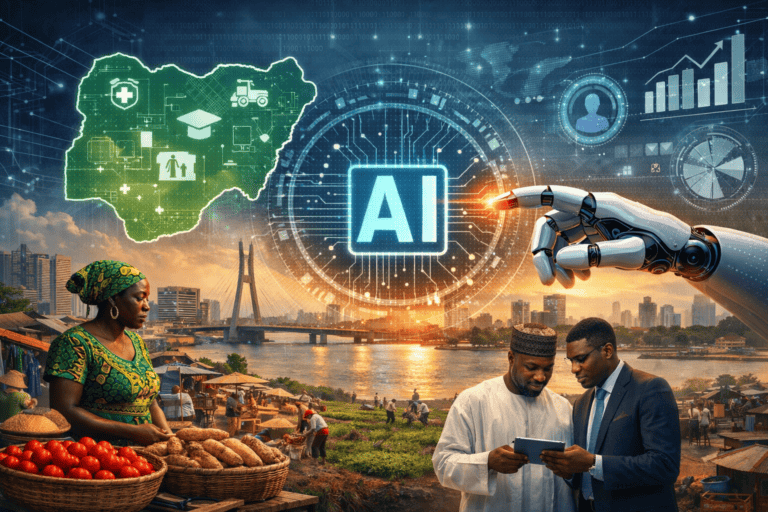
Across the world, Artificial Intelligence (AI) is transforming how people live, work, and interact, with no exception to Nigeria, where more than 200 million people span both urban and rural communities, facing varied developmental challenges. AI offers tools that could fundamentally improve access to services, economic opportunities, and social outcomes.
The Nature of Artificial Intelligence
Artificial Intelligence (AI) enables computers to perform tasks that typically require human intelligence, such as interpreting language, detecting patterns, making predictions, and automating decisions. Unlike simple automation, AI learns and improves over time, complementing human judgment to enhance effectiveness in serving communities.
How AI Functions in Community Settings
In practice, AI analyses relevant data to generate insights or actions that support decision-making or task automation. For example, in healthcare, it can suggest likely diagnoses based on patient data, while in agriculture, it can recommend optimal planting strategies using weather, soil, and crop information.
For successful deployment, AI usually requires:
- Data collected responsibly from relevant sources
- Computing power to train and run models
- User interfaces such as apps, dashboards, or chatbots
- Human oversight to ensure ethical, safe, and context‑appropriate outcomes
International and Continental Perspectives
Globally, AI drives development and supports Sustainable Development Goals, with advanced economies using it in smart cities, personalised education, and public services. In Africa, countries are adopting AI strategies that prioritise governance, skills, ethics, research, and infrastructure to ensure responsible and equitable adoption.
Nigeria’s Policy and Institutional Space
Nigeria recognises AI’s potential and has launched a National Artificial Intelligence Strategy to boost development across sectors, with input from industry and academia. Regulatory frameworks focus on ethics, transparency, and data protection. NITDA promotes AI literacy and ethical use, while initiatives such as the 3 Million Technical Talent programme aim to build a skilled domestic AI workforce, supported by professional associations that connect academia, industry, and government.
Leading AI Use Cases for Community Development in Nigeria
Across sectors, Nigerian organisations and startups are using specific AI tools and technologies to address local challenges. Below, we describe key applications, illustrate use cases, and highlight the best-functioning AI systems in practice.
Healthcare: Enhancing Access and Outcomes
Healthcare systems in Nigeria face severe resource constraints, particularly in rural communities. AI technologies are playing a role in diagnosing disease, improving patient management, and extending services through digital platforms.
Digital health assistants and chatbots: AI-powered virtual assistants can interact with patients to offer symptom assessment, preventive advice, and remote support. Platforms developed by Nigerian health-tech firms provide users with guidance and referrals via text or voice interfaces.
Diagnostic support systems: Machine learning models can analyse imaging data to detect conditions such as tuberculosis or pneumonia more quickly than conventional methods. These tools assist clinicians in making more accurate decisions, especially where specialists are in short supply.
Public health optimisation: AI systems that analyse patient data can predict outbreaks or resource needs, helping health systems allocate vaccines and supplies to where they are most needed.
In each case, AI functions as a decision-support tool, complementing clinicians rather than replacing them.
Education: Personalised and Inclusive Learning
AI’s capacity to tailor content and provide feedback has promising implications for education.
Personalised learning platforms: Adaptive learning systems adjust curriculum delivery based on a student’s pace and performance. In Nigerian classrooms, these platforms can help teachers manage diverse learner needs and fill gaps where specialised instruction is unavailable.
Automated assessment tools: AI can support grading and feedback for assignments, freeing educators to focus more on pedagogy.
Language and accessibility: With over 500 local languages, AI tools that translate or interpret content into local tongues can enhance comprehension and inclusivity.
While Nigeria’s formal policy dialogue on AI in education continues, momentum at universities and schools suggests that AI will complement teachers’ capacity and drive more equitable learning outcomes.
Agriculture: Precision Farming and Support for Smallholders
Agriculture remains central to Nigeria’s economy and the livelihoods of millions.
AI helps farmers optimise decisions by:
- Analysing satellite and drone imagery to assess crop health and soil conditions
- Predicting weather patterns and suggesting optimal planting and irrigation schedules
- Identifying pests or diseases early to reduce crop loss
Startups combine machine learning and mobile interfaces to reach farmers directly with actionable insights. These tools are especially valuable for smallholder farmers who lack access to extension services.
Public Services and Governance: Efficiency and Responsiveness
AI can make public services more efficient and accessible.
AI chatbots for government services: Virtual assistants respond to citizen queries about public services, reducing wait times and streamlining service delivery.
Traffic and resource optimisation: Predictive analytics help traffic authorities reduce congestion and plan waste collection routes more effectively.
Emergency response frameworks: AI models are being explored to allocate resources for emergency services, enhancing public safety and the responsiveness of governance.
Financial Inclusion: Expanding Access to Credit and Services
AI is reshaping how Nigerian financial systems serve underserved populations.
AI-powered credit scoring: By analysing alternative data, AI models assess creditworthiness for individuals or micro-businesses that traditional banks might overlook.
Fraud detection and customer service: Automated systems detect suspicious activity more quickly and provide instant customer support.
FinTech companies are already using AI to enhance financial inclusion, expanding access to banking services for millions.
Impact on the Nigerian Society and Economy
The thoughtful application of AI in these areas stands to generate broad societal benefits:
- Improved service delivery in healthcare, education, and public services
- Increased agricultural productivity and food security
- Greater financial inclusion and economic participation
- Enhanced data-driven governance
Strategic AI adoption could contribute significantly to economic growth, provided innovation ecosystems are nurtured responsibly.
Challenges in the Nigerian Context
Despite its potential, AI adoption in Nigeria faces challenges, including inconsistent electricity and internet access, limited high-quality data, low digital literacy and specialised skills, and the lack of comprehensive AI-specific laws to ensure ethical use, transparency, and accountability.
Pathways for Progress
For meaningful impact, Nigeria must:
- Strengthen regulatory frameworks to protect citizens and encourage responsible innovation
- Expand digital infrastructure in underserved regions
- Invest in data governance systems that support ethical and secure AI deployment
- Scale training and capacity initiatives to create a robust local AI workforce
Collaboration among government, private sector, academia, and civil society is crucial to ensure AI drives inclusive and ethical development. Nigerian institutions and innovators are already applying AI pragmatically, and with strategic planning and safeguards, it can play a central role in sustainable community development.
Closing Insight
AI is not a cure-all for Nigeria’s development challenges, but when used thoughtfully and fairly, it can enhance daily life, strengthen institutions, and create opportunities, reshaping how communities deliver services and achieve optimal benefits.

Senior Reporter/Editor
Bio: Ugochukwu is a freelance journalist and Editor at AIbase.ng, with a strong professional focus on investigative reporting. He holds a degree in Mass Communication and brings extensive experience in news gathering, reporting, and editorial writing. With over a decade of active engagement across diverse news outlets, he contributes in-depth analytical, practical, and expository articles exploring artificial intelligence and its real-world impact. His seasoned newsroom experience and well-established information networks provide AIbase.ng with credible, timely, and high-quality coverage of emerging AI developments.