


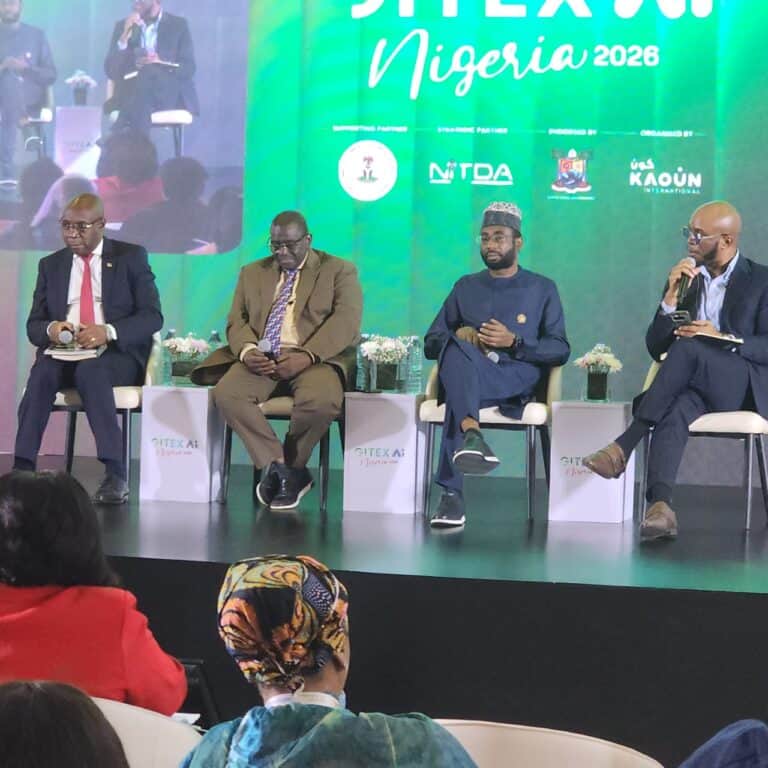
ABUJA, Nigeria – 31 August 2026: GITEX Nigeria 2026 opened in Abuja on Monday with senior government officials, technology leaders, investors and digital economy stakeholders converging around a growing ambition: to position Nigeria and West Africa as active builders of artificial intelligence, digital infrastructure and sovereign technology rather than merely consumers of innovation developed elsewhere.
The second edition of what organisers describe as West Africa’s largest technology, AI and startup event began with a high-profile inauguration ceremony and the Government Leadership & AI Summit, held under the theme “Beyond Connectivity – The Bridge to Sovereign AI & Innovation.”
The event, which runs across Abuja and Lagos from 31 August to 3 September 2026, is held under the patronage of President Bola Ahmed Tinubu and supported by the Federal Ministry of Communications, Innovation and Digital Economy in collaboration with the National Information Technology Development Agency (NITDA). It is endorsed by the Lagos State Government and organised by KAOUN International.
The Abuja opening was covered by AIBase reporter, Ahmad Ibrahim.
At the centre of the opening-day discussions was a common message from government leaders: Nigeria must build the capabilities, infrastructure and institutions required to participate more meaningfully in the global technology economy.
‘Owning the capabilities, infrastructure and intelligence’
Kashifu Inuwa Abdullahi, Director General of NITDA, framed Nigeria’s technology ambitions around the concept of digital sovereignty, arguing that the country must gain greater control over the systems and infrastructure that power its digital future.
“Achieving true digital sovereignty means owning the capabilities, infrastructure, and intelligence that power our future,” Abdullahi said.
He pointed to national initiatives including DL4ALL, 3MTT and Project BRIDGE, which he said are intended to expand Nigeria’s technical talent base and strengthen digital inclusion.
“Through strategic initiatives like DL4ALL, 3MTT and Project BRIDGE, we are rapidly scaling our technical talent pool and extending high-speed digital inclusion across every local government area,” he said.
Abdullahi added that Nigeria is developing the policy, cloud infrastructure and regulatory systems required to strengthen local technological capacity and support the responsible deployment of artificial intelligence.
“We are building the policy, cloud infrastructure, and regulatory frameworks necessary to host our data locally, deploy AI responsibly, and enhance overall national productivity,” he said.
For the NITDA Director General, GITEX Nigeria represents more than an industry gathering.
“GITEX NIGERIA positions our country as a global force shaping the international tech ecosystem, not just participating in it,” Abdullahi said.
Lagos makes the case for compute infrastructure
While federal authorities focused on national digital sovereignty, Lagos State Governor Babajide Sanwo-Olu used his remarks to highlight what he described as major investment opportunities emerging around computing infrastructure and public-sector digitalisation.
“Most international capital looks at Nigeria and sees consumer fintech. That was the last decade’s trade,” Sanwo-Olu said.
According to the governor, one of the most significant opportunities currently being undervalued is computing capacity.
“Here is what I believe is being under-priced today. First, compute,” he said.
Sanwo-Olu argued that Lagos, as one of Africa’s major landing points for subsea cables, has significant connectivity capacity but still requires additional computing infrastructure to support growing digital and AI workloads.
“Lagos is one of the most cable-landed cities on the African continent. We have world-class subsea capacity arriving on our shores – and comparatively little of the compute that should sit behind it.”
He said a significant share of African AI workloads continues to be processed outside the continent, creating challenges around latency, cost and data sovereignty.
“Africa’s AI workloads are currently being processed in Europe. That is a latency problem, a cost problem, a data sovereignty problem, and therefore an investment opportunity.”
Sanwo-Olu said Lagos intends to leverage its electricity legislation, fibre infrastructure programme and data centre development to strengthen its position as a potential computing hub.
“With our electricity law, our fibre programme and our data centre campuses, Lagos is the natural place to fix it,” he said.
The governor also highlighted the commercial potential of government digitalisation, arguing that the public sector itself is becoming a significant market for enterprise technology.
“Second, the government market itself,” Sanwo-Olu said.
“Lagos operates a budget larger than that of several West African countries.”
As the state digitises procurement, revenue collection, permits, health records, transport and land administration, he said, new opportunities are emerging for technology companies.
“We are creating a serious, recurring, creditworthy enterprise software market – one that most global technology firms have not yet properly bid for.”
‘We are leading a new era for Africa’
Senator Dr George Akume, Secretary to the Government of the Federation, linked Nigeria’s digital ambitions to the Federal Government’s broader economic transformation agenda.
“Under the vision of His Excellency President Bola Ahmed Tinubu and the Renewed Hope Agenda, Nigeria is boldly driving towards a $1 trillion economy,” Akume said.
However, he argued that achieving that ambition would require Nigeria to move beyond basic connectivity and towards indigenous innovation and technological self-reliance.
“To achieve economic transformation, we must now move far beyond basic connectivity to build true indigenous innovation and digital sovereignty,” he said.
Akume described GITEX Nigeria as a platform that brings together government strategy and private-sector execution.
“GITEX NIGERIA provides the strategic platform where government vision aligns with private sector execution.”
He said Nigeria now faces an opportunity to transition from consuming foreign technology to developing the talent, infrastructure and AI capabilities required to compete internationally.
“This is our opportunity for a decisive transition from being mere consumers of foreign technology to becoming global producers of talent, sovereign infrastructure, and inclusively designed AI — built by Nigeria, for Nigeria.”
Akume concluded with a broader declaration of Africa’s technological ambitions.
“We are leading a new era for Africa,” he said.
Beyond connectivity to sovereign AI
The Government Leadership & AI Summit brought together more than 500 public- and private-sector leaders, investors and technology stakeholders, alongside more than 25 international experts.
The discussions focused on the infrastructure and policy foundations required for African countries to convert growing digital ambition into long-term economic value.
Sessions examined issues ranging from AI, cybersecurity and data sovereignty to digital public infrastructure, connectivity, investment and strategic partnerships.
One of the central discussions, “Backbone Infrastructure & Last-Mile Connectivity: Cables, Satellites & Blended Finance,” explored how infrastructure ranging from subsea cables and telecommunications towers to satellites and edge computing could help close Africa’s connectivity gap.
Another session, “Getting Private Capital to Move into Digital Infrastructure,” examined the investment, governance and deal-structure challenges that continue to limit commercial investment in critical digital infrastructure across West Africa and the wider continent.
The summit also explored the growing market around digital government through a session titled “An African Opportunity: The Turning Point of eGov & Digital Interoperability.”
As African governments expand digital identity systems, payment platforms and data-exchange infrastructure, the discussion highlighted potential opportunities for technology providers, investors and financial institutions.
The underlying message throughout the opening day was clear: connectivity alone will not define the next stage of Africa’s technology development. The focus is increasingly shifting towards ownership of infrastructure, local computing capacity, AI capabilities, interoperable public systems and the policies required to support them.
GITEX moves to Lagos for startup and investment focus
Following the Government Leadership & AI Summit in Abuja, GITEX Nigeria will move to Lagos for its Tech Expo on 2 and 3 September, alongside the Future Economy Conference and FDX by GITEX.
The Lagos programme is expected to focus heavily on startups, entrepreneurship, investment and access to international markets.
Organisers said more than 200 investors from 30 countries, collectively managing approximately US$200 billion in assets, are expected to participate.
International investment firms joining the programme include Askya Investment Partners, Incofin Investment, Triple Jump, Lightrock, Global Ventures* and Innovest Afrika.
The organisers also pointed to investment activity emerging from the inaugural GITEX Nigeria in 2025 as an example of the event’s potential to create longer-term relationships between startups and investors.
According to the organisers, venture studio FirstFounders connected with 18 startups at the 2025 edition, with LabTracka, Vant and GraceAI subsequently entering deeper discussions with the firm.
Vant, an AI-powered business banking and management platform, later joined the FirstFounders portfolio through an investment valued at US$200,000, combining funding with operational support.
As GITEX Nigeria 2026 moves from government policy discussions in Abuja to startup and investment activity in Lagos, the event is positioning itself as a meeting point between Nigeria’s public-sector digital ambitions and the private-sector infrastructure, innovation and capital required to support them.
For Nigeria’s technology ecosystem, the conversations in Abuja pointed towards a broader shift in ambition. Government leaders are increasingly framing artificial intelligence and digital transformation not simply as tools to be adopted, but as strategic capabilities that the country must help build, govern and own.
Whether that ambition translates into the infrastructure, investment and execution required to deliver sovereign AI at scale will remain one of the defining questions for Nigeria’s digital economy in the years ahead.
