

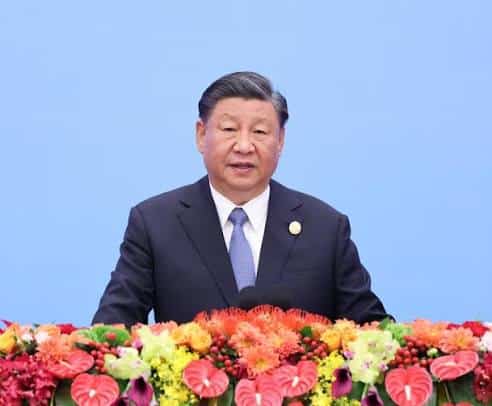
Chinese President Xi Jinping has unveiled an ambitious strategy to position China at the forefront of global artificial intelligence development, presenting Beijing as a leading advocate for international AI cooperation while challenging the United States’ dominance in the rapidly evolving sector.
Speaking at the opening of the 2026 World Artificial Intelligence Conference (WAIC) in Shanghai, Xi said artificial intelligence should be developed through international collaboration rather than controlled by any single nation.
He called for greater global coordination on AI governance, standards, and safety as the technology becomes increasingly influential in economies, industries, and national security.
Xi described AI as a transformative force comparable to historic innovations such as electricity and the steam engine.
He urged governments to ensure that the benefits of the technology are shared broadly and warned against the emergence of new technological divides between developed and developing nations.
While Xi did not directly mention the United States, his remarks came amid intensifying competition between the world’s two largest economies over advanced technologies.
Washington has imposed a series of restrictions on China’s access to advanced semiconductors and AI-related technologies, arguing that such measures are necessary for national security.
Beijing has repeatedly criticised those restrictions as barriers to technological development and international cooperation.
As part of China’s new initiative, Xi pledged expanded support for developing countries seeking to build AI capabilities.
Chinese officials announced plans to provide thousands of AI training opportunities over the next five years and deepen cooperation with countries across Asia, Africa, Latin America, and other emerging regions.
The conference also highlighted China’s push for open-source artificial intelligence models.
Beijing argues that wider access to AI technology can help accelerate innovation and reduce barriers for countries that lack the resources to develop advanced systems independently.
A significant development at the gathering was the establishment of a new international body, the World AI Cooperation Organisation.
The initiative has attracted support from nearly 30 countries and is intended to promote collaboration on AI development, governance, and technical standards.
Analysts view the move as part of China’s broader effort to increase its influence over the future rules governing artificial intelligence worldwide.
The announcement underscores how artificial intelligence has become a central arena of global competition.
China has invested heavily in domestic AI research, computing infrastructure, and advanced models to reduce its reliance on foreign technology and strengthen its position as a technological power.
Xi’s address marks one of Beijing’s clearest statements yet that it intends not only to compete in the development of artificial intelligence, but also to help shape the international framework that governs its use.
As the global race for AI leadership accelerates, the conference in Shanghai signals China’s determination to play a leading role in defining the next era of technological innovation.

Bio: An (HND, BA, MBA, MSc) is a tech-savvy digital marketing professional, writing on artificial intelligence, digital tools, and emerging technologies. He holds an HND in Marketing, is a Chartered Marketer, earned an MBA in Marketing Management from LAUTECH, a BA in Marketing Management and Web Technologies from York St John University, and an MSc in Social Business and Marketing Management from the University of Salford, Manchester.
He has professional experience across sales, hospitality, healthcare, digital marketing, and business development, and has worked with Sheraton Hotels, A24 Group, and Kendal Nutricare. A skilled editor and web designer, He focuses on simplifying complex technologies and highlighting AI-driven opportunities for businesses and professionals.
LinkedIn
1 Comment
They pull out big surprise with G5 and I have no doubt if and when they do it again with AI. Good luck. China!