

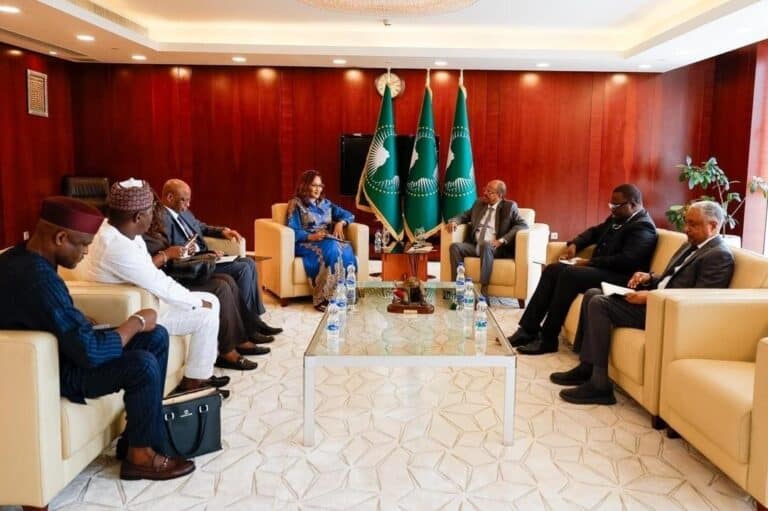
Nigeria and the African Union (AU) have reinforced their commitment to regional security, economic development and artificial intelligence (AI) cooperation following a series of high-level meetings held on the sidelines of the 49th Ordinary Session of the Executive Council of the African Union in Addis Ababa.
The discussions, led by Nigeria’s Minister of State for Foreign Affairs, Bianca Odumegwu-Ojukwu, focused on security challenges in West Africa and the Sahel, peace support operations, economic transformation, youth development and the growing role of artificial intelligence in shaping Africa’s future.
Odumegwu-Ojukwu met separately with AU Commissioner for Political Affairs, Peace and Security, Dr Bankole Adeoye, and African Union Commission Chairperson, Mahmoud Ali Youssouf, as leaders sought to strengthen cooperation on issues affecting the continent.
During her meeting with Adeoye, the minister said both sides reviewed the evolving security situation in West Africa and the Sahel, Nigeria’s role in regional stability and the challenges confronting peace support operations across Africa.
“We discussed regional security situations in West Africa and the Sahel, Nigeria’s regional role in the evolving geopolitical dynamics and the challenges facing peace support operations in Africa in general,” she said.
The talks also examined Nigeria’s longstanding contribution to peace and security efforts across the continent. According to Odumegwu-Ojukwu, Nigeria has served on the AU Peace and Security Council for the past 22 years and continues to maintain a firm position against unconstitutional changes of government in the region.
She noted that discussions covered Nigeria’s commitment to democratic governance and its continued support for the Multinational Joint Task Force (MNJTF), which is involved in combating terrorism and insecurity in the Lake Chad Basin region.
The minister disclosed that the African Union has committed approximately $21.1 million to the operations of the MNJTF while continuing to explore preventive mechanisms to address conflict across Africa.
Beyond traditional security concerns, both sides also examined the growing role of technology in peace and security operations. Adeoye advocated for the full operationalisation of the African Standby Force and called for the development of capacity and networks for AI-enabled drones and conflict-management architecture.
The discussions reflected a broader shift within continental policymaking circles, where artificial intelligence is increasingly viewed as both an economic opportunity and a strategic tool for addressing emerging security challenges.
Related
- Kenya And EU Deepen Digital Ties: Focus on AI and Infrastructure
- IUCEA Launches Regional AI Alliance to Unite East African Efforts
- ECOWAS Targets Coordinated AI Governance Across West Africa
- Uganda, EAC, AfDB Advance Africa’s AI Backbone
- Bluechip Technologies to Host AI and Data Summit in Lagos
In a separate bilateral meeting, Odumegwu-Ojukwu and AU Commission Chairperson Mahmoud Ali Youssouf explored Nigeria’s role within the African Union system, regional political developments and Africa’s long-term socio-economic prospects.
The AU Commission Chairperson reportedly commended Nigeria’s leadership role within both the African Union and the Economic Community of West African States (ECOWAS), particularly in the fight against terrorism and efforts to promote regional peace, stability and integration.
According to the minister, Youssouf stressed that Africa faces significant demographic and economic pressures that require innovative solutions to unlock sustainable growth.
He highlighted innovation, job creation, agriculture, services and investment in artificial intelligence as essential pillars for the continent’s future development.
Youssouf also observed that Africa has not invested sufficiently in AI and urged greater commitment to emerging technologies to improve competitiveness and productivity across the continent.
The AU Chairperson cited the investments of the Dangote Group in several African countries as an example of African-led industrial development that supports regional integration, industrialisation, self-reliance and job creation.
The meetings further explored opportunities to strengthen diplomatic training programmes for young African diplomats and to enhance partnerships among regional organisations to support peace, security and good governance.
The renewed engagement comes at a time when African governments are increasingly prioritising digital transformation and AI adoption while simultaneously addressing security threats, humanitarian challenges and economic pressures across the continent.
Analysts say the discussions underscore a growing recognition among African leaders that future prosperity will depend not only on security and political stability but also on investments in technology, innovation and human capital development.
As the African Union continues deliberations during its 49th Executive Council session, Nigeria’s engagements in Addis Ababa signal a broader push to align security priorities with economic modernisation and emerging technologies, placing artificial intelligence at the centre of Africa’s long-term development agenda.

AI Writer
Bio: Joseph Michael is an MBA graduate in Marketing from Ladoke Akintola University of Technology and a passionate tech enthusiast. As a professional writer and author at AIbase.ng, he simplifies complex AI concepts, explores digital innovation, and creates practical guides for Nigerian learners and businesses. With a background in marketing and brand communication, Joseph brings clarity, insight, and real-world relevance to every article he writes.