

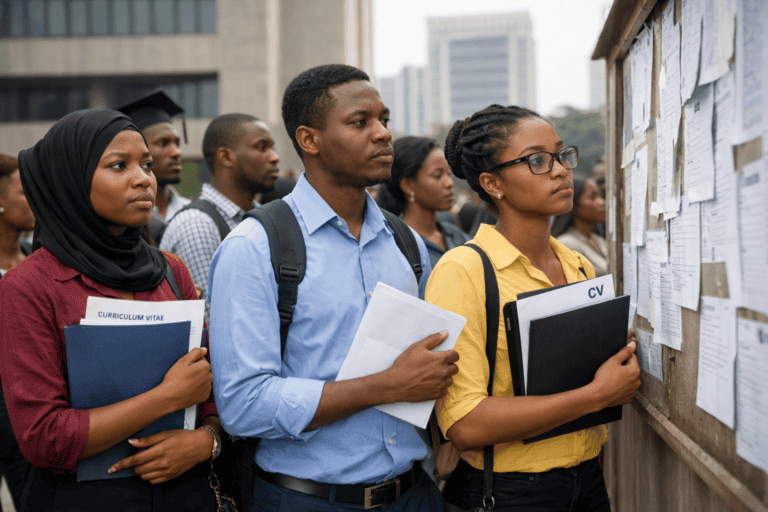
For many young graduates, the fear is palpable: Will AI take our jobs? Will our degrees become irrelevant? Is the future already slipping out of our hands? These concerns are understandable, especially in a country where unemployment and underemployment remain persistent challenges. Yet, despite the anxiety, the AI era is far from a death sentence for Nigerian graduates. In fact, it presents one of the most transformative opportunities of our time.
A closer look reveals that AI is not simply replacing jobs; it is reshaping industries, creating new roles, and demanding new skills. Nigerian graduates who adapt, innovate, and position themselves strategically can thrive in this evolving landscape.
Understanding the Shift: AI as a Tool, Not a Threat
AI is best understood as an enabler. It automates repetitive tasks, analyses large datasets, and enhances efficiency. However, it does not replace human creativity, emotional intelligence, cultural understanding, or strategic thinking. These are areas where Nigerian graduates can excel.
Rather than viewing AI as a competitor, it is more productive to see it as a powerful tool that amplifies human capability. For example, AI can handle data processing, but it still requires human oversight to interpret results, make decisions, and apply insights in context. This synergy between human and machine is where the real value lies.
New Career Pathways Emerging in the AI Economy
The AI-driven economy is generating entirely new categories of work. Nigerian graduates who embrace these opportunities can position themselves at the forefront of innovation. Some of the most promising areas include:
AI Ethics and Policy As AI becomes more integrated into society, there is a growing need for professionals who understand governance, regulation, and ethical considerations. Graduates in law, philosophy, political science, and social sciences can play vital roles in shaping responsible AI use in Nigeria.
Data Annotation and Labelling AI systems require vast amounts of labelled data to function effectively. This has created a booming industry for data annotators, quality assurance specialists, and dataset curators. These roles are accessible to graduates from diverse fields with minimal technical background.
Digital Content and Creative Industries AI tools are transforming content creation, but they still rely heavily on human creativity. Writers, designers, marketers, and media professionals who learn to integrate AI into their workflow can dramatically increase productivity and output quality.
Tech-Enabled Entrepreneurship AI lowers the barrier to entry for starting a business. From automated customer service to AI-driven market research, Nigerian graduates can build lean, efficient start-ups with global reach. The rise of fintech, edtech, and healthtech in Nigeria demonstrates the potential for innovation.
Upskilling: The Key to Staying Relevant
The most significant advantage Nigerian graduates can cultivate is adaptability. The AI era rewards those who continuously learn and evolve. Fortunately, upskilling has never been more accessible. Free and affordable online courses, virtual bootcamps, and digital communities offer pathways into AI-related fields without the need for expensive degrees.
Skills that are increasingly valuable include:
- Data literacy
- Basic programming
- Digital marketing
- AI-assisted research
- Product management
- Cybersecurity
- Cloud computing
Even graduates in non-technical fields can benefit from understanding how AI tools apply to their discipline. The goal is not to become an engineer overnight but to develop a hybrid skill set that blends domain expertise with digital competence.
Nigeria’s Unique Advantage in the AI Era
Nigeria’s youthful population is one of its greatest strengths. With millions of energetic, ambitious graduates entering the workforce each year, the country has the human capital needed to drive innovation. Additionally, Nigeria’s cultural diversity, entrepreneurial spirit, and growing tech ecosystem create fertile ground for AI adoption.
Local challenges such as healthcare gaps, agricultural inefficiencies, and educational limitations present opportunities for AI-driven solutions. Nigerian graduates who understand these problems intimately are well positioned to design context-specific innovations.
The Human Touch Still Matters
AI may be powerful, but it cannot replicate the full spectrum of human experience. Professions that rely on empathy, cultural nuance, negotiation, and interpersonal relationships remain firmly in human hands. Teachers, counsellors, social workers, community leaders, and creative professionals will continue to play essential roles.
Moreover, AI systems themselves require human oversight to ensure fairness, accuracy, and cultural relevance. Nigerian graduates bring perspectives that global AI models often lack.
Read Also:
8 Essential AI Skills Nigerians Need to Launch a Career in AI
A Future Full of Possibility
The AI era is not a threat to Nigerian graduates; it is a call to evolve. While the landscape is changing, it is also expanding, offering new opportunities for those willing to adapt. Rather than fearing displacement, graduates can embrace AI as a catalyst for growth, innovation, and empowerment.
Nigeria stands at the threshold of a technological revolution. With the right mindset and skills, its graduates can lead the charge, shaping a future where AI enhances human potential rather than diminishing it.
The AI era in Nigeria is not all doom and gloom; for adaptable and skilled graduates, it opens doors to new careers, innovation, and professional growth.

Bio: An (HND, BA, MBA, MSc) is a tech-savvy digital marketing professional, writing on artificial intelligence, digital tools, and emerging technologies. He holds an HND in Marketing, is a Chartered Marketer, earned an MBA in Marketing Management from LAUTECH, a BA in Marketing Management and Web Technologies from York St John University, and an MSc in Social Business and Marketing Management from the University of Salford, Manchester.
He has professional experience across sales, hospitality, healthcare, digital marketing, and business development, and has worked with Sheraton Hotels, A24 Group, and Kendal Nutricare. A skilled editor and web designer, He focuses on simplifying complex technologies and highlighting AI-driven opportunities for businesses and professionals.
LinkedIn