

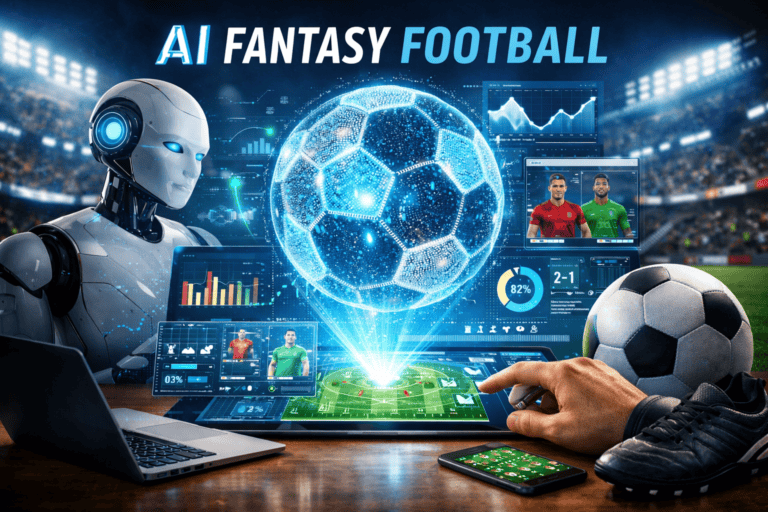
Fantasy football is no longer just about gut feelings and spreadsheets. Today, it’s a high-stakes, data-driven arena where machine learning AI is transforming how teams are built, matches are analysed, and victories are claimed. From predictive analytics to personalised AI assistants, technology is redefining the game for casual managers and competitive players alike.
This article dives deep into AI in fantasy football, exploring its mechanics, leading platforms, practical applications, global trends, and the specific opportunities and challenges within markets. It offers a clear, evidence-based guide for anyone looking to understand how intelligence, both human and artificial, shapes the fantasy football opportunities.
What Is AI Fantasy Football?
AI fantasy football uses artificial intelligence to help managers make smarter decisions in assembling and managing their teams. By leveraging predictive analytics, machine learning, and natural language processing, AI analyses vast amounts of historical and real-time data, identifies subtle patterns, and provides insights that go beyond traditional intuition and manual statistics.
Core Concepts in AI Fantasy Football
To frame our discussion, it helps to clearly define the AI principles most relevant to fantasy sports.
Predictive Analytics
Predictive analytics uses past data to forecast future outcomes. In fantasy football, predictive models estimate player performance, injury risk, and match impact. These models often incorporate machine learning algorithms that learn from historical performance trends.
Machine Learning
Machine learning (ML) is a subset of AI where systems improve their performance with exposure to data. In fantasy football, ML models repeatedly ingest match data, transfer news, weather conditions, and other variables to refine predictions.
Natural Language Processing
Natural Language Processing (NLP) allows computers to interpret and generate human language. Fantasy football platforms utilise NLP to summarise player news, extract insights from textual sources, and even generate analysis summaries.
Reinforcement Learning
Reinforcement learning (RL) is an AI technique where a model learns optimal strategies through trial and error. In fantasy football, RL can simulate various lineup choices and strategies to identify the most rewarding configuration.
Practical Application
In a conventional fantasy football league, managers manually select players, adjust lineups, and track performance. With AI, this process becomes augmented in several ways.
Data Aggregation and Analysis
AI systems collect data from match statistics, player form, injuries, weather forecasts, schedule difficulty, and even sentiment from social media or news outlets. This breadth of data surpasses what a human manager can reasonably monitor.
Automated Player Recommendations
Based on predictive models, AI suggests optimal player selections for upcoming matchdays. These recommendations factor in probability scores, expected points, and comparative performance metrics.
Lineup Optimisation
AI tools can analyse your entire squad and recommend the best starting eleven or active roster based on fixture difficulty, player rotation risk, and matchup dynamics.
Transfer and Trade Advice
Sophisticated AI platforms assess whether a particular transfer or trade is statistically advantageous. They may recommend selling a high-value underperformer or acquiring an emerging talent.
Risk and Scenario Modelling
Advanced systems simulate multiple “what-if” scenarios, such as potential injuries or changes in team tactics. This helps managers prepare for contingencies.
Leading AI Tools and Platforms in Fantasy Football
AI fantasy football is not a monolithic field; it comprises a spectrum of tools, each with its unique strengths and target users. Some are integrated into major fantasy platforms, while others are independent analytical services.
- AI-Powered Recommendation Engines
These systems provide actionable suggestions on player picks and lineups:
- FantasyPros AI – Known for consensus-based projections that integrate machine learning with expert inputs. Its strength lies in synthesising a wide range of expert rankings into a single, intelligent outlook.
- RotoWire’s AI Tools – Offers predictive analytics with granular player metrics. RotoWire’s tools excel in weighty statistical output, ideal for users who want depth.
- ScoutMind AI – A more experimental solution born out of research labs. It emphasises reinforcement learning to teach itself the most effective strategies over time.
Use Cases
Recommendation engines help casual and serious managers alike cut through data overload and focus on statistically sound choices.
Best Functionality
They shine in creating personalised advice based on user-owned squads and league-specific rules.
- Automated Content Assistants
These tools write summaries, highlight the impact of news, and explain complex trends.
- OpenAI GPT‑based Assistants (custom integrations) – Used by some platforms to generate weekly insights, player narratives, and trend explanations.
- SportScript AI – Designed specifically for sporting content, SportScript provides NLP-generated bullet points from raw data.
Use Cases
Ideal for managers who want narrative context rather than raw numbers.
Best Functionality
These systems excel at translating data into natural language insights that are easier to digest than spreadsheets.
- Predictive Modelling Platforms
These solutions focus on statistical forecasting.
- FootyAI – A dedicated predictive model for football that trains on years of match data. FootyAI can forecast player-level performance metrics.
- GridIron Forecast – Used in American football fantasy leagues for advanced probability distributions of player outcomes.
Use Cases
Useful for users who want projections that go beyond basic expected points.
Best Functionality
High accuracy forecasts with confidence intervals that show the range of possible outcomes.
- Personalised AI Agents
The frontier of fantasy football tools includes personalised AI agents that learn a user’s play style.
- MyManager AI – Adapts to a user’s risk tolerance and competitive behaviour, offering customised strategic feedback.
Use Cases
Best suited for committed players aiming to improve their decision-making over time.
Best Functionality
Continuous learning based on user history, enabling tailored strategy evolution.
AI in Diverse Fantasy Football Formats
Fantasy football takes many shapes, each with different strategic demands.
Head-to-Head Leagues
In head-to-head formats, weekly matchups heighten the value of matchup‑specific insights. AI tools that assess opponent weaknesses and fixture difficulty can provide a competitive edge.
Total Points Leagues
Here, the objective is to score the most points over a season. Predictive analytics that model consistent performers are especially valuable.
Salary Cap or Auction Leagues
In leagues with budget constraints, AI can optimise player value for money, advising on undervalued assets and budget allocation strategies.
Draft Leagues
AI can support draft phase planning by generating tiered player rankings and simulating draft outcomes.
Impact of AI Fantasy Football
AI fantasy football intersects with broader economic, social, and educational trends.
Economic Impacts
AI tools have created micro-industries, with analysts, content creators, and data scientists offering insights and generating subscription-based revenue. localised AI development could boost the tech sector, create jobs, and retain economic value domestically.
Education and Skills Development
The use of AI in fantasy football offers informal educational benefits. Players who engage with predictive analytics and data interpretation inadvertently build analytical skills transferable to academic and professional contexts.
Jobs and Professionalisation
AI can professionalise the hobby. Some players now compete in high‑stakes tournaments backed by sponsors. In the long term, roles such as fantasy football analysts and strategists could emerge as recognised professions.
Governance and Ethical Considerations
AI incorporation raises ethical questions. If AI tools become deeply embedded, they could erode the skill‑based nature of fantasy sports, turning outcomes into algorithmic competitions. Platforms must balance accessibility with fair play, ensuring that AI augments rather than dominates strategic decision‑making.
Social Interactions
Fantasy football has always been social; leagues among friends and coworkers generate camaraderie and rivalry. AI tools reshape this dynamic by introducing data asymmetries; those with access to advanced analytics may outperform less informed peers.
Summary
To fully realise AI fantasy football’s potential, several key changes are needed: improving access to high-quality, real-time data, developing affordable, locally adapted tools, clarifying regulatory frameworks, raising AI awareness through education, and setting ethical standards for transparency and fairness.
By addressing these areas, stakeholders can make fantasy football smarter, more inclusive, and engaging, blending technological advancement with the human passion for strategy and competition.

Senior Reporter/Editor
Bio: Ugochukwu is a freelance journalist and Editor at AIbase.ng, with a strong professional focus on investigative reporting. He holds a degree in Mass Communication and brings extensive experience in news gathering, reporting, and editorial writing. With over a decade of active engagement across diverse news outlets, he contributes in-depth analytical, practical, and expository articles exploring artificial intelligence and its real-world impact. His seasoned newsroom experience and well-established information networks provide AIbase.ng with credible, timely, and high-quality coverage of emerging AI developments.