

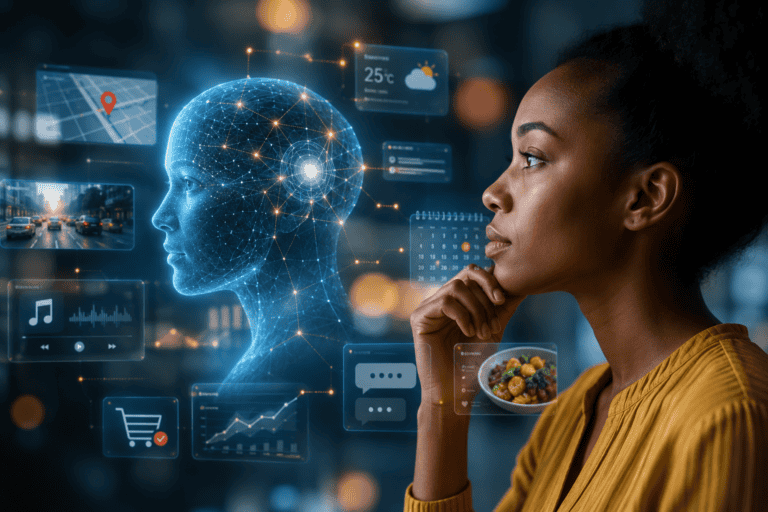
Without any doubt, Artificial intelligence has moved far beyond simply responding to prompts or executing commands. A more subtle and arguably more powerful shift is now underway: the rise of anticipatory AI, systems designed to predict what humans will do next and act ahead of time.
This development represents a major change in how we interact with technology. Instead of waiting for input, these systems attempt to infer intent, context, and future behaviour. In doing so, they are gradually reshaping how decisions are made across digital environments, from search engines and entertainment platforms to finance, healthcare, and workplace tools.
Understanding anticipatory AI is essential not only for technologists but for anyone who uses modern digital services, which is to say, almost everyone.
What is Anticipatory AI?
Anticipatory AI refers to artificial intelligence systems that analyse patterns in behaviour, context, and historical data to predict future actions or needs before they are explicitly expressed.
Unlike traditional AI systems that respond to commands, anticipatory AI is proactive. It attempts to answer questions such as:
- What will the user want next?
- What action is most likely to follow?
- What information or service should be presented before it is requested?
This is achieved through machine learning models trained on large datasets of user interactions, behavioural signals, and contextual information such as location, time of day, device usage, and historical preferences.
In simpler terms, anticipatory AI is about shifting from reaction to prediction.
How Anticipatory AI Works
At its core, anticipatory AI relies on pattern recognition and probabilistic modelling. It does not “know” the future in a human sense. Instead, it calculates likelihoods based on past behaviour and similar user profiles.
A simplified breakdown of the process is shown below:
| Stage | Function | Example |
|---|---|---|
| Data Collection | Gathers behavioural signals | Clicks, searches, watch time |
| Pattern Analysis | Identifies behavioural trends | Frequent evening browsing of videos |
| Prediction Model | Estimates the likely next action | Suggesting a similar video at 7 pm |
| Pre-emptive Action | Delivers suggestions or automation | Auto-playing recommended content |
Modern systems often combine several AI techniques, including:
- Deep learning neural networks
- Reinforcement learning
- Natural language processing
- Real-time behavioural analytics
These models continuously update as new data becomes available, making their predictions more refined over time.
Everyday Examples of Anticipatory AI
Although the term may sound futuristic, anticipatory AI is already embedded in everyday digital life.
Search engines like Google predict queries as you type. Streaming platforms recommend content based on viewing history. Smartphones suggest replies to messages or remind users to leave for appointments based on traffic conditions.
Even navigation apps that suggest faster routes before congestion occurs are a form of anticipatory intelligence.
The table below highlights common applications:
| Sector | Anticipatory AI Function | Real-World Example |
|---|---|---|
| Entertainment | Predicts content preferences | Netflix recommendations |
| Communication | Suggests responses or actions | Smart reply suggestions in email |
| Navigation | Predicts travel conditions | Google Maps traffic rerouting |
| Retail | Predicts purchasing intent | “Frequently bought together” suggestions |
| Productivity | Predicts task priorities | Calendar scheduling suggestions |
What unites these systems is their ability to reduce friction between intention and action.
The Benefits of Anticipatory AI
One of the main advantages of anticipatory AI is efficiency. By reducing the number of decisions users must make, it streamlines digital experiences and saves time.
For example, a well-trained recommendation system can surface relevant content faster than a manual search. In workplace settings, anticipatory tools can help prioritise tasks or automate repetitive decision-making.
There is also an accessibility benefit. Users who struggle with complex interfaces or cognitive overload may find anticipatory systems easier to use.
From a business perspective, anticipatory AI increases engagement. Studies across digital platforms consistently show that personalised recommendations significantly increase user retention and interaction time, although exact figures vary by industry and platform design.
The Risks and Ethical Concerns
Despite its benefits, anticipatory AI raises important concerns, particularly around autonomy, privacy, and behavioural influence.
The most significant issue is that prediction can easily become persuasion. When a system consistently predicts what a user is likely to do, it may also shape what the user ultimately does. This creates a feedback loop where behaviour is gradually guided by algorithmic suggestions.
Privacy is another major concern. Anticipatory AI depends on large volumes of personal data, including behavioural patterns that users may not consciously realise they are sharing.
There is also the issue of transparency. Many anticipatory systems operate as “black boxes,” meaning users do not know why certain predictions or recommendations are made.
Anticipatory AI vs Traditional AI
To understand the shift more clearly, it is useful to compare anticipatory AI with traditional reactive AI systems.
| Feature | Traditional AI | Anticipatory AI |
|---|---|---|
| Approach | Reactive | Proactive |
| Input requirement | User prompt needed | Works without explicit input |
| Goal | Solve a request | Predict future needs |
| Example | Chatbot answering questions | App suggests what you need next |
| User control | High | Reduced (subtle influence) |
This transition represents a deeper integration of AI into human decision-making processes.
The Psychology Behind Anticipatory AI
The effectiveness of anticipatory AI is closely linked to human psychology. Humans are naturally drawn to systems that reduce cognitive effort. When technology consistently anticipates needs correctly, it creates a sense of convenience and trust.
However, this also introduces behavioural conditioning effects. Over time, users may become less inclined to make independent decisions or actively search for alternatives, relying instead on system-generated suggestions.
This is where anticipatory AI intersects with broader discussions around digital dependency and decision fatigue.
Read also: Meta Introduces AI Support Assistant on Facebook and Instagram
The Future of Anticipatory AI
The next stage of anticipatory AI is likely to involve deeper integration into everyday environments, particularly through wearable devices, smart homes, and autonomous agents.
Instead of suggesting actions, future systems may begin to execute them automatically within defined boundaries. For example:
- Automatically booking travel based on calendar patterns
- Preparing work summaries before meetings
- Adjusting financial decisions based on spending behaviour
While these developments promise convenience, they also intensify questions around control and consent.
The key challenge will be balancing predictive power with user autonomy.
Rapping up
Anticipatory AI represents a significant evolution in artificial intelligence, shifting technology from reactive tools to predictive systems that anticipate human needs. It is already embedded in many digital platforms, often in ways users do not consciously recognise.
While it offers clear benefits in efficiency, accessibility, and personalisation, it also introduces complex ethical and psychological questions. As these systems become more sophisticated, the boundary between assistance and influence will continue to blur.
Understanding anticipatory AI is therefore not just a technical concern, but a broader societal one. It challenges us to consider how much decision-making we are willing to delegate to machines that increasingly appear to understand us better than we understand ourselves. X

Senior AI Writer
Bio: Okikiola is a writer and AI enthusiast with a background in Office Technology and Management from the Federal Polytechnic Offa. She went further to study an MSc in International Business at De Montfort University (DMU). With extensive work experience across administrative and business roles, she now focuses on exploring how artificial intelligence can transform work, innovation, and everyday life.