

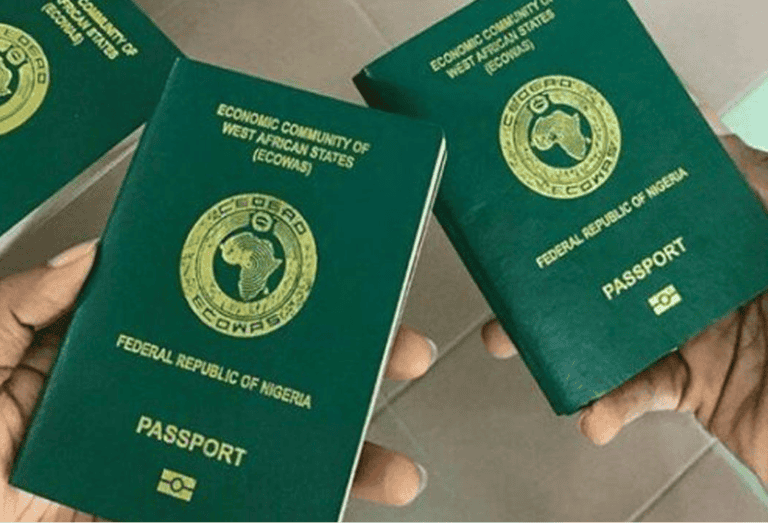
The Federal Government has commenced construction of a $70 million National Passport Booklet Production Centre in Abuja, describing the proposed facility as an artificial intelligence-driven project expected to begin local production of Nigerian electronic passport booklets by May 2027.
The Minister of Interior, Olubunmi Tunji-Ojo, announced the development on Friday, November 20, 2026, during the groundbreaking ceremony at the headquarters of the Nigeria Immigration Service (NIS). He said the project was designed to reduce Nigeria’s dependence on foreign manufacturers and strengthen domestic control over the production of its international travel documents.
According to the minister, the facility will initially have the capacity to produce six million passport booklets annually, with plans to expand production to 10 million booklets per year. Nigeria’s estimated annual requirement is between 1.8 million and two million booklets, meaning the proposed plant could produce considerably more than the country currently needs.
Tunji-Ojo said the manufacturing centre would operate as an artificial intelligence-driven, off-grid facility. However, the government has not yet publicly detailed the specific AI systems that will be deployed in the factory or explained precisely how they will be integrated into passport production.
The project is being developed in partnership with Iris Smart Technologies on a 1.1-hectare site within the Nigeria Immigration Service headquarters in Abuja. The minister said the estimated $70 million investment would be delivered through a private-sector arrangement without direct financial expenditure by the Federal Government.
The initiative forms part of a broader government programme to localise Nigeria’s passport production value chain. Although passport applications, processing and personalisation have increasingly been handled within the country, the physical production of passport booklets has remained dependent on overseas manufacturers.
Tunji-Ojo said the government began reforms in 2023 by automating passport applications and approvals. A data centre was subsequently established in 2024, while a centralised passport personalisation centre was completed in September 2025. The new manufacturing facility is intended to bring the production of the physical booklets into the country.
The minister said the additional production capacity could also position Nigeria to supply electronic passport booklets to other African countries, particularly within the Economic Community of West African States (ECOWAS). He noted that several African countries currently rely on suppliers in Europe and the Americas for their travel documents.
He described the project as an important step towards strengthening national sovereignty and reducing exposure to foreign exchange fluctuations and international supply-chain disruptions that could affect passport availability.
Related
US Warns Nigerians Against AI-Edited Passport Photos
5 Dangers of AI Chatbots on Nigerians’ Critical Thinking
Nigeria Pushes Ambition to Become Africa’s AI Powerhouse
Nigeria Startup Launches Africa’s Largest AI Drone Production Plant
Minister Urges Youths to Harness AI and Robotics for Innovation and National Growth
The Comptroller-General of the Nigeria Immigration Service, Kemi Nandap, also welcomed the development, saying local production would strengthen the security and reliability of Nigeria’s travel documents. She emphasised the importance of ensuring that the facility meets recognised international standards for secure document manufacturing.
The AI component is part of the government’s description of the proposed facility, but the announcement did not specify whether the technology would be used for production monitoring, quality control, security inspection or other manufacturing functions. Those details will be important in assessing the project’s actual AI capabilities as construction progresses.
If completed and commissioned as planned in May 2027, the facility would represent a major change in Nigeria’s approach to passport manufacturing, moving the country from reliance on imported booklets towards domestic production. Its proposed capacity could also create opportunities for technology transfer, specialised employment and regional exports.
For now, the May 2027 date remains the government’s target. The project’s eventual impact will depend on the timely completion of construction, installation of the required manufacturing systems and the facility’s ability to meet international standards for electronic passport production.

AI Writer
Bio: Joseph Michael is an MBA graduate in Marketing from Ladoke Akintola University of Technology and a passionate tech enthusiast. As a professional writer and author at AIbase.ng, he simplifies complex AI concepts, explores digital innovation, and creates practical guides for Nigerian learners and businesses. With a background in marketing and brand communication, Joseph brings clarity, insight, and real-world relevance to every article he writes.