


The challenge goes beyond detecting fake content
As Nigeria moves towards its 2027 general elections, the growing influence of social media on political communication is creating another challenge for electoral integrity: the ability to produce and circulate convincing false information at scale.
Artificial intelligence has made the creation of manipulated photographs, fabricated audio recordings and realistic-looking videos increasingly accessible. In an election environment where political narratives can spread rapidly through digital communities, the consequences could extend beyond online arguments to public confidence in candidates, electoral institutions and the credibility of the voting process.
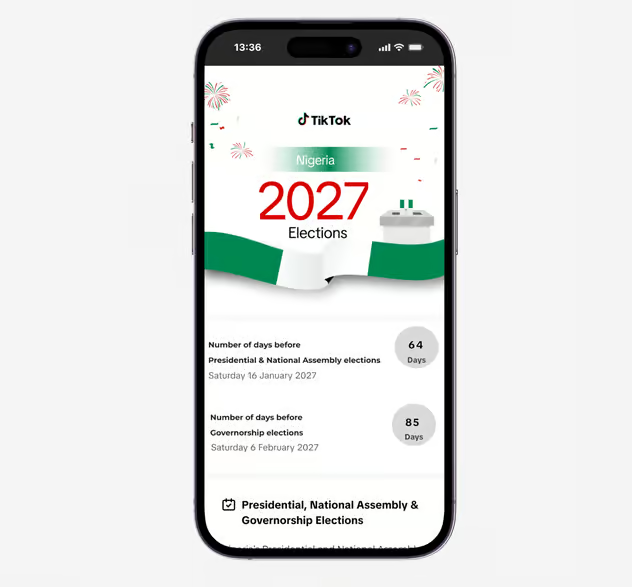
Against this backdrop, TikTok announced additional election safety measures for Nigeria on 16 November 2026. The initiative combines AI-generated content identification, specialised election monitoring, fact-checking partnerships and an in-app Election Centre developed in collaboration with the Independent National Electoral Commission (INEC).
The announcement raises an important question: are these measures sufficient to address the increasingly sophisticated ways political disinformation can be produced, distributed, and amplified?
The answer will depend less on the number of safeguards announced than on how effectively they work when electoral competition intensifies.
What TikTok is putting in place
TikTok says its preparations are being coordinated by a dedicated Nigerian election taskforce that includes specialists in cybersecurity, misinformation, and platform integrity. The team is expected to work alongside the platform’s existing moderation technology and external partners.
One significant component is an in-app Election Centre developed with INEC. The centre is intended to help users access electoral information, including guidance on when and how to vote, alongside educational material on recognising misinformation.
TikTok is also working with DUBAWA, the fact-checking and media literacy initiative of the Centre for Journalism Innovation and Development (CJID). Under the arrangement, DUBAWA will provide educational videos to help users recognise manipulated material and understand how AI-generated content can be used to mislead.
The platform has also identified Code for Africa as a fact-checking partner in Nigeria. Separately, its collaboration with the Nigeria Union of Journalists (NUJ) includes training for more than 300 media professionals across Lagos, the Federal Capital Territory, Ogun and Oyo on information verification, digital platforms and responsible election reporting.
These interventions recognise that election misinformation cannot be addressed through automated content removal alone. Journalists, fact-checkers, electoral authorities and ordinary users all have roles in identifying and challenging misleading information.
AI labelling is useful, but it is not a complete solution
A central part of TikTok’s strategy is its approach to AI-generated content.
The platform requires realistic AI-generated content to be labelled and uses several identification methods, including creator disclosures, Content Credentials based on the C2PA standard and invisible watermarking technologies.
TikTok says more than three billion videos have been labelled through a combination of creator disclosures and these technologies since introducing its AI-content labelling measures.
However, labelling should not be confused with verification.
An AI-generated video can be clearly labelled and still contain false or misleading political claims. Conversely, manipulated material that is not correctly identified may circulate without the context users need to assess its authenticity.
Content Credentials and watermarking can help establish information about a file’s origin or editing history where the relevant credentials are available. They cannot independently establish whether the political statement in a video is true.
There is also the problem of material that has been downloaded, edited, compressed or reposted across multiple platforms. Such processes can complicate identifying the original source and preserving authenticity information.
For Nigerian political content, the challenge may be particularly difficult when misleading material is presented as an excerpt from a campaign speech, an alleged private conversation or a recording attributed to a public official.
The question is therefore not simply whether TikTok can recognise AI-generated material. It is whether the platform can distinguish between manipulated media, legitimate political satire, authentic recordings presented without context and outright fabricated claims without suppressing legitimate political expression.
The bigger problem is how disinformation spreads
AI-generated content is only one part of the electoral misinformation challenge.
Political disinformation can also involve authentic photographs circulated with false captions, old videos presented as recent events, misleading interpretations of electoral procedures and fabricated claims attributed to candidates or public institutions.
Some of the most influential false narratives may not require sophisticated technology at all. A misleading message distributed through a network of influential accounts, reposted by trusted community figures and reinforced in private messaging groups, can acquire credibility through repetition.
This is an important limitation in relying too heavily on AI detection.
A platform may successfully identify a synthetic video while failing to recognise the broader misleading narrative being promoted through authentic images, edited clips and coordinated posts.
TikTok says it removes false information about when and how people can vote and prohibits accounts that impersonate politicians or news organisations. Where an election-related claim cannot immediately be verified, it says it can attach an unverified-information label and prevent the content from being recommended on its For You feed.
These measures are relevant, but their effectiveness will depend on the speed of detection, the quality of verification and the ability of moderation systems to understand Nigerian political and linguistic contexts.
The accountability question: who checks the platform?
TikTok’s announcement also raises a wider governance issue.
The company is simultaneously the platform operator, the organisation enforcing its content rules, and the institution deciding how potentially misleading material is labelled, restricted, or removed.
Its partnerships with INEC, DUBAWA and Code for Africa provide an important layer of external expertise. However, partnerships alone do not establish whether enforcement decisions are consistently accurate or whether users have sufficient transparency when content is restricted.
For a country with a politically diverse population and a complex information environment, moderation decisions require sensitivity to language, regional context, political expression and the distinction between criticism and deliberate deception.
There must also be room for legitimate disagreement about candidates, policies, public institutions and the conduct of the electoral process.
An effective election integrity framework should not become a mechanism for insulating political actors or institutions from scrutiny. False claims about voting procedures deserve intervention, but legitimate reporting, investigative journalism, satire and evidence-based criticism must remain protected.
The credibility of TikTok’s approach will therefore depend partly on whether it can explain its decisions, correct moderation errors and provide meaningful avenues for appeals.
What the removal figures actually tell us
TikTok has cited the removal of more than 210,000 videos between April and June 2026 for violations involving civic and election integrity, misinformation and harmfully misleading AI-generated content.
The company also says more than 99 per cent of the affected videos were removed before users reported them.
The figures indicate the scale of enforcement activity claimed by the platform, but they should be interpreted carefully.
The April-to-June removal figure in TikTok’s 16 November announcement is not accompanied by a Nigeria-specific breakdown. It should therefore not be presented as 210,000 videos removed exclusively in Nigeria.
Furthermore, the number of videos removed does not, by itself, establish how much harmful information users encountered before intervention, how widely the material circulated or whether the same narratives continued through other accounts and platforms.
The distinction matters. Enforcement statistics can demonstrate moderation activity, but they are not a substitute for independent evidence of reduced exposure to disinformation or improved public understanding.
For Nigerian researchers and civil society organisations, more detailed reporting would be useful. This could include country-specific figures, the languages in which violations were identified, the time taken to act on credible reports, the number of successful appeals and the proportion of misleading material detected before significant circulation.
Without such information, the public has limited grounds for independently evaluating the effectiveness of the platform’s intervention.
Nigeria’s information environment requires more than platform intervention
TikTok’s initiative is significant, but the responsibility for protecting electoral information cannot rest with one social media company.
INEC has an important role in communicating authoritative information about voter registration, polling arrangements, electoral procedures and official announcements. Timely and accessible communication can reduce the space in which fabricated instructions and misleading claims gain traction.
News organisations also have a responsibility to verify material before publication, particularly when videos and recordings are presented as evidence of political misconduct or electoral irregularities.
Fact-checking organisations can help challenge false narratives, but their work is most effective when corrections reach the same audiences exposed to the original claims.
Digital literacy is equally important. Users need to understand that a verified account does not guarantee that every post is accurate, an AI label does not automatically mean that content is false, and a widely shared video is not necessarily authentic.
These distinctions are essential in an election cycle where political communication is likely to intensify and where speed of publication can sometimes take precedence over verification.
There is also a need for cooperation between platforms. A misleading video removed from one service may continue circulating elsewhere, making coordinated responses and credible public information particularly important.
Related
- TikTok AI Video Guide: How Nigerian Creators Can Avoid Content Removal and Grow Faster
- “AI Could Kill Us All”: Ex-Researcher Sounds Alarm on Tech’s Future
- AI Media Literacy in Sub-Saharan Africa Gets $200,000 TikTok Boost Amid Deepfake Concerns
- Next‑Gen AI Compute: Anthropic Strengthens Ties with Google and Broadcom
- Stakeholders Call for Safeguards Against AI Election Manipulation
The real test comes during the election campaign
TikTok’s announcement represents a useful step towards preparing for Nigeria’s 2027 elections. Its combination of election monitoring, AI labelling, fact-checking partnerships and voter information acknowledges that the risks facing digital political communication are interconnected.
However, the announcement should be treated as a commitment to be tested, rather than proof that the problem has been solved.
The critical questions will emerge as campaigns intensify: how quickly will manipulated content be identified? Will local languages and political references receive adequate moderation attention? How transparent will the company be about enforcement decisions? Can users challenge incorrect labels or removals? And will independent researchers have enough information to assess the platform’s performance?
Ultimately, the credibility of TikTok’s election safety measures will be determined by their practical impact, not the scale of the announcement.
Nigeria’s 2027 elections will test more than social media platforms’ ability to detect AI-generated content. They will test whether technology companies can protect the integrity of political information while preserving legitimate debate, accountability and freedom of expression.
TikTok has outlined its approach. The more consequential question is whether it can deliver when the pressure on Nigeria’s digital information environment is at its highest.

Tech & AI Reporter
Bio: John O. Abdullahi is a multi-skilled technology and AI journalist and fact-checker at AIBase Nig. An IT graduate with extensive experience in news reporting, editorial writing, event coverage, and interviewing industry leaders and AI founders. Also contributes to strategic planning, management decisions, and event coordination, with a passion for credible journalism, technology, and innovation.