




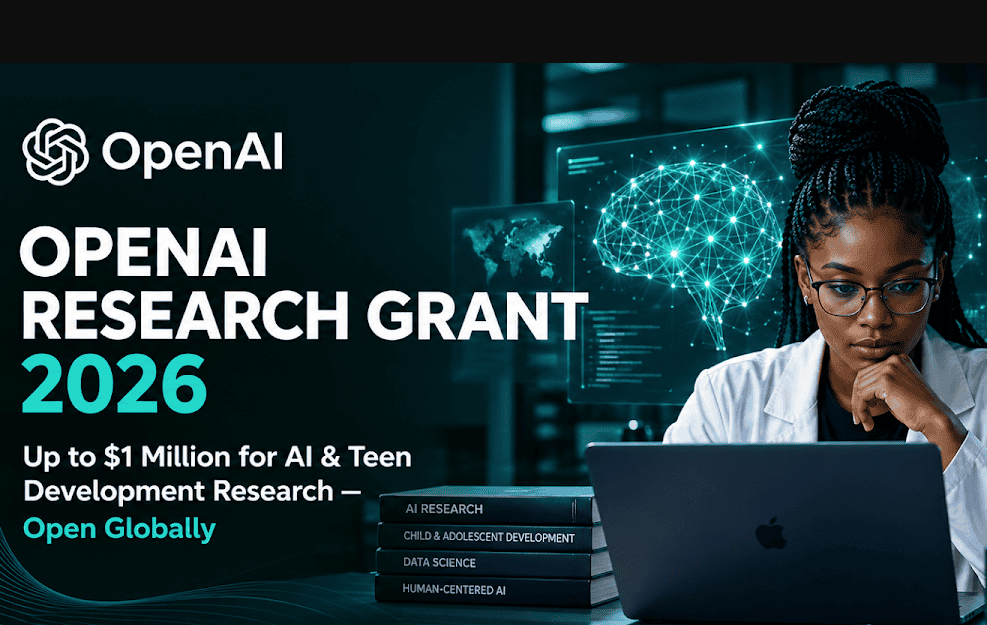
Overview of the OpenAI AI and Teen Development Research Grant Opportunity
Provider: OpenAI
Opportunity type: Research grant
Total programme funding: Up to US$5 million
Maximum individual grant: Up to US$1 million per project
Application deadline: 6 October 2026, 11:59 PM PDT
Expected notification: On or before 13 November 2026
Geographic eligibility: Applications are welcomed from any country
Application language: English
Research language: Research may be conducted in any language
About the opportunity
OpenAI is committing US$5 million to support independent research examining how generative artificial intelligence affects the lives and development of teenagers aged 13–17.
The programme is intended to build evidence about how teenagers use AI, the effects of that use, and the factors that influence outcomes. OpenAI says the research is intended to contribute to understanding of the opportunities and challenges associated with AI use during adolescence, with particular attention to social and emotional development.
OpenAI also states that the research may help inform the development of AI products for teenagers and contribute evidence to discussions involving policymakers and regulators.
Who can apply?
Applicants must:
-
Be 18 years of age or older.
-
Be affiliated with a research institution or organisation, and/or have significant relevant experience in areas such as child or adolescent development, well-being, human-computer interaction, AI impacts or a closely related field.
-
Be proposing research rather than a for-profit initiative. OpenAI states that for-profit organisations will not be prioritised at this time.
OpenAI explicitly states that it welcomes proposals from any country, although it says preference may be given to research from countries with significant AI adoption.
Multiple institutions may collaborate on a proposal.
Student, graduate student and post-doctoral researcher involvement can be supported through the grant.
What research is OpenAI looking for?
OpenAI welcomes research that develops evidence around areas including:
-
How teenagers use generative AI and how different patterns of use relate to developmental outcomes.
-
The potential effects of AI use on teenagers’ lives.
-
Individual, social, cultural and technical factors that influence the effects of AI use.
-
Technical interventions, safeguards and design choices that could increase benefits or improve safety for teenagers.
-
Differences in outcomes across ages, developmental stages, populations, cultures, languages and socioeconomic circumstances.
The programme encourages interdisciplinary research involving areas such as child and adolescent development, psychology, public health, human-computer interaction, communication, sociology, anthropology, data science and AI safety.
Research priorities
OpenAI identifies four particular areas of research interest:
Emotional development and well-being
Research concerning emotion regulation, resilience, identity, agency, self-esteem and social connection.
Social development and relationships
Research examining friendships, family relationships, belonging, communication, empathy, social skills and the relationship between AI and human connection.
Patterns, contexts and demographic differences
Research examining how outcomes vary according to factors such as time spent using AI, type and purpose of use, age, culture, language and socioeconomic circumstances.
Mitigations, age-appropriate design and policy approaches
Research evaluating safeguards, product interventions, AI literacy, parental or educator support and healthy-use practices..
Research methods
The programme is not restricted to one research methodology. OpenAI states that qualitative, quantitative, experimental, observational, theoretical, participatory and mixed-methods approaches are eligible.
Research involving teenagers directly in the design or interpretation of studies is welcome but is not required.
Research involving teenagers
Projects involving minors must address additional ethical and safeguarding requirements.
Applicants proposing research involving teenagers must explain:
-
The relevant institutional or independent ethics-review process.
-
How informed consent and age-appropriate assent will be obtained.
-
How participants’ privacy and data will be protected.
-
How disclosures of harm or imminent risk will be handled.
-
Whether sensitive personal, behavioural or mental-health information will be collected.
-
What relevant child-development, clinical or safeguarding expertise the research team has.
-
Parental consent arrangements, where appropriate.
OpenAI states that collecting sensitive information does not automatically make a project ineligible, but such projects may require additional ethical review, expertise, safeguards and time.
Funding
OpenAI will award individual research grants of up to US$1 million per project, with total programme funding of up to US$5 million.
A maximum of 10% of each project’s grant can be used for overhead or indirect costs.
Grant funding can support the involvement of students, graduate students and post-doctoral researchers.
Project timeline
OpenAI states that it has a strong preference for research projects capable of producing results within a relatively short timeframe.
Funded projects are expected to provide a working draft suitable for discussion at a small conference within 12 months of receiving funding. Funded projects must also provide an interim research progress update in Q1 2027, where appropriate including early findings.
Application requirements
Applications must be submitted in English and formatted as a single-spaced Google Doc.
Applicants must provide:
-
Project summary – less than one page outlining the proposed research and expected contribution.
-
Research proposal – maximum three pages, excluding references, covering the research questions, relevant prior research, proposed methods and analysis, study population and recruitment strategy, expected outputs, potential limitations and relevance to the programme.
-
Project plan and timeline – including key activities, milestones and expected completion date.
-
Budget and budget justification – including requested funding, major cost categories and other committed sources of support.
-
Project dependencies – requirements that need to be met for the research to proceed and risks that could affect completion.
-
Ethics and safeguarding statement – required for research involving minors, sensitive information or potentially vulnerable populations.
-
Team information – short CVs or biographies for the principal investigator and key team members.
-
Independence and conflicts disclosure – including relevant financial relationships, industry funding or other potential conflicts of interest.
How applications are assessed
OpenAI states that proposals will be considered against factors including:
-
Scientific rigour
-
Relevance to current public discourse on AI
-
Quality, clarity and coherence of the proposal
-
Potential to translate findings into guidance for models, products, safeguards, regulation or future research
-
Ethics and safeguarding
-
Feasibility
-
Team expertise
-
Inclusion and generalisability
-
Complementarity with existing evidence and OpenAI’s internal research agenda
-
Independence and credibility of the research
OpenAI says preference may be given to research involving ChatGPT, interdisciplinary teams, underrepresented populations or regions, and projects capable of producing evidence relevant to near- or medium-term policy and regulatory decisions.
Expected outputs
Every funded project will be expected to provide OpenAI with a final report covering:
-
The research question and methods
-
Results and supporting evidence
-
Limitations and sources of uncertainty
-
Recommendations for policymakers, regulators, technology providers or other stakeholders, where supported by the findings
OpenAI strongly encourages researchers to make their findings publicly available through a peer-reviewed publication, preprint, public report or similar format, although publication is not a condition of receiving funding.
Geographic scope
This is a global research opportunity. OpenAI explicitly states that it welcomes proposals from any country. It also says that preference may be given to research from countries with significant AI adoption and to projects involving underrepresented populations or regions.
Research itself may be conducted in any language, although applications must be submitted in English.
Important note for researchers working with minors
Because the programme specifically concerns teenagers aged 13–17, researchers planning to recruit minors should ensure that they have the appropriate ethics, safeguarding, consent, assent, privacy and data-protection arrangements before submitting a proposal.
Deadline and application
Application deadline: 6 October 2026 at 11:59 PM PDT.
OpenAI says applications will be reviewed on a rolling basis by a panel of internal researchers and experts, with selected applicants to be notified on or before 13 November 2026.
Apply: https://openai.smapply.org/prog/openais_ai_and_teen_development_research_grant_program/
Official opportunity information: https://openai.com/index/teen-development-research-grants/
Enquiries: collaborativeresearch@openai.com
The grants are funded and administered by OpenAI Group PBC, rather than the OpenAI Foundation.


Reviews
There are no reviews yet.