

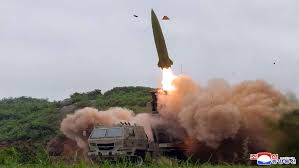
North Korea said Wednesday it had conducted its first test of artificial intelligence-guided missiles, marking a new step in Pyongyang’s efforts to modernise its weapons systems amid rising tensions on the Korean Peninsula and growing military cooperation with Russia.
State media agency KCNA reported that leader Kim Jong Un personally supervised the launch of a range of weapons systems, including tactical ballistic missiles, long-range artillery rockets and AI-guided precision cruise missiles.
The tests were intended to evaluate what the North described as “modern warfare” capabilities and the effectiveness of newly developed targeting and navigation systems. According to KCNA, the cruise missiles used artificial intelligence technology during their terminal guidance phase, enabling them to improve target recognition and strike accuracy.
North Korea also claimed the launches successfully tested “special mission warheads” for tactical ballistic missiles and ultra-precision navigation systems for 240mm multiple-launch rocket systems.
The announcement marked the first time North Korea has publicly acknowledged integrating AI into its missile guidance technology. Analysts said the disclosure signals Pyongyang’s intention to portray itself as advancing beyond conventional missile development into more sophisticated battlefield systems.
South Korea’s Joint Chiefs of Staff said earlier this week that it had detected several projectiles launched from North Korea’s west coast toward the Yellow Sea. South Korean officials did not immediately confirm the North’s claims about artificial intelligence capabilities but said allied intelligence authorities were analysing the launches.
Related:
- The Role of AI in Genomics: Unlocking the Power of Genetic Data
- Ghana Leverages AI and Precision Tech to Accelerate Science Development
- US military strikes AI deals with tech giants in push towards ‘AI-first’ fighting force
Military experts cautioned that the true sophistication of the AI systems remains difficult to verify independently because North Korea tightly controls information surrounding its weapons programs. Some analysts believe the “AI-guided” description may refer to upgraded automatic target-recognition systems rather than fully autonomous decision-making technology.
KCNA said the cruise missiles tested in the exercise had a strike range of approximately 100 kilometres, placing much of the Seoul metropolitan area within range if launched near the inter-Korean border.
North Korea has increasingly focused on developing short-range and tactical weapons systems designed to evade missile defences and threaten South Korean and U.S. military installations in the region.
KCNA said the weapons tests demonstrated “the combat reliability of modern strategic attack weapons systems” and reflected North Korea’s determination to strengthen its military deterrence capabilities.
The latest launches are part of a broader acceleration of North Korea’s missile development program. Since the collapse of denuclearisation talks with the United States in 2019, Kim has expanded testing of cruise missiles, hypersonic weapons and solid-fuel ballistic missiles while deepening military ties with Russia and China.
Western and South Korean officials have accused Pyongyang of supplying artillery shells, rockets and missiles to Russia for use in the war in Ukraine, allegations both Moscow and Pyongyang deny.
Analysts say battlefield feedback from those weapons may be helping North Korea improve the reliability and accuracy of its missile systems. North Korea has steadily expanded its cruise missile capabilities in recent years.
Existing systems already employ terrain-following navigation designed to evade missile defences. Experts say adding AI-assisted targeting could potentially improve precision against mobile or heavily defended targets.
“This appears aimed at showcasing North Korea’s attempt to move toward smarter battlefield weapons,” a Seoul-based defence analyst said. “But it remains unclear how advanced the AI capability actually is.”
The missile tests came as regional security tensions continue to rise. South Korea recently announced plans to pursue a nuclear-powered submarine program aimed at strengthening deterrence against North Korea’s expanding missile and nuclear arsenal.
The United States and South Korea have condemned North Korea’s repeated missile launches as violations of United Nations Security Council resolutions and have increased joint military exercises in response.
Pyongyang, however, has defended its weapons development as necessary to counter what it describes as hostile policies from Washington and Seoul.

Senior Reporter/Editor
Bio: Ugochukwu is a freelance journalist and Editor at AIbase.ng, with a strong professional focus on investigative reporting. He holds a degree in Mass Communication and brings extensive experience in news gathering, reporting, and editorial writing. With over a decade of active engagement across diverse news outlets, he contributes in-depth analytical, practical, and expository articles exploring artificial intelligence and its real-world impact. His seasoned newsroom experience and well-established information networks provide AIbase.ng with credible, timely, and high-quality coverage of emerging AI developments.