

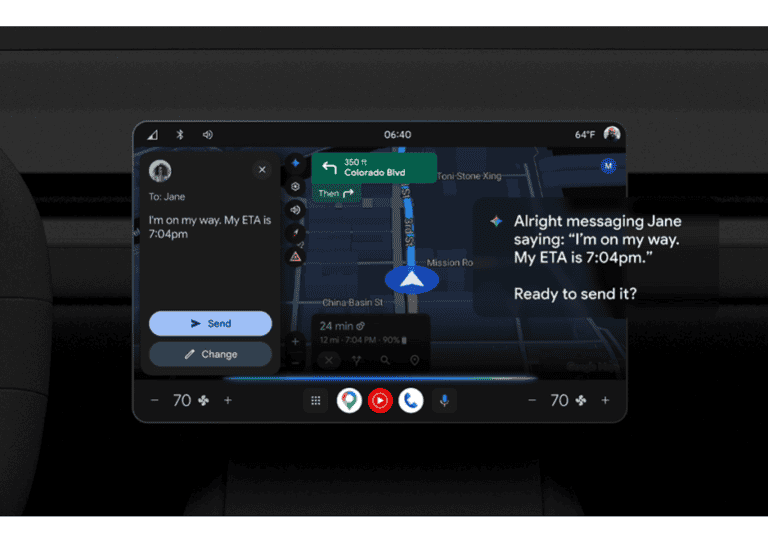
Google is rolling out its Gemini artificial intelligence assistant to millions of vehicles worldwide, marking one of the company’s most significant upgrades to in-car technology yet.
The rollout will see Gemini integrated into cars equipped with Google-built-in systems and Android Auto, gradually replacing the existing Google Assistant with a more advanced, conversational AI designed to make driving interactions more natural and intuitive.
The announcement was confirmed by Google in a blog post and highlighted in its latest Android for Cars platform update. The company said the move is part of its broader strategy to bring generative AI into everyday environments, including smartphones, homes, and now vehicles.
According to Google, Gemini will allow drivers to interact with their cars using more natural speech, moving beyond rigid voice commands. Instead, users will be able to hold back-and-forth conversations with the assistant to complete tasks such as navigation, messaging, media control, and information requests while on the road.
The system is designed to improve safety and convenience by reducing the need for manual interaction with dashboards and mobile devices. Drivers can activate Gemini using voice controls or steering wheel buttons, continuing the hands-free experience already available in modern infotainment systems.
Google stated that Gemini is being rolled out in stages and will initially be available in English in the United States, before expanding to additional languages and regions over time. The upgrade will be delivered via over-the-air software updates to eligible vehicles.
The company also confirmed that the assistant will be available on both Android Auto, which runs on smartphones, and Android Automotive OS, which is built directly into vehicle infotainment systems. This means the rollout will affect a wide range of car manufacturers, including those that already use Google’s built-in platform.
Industry reports indicate that major automotive partners, including General Motors, are among the first to adopt the new system at scale. GM alone is expected to roll out Gemini to approximately 4 million vehicles, covering brands such as Cadillac, Chevrolet, Buick, and GMC for model year 2022 and newer.
Google says Gemini will enhance key in-car functions, including navigation assistance, messaging summaries, music control, and contextual queries, allowing drivers to ask more complex questions while receiving real-time, conversational responses.
Related: Elon Musk Says Millions Of Tesla Cars Will Need Hardware Upgrades For True “Full Self-Driving”
The company has positioned the update as part of a wider shift toward “agentic” AI systems tools that can understand intent, perform multi-step tasks, and operate seamlessly across different services.
Google first previewed Gemini integration for cars at its developer events, where it demonstrated how the assistant could manage multi-step driving requests such as planning routes, adjusting entertainment, and handling communications without requiring multiple manual inputs.
The rollout reflects growing competition among technology firms to dominate the in-car digital experience, with both Google and Apple investing heavily in vehicle operating systems and AI-powered assistants.
While the transition is still ongoing, Google says the long-term goal is to make Gemini the central intelligence layer across all its connected platforms, including cars, phones, and home devices.

AI Writer
Bio: Joseph Michael is an MBA graduate in Marketing from Ladoke Akintola University of Technology and a passionate tech enthusiast. As a professional writer and author at AIbase.ng, he simplifies complex AI concepts, explores digital innovation, and creates practical guides for Nigerian learners and businesses. With a background in marketing and brand communication, Joseph brings clarity, insight, and real-world relevance to every article he writes.