


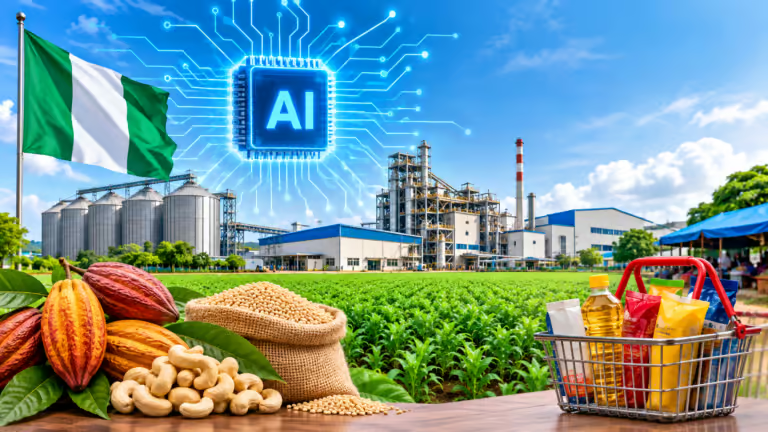
Artificial intelligence could help accelerate Nigeria’s industrial growth by improving productivity in agriculture and manufacturing, but weak consumer purchasing power may limit the benefits, an industry executive has warned.
Sadiq Usman, Managing Director of FMN Agro and Group Director of Strategic Partnerships and Engagement at FMN Holding, said productivity gains from AI would not automatically translate into sustained industrial expansion without sufficient consumer demand.
He made the remarks at a quarterly webinar organised by the NEPAD Business Group Nigeria (NBGN), which examined the adoption of AI across commodity-based value chains, from primary production to processing and value addition.
Usman said AI could help improve agricultural productivity, reduce post-harvest losses, optimise manufacturing operations and strengthen the competitiveness of locally processed products.
However, he warned that increased production efficiency would have limited economic impact if consumers lacked the purchasing power to absorb additional output.
According to him, AI could increase factory capacity utilisation and reduce production costs, but the wider benefits would depend partly on whether efficiency gains resulted in higher wages, lower prices and stronger household purchasing power.
He outlined two possible outcomes of AI-driven productivity: improved wages and consumer spending, or worker displacement, alongside lower production costs that could make goods more affordable.
Usman said Nigeria’s most practical medium-term approach was to apply AI across existing resource-based value chains, particularly agriculture and agro-industrial processing, rather than prioritising advanced AI development without addressing basic economic constraints.
He identified precision agriculture, predictive maintenance, automated quality control, energy optimisation, demand forecasting and logistics planning as areas where AI could improve productivity.
In agriculture, AI-enabled systems could help farmers make better decisions on planting, weather risks, pest control and harvesting. Digital tools could also improve storage, aggregation and market coordination.
In manufacturing, sensors and predictive analytics could help identify equipment faults before breakdowns, optimise energy use, reduce production waste and improve product quality.
Usman said these technologies could be particularly useful in processing grains, cassava, cocoa, cashew, palm oil and other commodities, where greater efficiency could strengthen domestic production and reduce dependence on imported finished products.
He stressed, however, that AI adoption would require reliable electricity, infrastructure, raw-material supply, financing and access to markets.
Earlier, Bashorun Randle, Chairman of NBGN, said Nigeria needed to move beyond exporting raw commodities towards processing, manufacturing and producing higher-value goods for domestic and international markets.
Randle said AI could support precision farming, mineral exploration, manufacturing efficiency, quality control, logistics and market access. He called for stronger collaboration among government, private-sector operators, financial institutions, technology providers and research institutions to support technology adoption and industrial development.
Related:
Also speaking, Dr Muh’tahir Oloyede of the Innovation Hub at the University of Ilorin said AI could help address inefficiencies across commodity value chains and accelerate industrial development.
He identified unreliable electricity, limited connectivity, inadequate local data, financing constraints, skills gaps and fragmented agricultural production as major barriers to effective AI adoption.
Oloyede advocated affordable, locally adapted AI solutions supported by pilot programmes, collaboration between industry and universities, and measurable productivity outcomes.
He proposed a phased approach involving the selection of priority commodity value chains, pilot testing, evaluation and the expansion of solutions that demonstrate commercial viability.
He said AI adoption should be assessed through measurable improvements in yields, processing efficiency, product quality, energy use, losses and market access, rather than technology acquisition alone.
Nigeria’s agricultural export performance also highlights the need to strengthen value addition. The National Bureau of Statistics’ foreign trade data for the second quarter showed agricultural exports fell to N802.99 billion, from N1.26 trillion in the corresponding period of 2025.
Cashew nuts in shell, cocoa beans and sesame seeds were among the leading agricultural export products during the quarter.
The speakers said Nigeria’s industrial transformation would require a coordinated approach combining AI adoption with infrastructure development, skills, investment and stronger domestic demand.
They stressed that the objective should be to use technology to increase productivity, retain more value locally and build competitive industries around the country’s natural resources.
The webinar brought together business leaders, investors, financial institutions, development partners and technology stakeholders to discuss practical approaches to AI adoption across Nigeria’s commodity-based value chains.
