

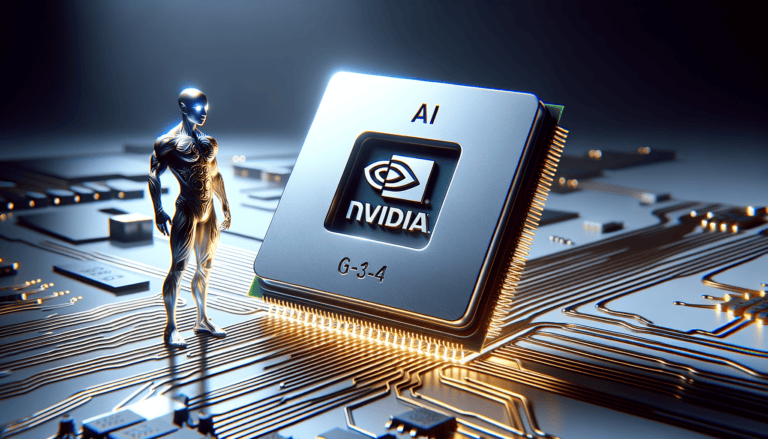
NVIDIA is a key player in artificial intelligence because it builds a complete AI ecosystem, not just chips. This system integrates hardware, software, platforms, networking, and cloud services into a single, unified structure.
For beginners, it can be seen as an “AI factory”: chips provide computing power, software controls it, and platforms package it into usable AI systems.
Working together, these layers enable major AI capabilities like training large models, running real-time AI, simulating real-world environments, and powering AI in devices such as cars, robots, and cloud applications.
To understand how this works clearly, below is a breakdown of NVIDIA’s ecosystem into simple layers:
1. Chips (Hardware Layer): High-Performance AI Compute
At the foundation of NVIDIA’s ecosystem are its chips, designed for the extreme parallel processing required by modern AI systems.
- NVIDIA A100 – widely used for training large AI models in data centres, providing massive computational workrate for deep learning workloads.
- NVIDIA H100 – built for generative AI and transformer models, significantly accelerating training and inference for large language models.
- NVIDIA Blackwell – next-generation architecture focused on scaling AI performance efficiently across large GPU clusters while improving energy efficiency.
- NVIDIA Grace CPU – a CPU designed to work alongside GPUs, improving memory bandwidth and balancing system workloads for better overall performance.
These chips form the raw computational engine of AI systems.
2. Software Layer: Programming and Intelligence Control
The software layer transforms raw hardware into a programmable AI system.
At the centre is:
- CUDA – a programming environment that allows developers to directly control GPU computing power and has become the global standard for AI acceleration.
Supporting tools such as cuDNN and TensorRT further optimise deep learning performance by improving training efficiency and speeding up AI inference during deployment.
Frameworks like:
- PyTorch
- TensorFlow
These are deeply integrated with NVIDIA’s ecosystem, allowing developers to build and deploy AI models without dealing with low-level hardware complexity.
In simple terms, the software layer acts as the control system that makes AI computation usable and scalable.
3. Platform Layer: End-to-End AI Systems
Beyond individual tools, NVIDIA provides complete platforms that simplify AI deployment for organisations.
- NVIDIA DGX H100 – a fully integrated AI supercomputer that combines hardware and software into a ready-to-use system for training massive AI models.
Platforms such as Omniverse and AI Enterprise extend this capability by enabling simulation, digital collaboration, and enterprise-scale AI deployment.
This layer removes the complexity of infrastructure design, allowing organisations to focus on building AI solutions rather than managing systems.
4. Networking and Infrastructure Layer
Through Mellanox Technologies, NVIDIA strengthened the communication backbone required for large-scale AI computing.
This layer enables:
- High-speed communication between GPUs
- Low-latency data transfer across clusters
- Efficient scaling of AI workloads across entire data centres
Without this layer, large AI models would struggle to train efficiently across distributed systems.
5. Cloud Integration and AI-as-a-Service
NVIDIA extends its ecosystem through major cloud providers:
- Amazon Web Services
- Microsoft Azure
- Google Cloud
Its DGX Cloud offering allows organisations to access high-performance AI computing without owning physical infrastructure.
This enables companies to:
- Train AI models on demand
- Scale compute resources instantly
- Pay only for what they use
It significantly lowers the barrier to advanced AI development.
6. Core Functionalities of NVIDIA’s Ecosystem
These are the key capabilities enabled by the full stack:
AI Training at Massive Scale
NVIDIA enables the training of extremely large AI models using thousands of GPUs working in parallel. This capability is what makes modern large language models possible. It also allows researchers to iterate faster, reducing model development from months to days.
Real-Time AI Inference
After training, AI models must respond instantly to user input. NVIDIA optimises this process so that AI systems can deliver real-time predictions, whether for chatbots, fraud detection, or image recognition.
Simulation and Digital Twins
NVIDIA enables virtual replicas of real-world environments such as cities, factories, and vehicles. These digital twins allow engineers to test, predict, and optimise systems safely before deploying them in reality, reducing risk and cost.
Generative AI Acceleration
Generative AI systems that create text, images, or video require enormous computing power. NVIDIA accelerates both training and deployment, making large-scale generative systems faster, more efficient, and more accessible.
High-Performance Parallel Computing
Beyond AI, NVIDIA systems are widely used for scientific simulations, physics modelling, and weather forecasting. Their ability to process thousands of operations simultaneously makes them ideal for complex research workloads.
Edge AI Deployment
AI is no longer limited to data centres. NVIDIA enables AI models to run directly on devices such as robots, cameras, and autonomous vehicles. This allows systems to make real-time decisions without cloud dependency, which is critical for safety and responsiveness.
7. Best Functionalities Across Industries
Healthcare
AI improves medical imaging accuracy, helping detect diseases earlier. It also accelerates drug discovery by simulating molecular interactions before physical testing.
Automotive
Self-driving systems rely heavily on simulation and edge AI. Vehicles process sensor data in real time, while millions of simulated driving scenarios improve safety before deployment.
Finance
Financial institutions use AI for fraud detection, risk analysis, and trading optimisation. This improves decision speed and reduces financial exposure.
Robotics & Manufacturing
Factories use AI for predictive maintenance and digital twins of production lines, reducing downtime and improving efficiency.
Telecommunications
AI helps optimise network traffic, improve 5G performance, and reduce latency across communication systems.
Enterprise AI
Businesses use NVIDIA platforms to automate workflows, analyse large datasets, and deploy AI systems without building infrastructure from scratch.
8. Integrated Ecosystem Architecture
Applications (Healthcare, Automotive, Finance, Robotics)↑Core Functionalities (Training, Inference, Simulation, Generative AI, Edge AI)↑Platforms (DGX, Omniverse, AI Enterprise)↑Software (CUDA, PyTorch, TensorRT)↑Chips (GPUs, CPUs)↑Networking (Mellanox)
Conclusion
NVIDIA’s ecosystem is powerful because it is not fragmented. It is a carefully structured AI stack where each layer builds on the next: chips provide compute power, software enables control, platforms deliver ready-to-use systems, and functionalities define what the system can actually do. Ultimately, this layered integration is what makes NVIDIA not just a chip manufacturer, but a foundational infrastructure provider for the entire AI era.

Senior Reporter/Editor
Bio: Ugochukwu is a freelance journalist and Editor at AIbase.ng, with a strong professional focus on investigative reporting. He holds a degree in Mass Communication and brings extensive experience in news gathering, reporting, and editorial writing. With over a decade of active engagement across diverse news outlets, he contributes in-depth analytical, practical, and expository articles exploring artificial intelligence and its real-world impact. His seasoned newsroom experience and well-established information networks provide AIbase.ng with credible, timely, and high-quality coverage of emerging AI developments.