


On March 19, 2026, Elon Musk outlined his view of the global artificial intelligence race, identifying Google, China, and SpaceX as likely frontrunners, while leaving out both OpenAI and his own startup, xAI.
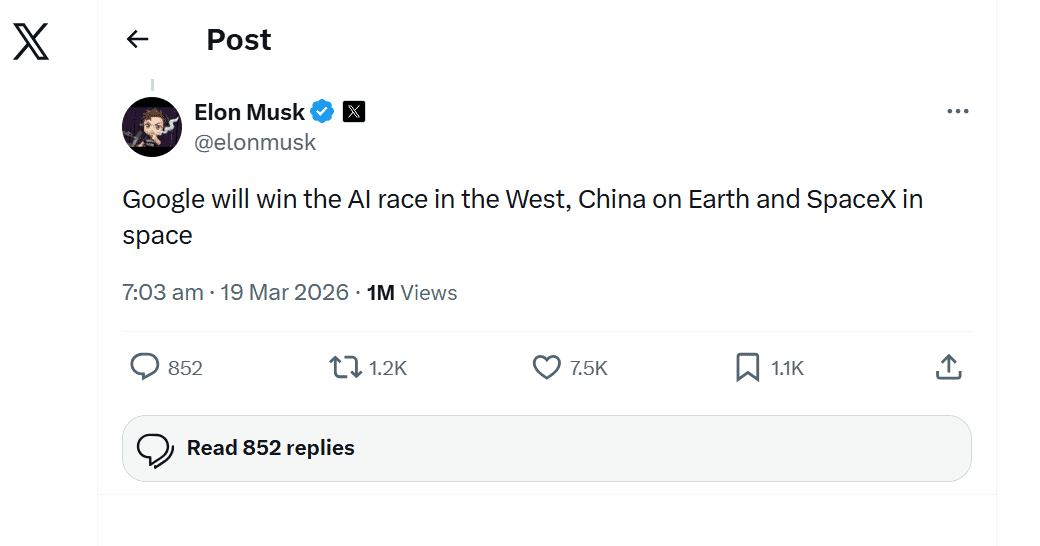
At about 12:33 PM on that day, Musk posted on the social media platform X that the race to dominate artificial intelligence would not produce a single global winner. Instead, he projected a fragmented outcome in which different players emerge dominant across regions and domains.
Musk outlined what he described as a split in AI leadership, stating that Google would dominate in Western markets, China would lead globally, and SpaceX would emerge as the frontrunner in space-based AI systems. His remarks also pointed to the growing importance of infrastructure, particularly satellite networks and space transportation, in shaping the next phase of AI deployment.
According to Musk, Google is best positioned to lead in the West, citing its deep-rooted advantage in data, infrastructure, and long-term research through its AI divisions. The company has played a central role in advancing machine learning and large-scale AI systems, giving it a structural edge across the United States and Europe.
For the broader global landscape, Musk pointed to China as the likely leader, reflecting the country’s scale, rapid deployment of AI technologies, and strong state-backed push to integrate artificial intelligence across industries. China’s growing influence in AI has increasingly positioned it as a counterweight to Western tech dominance.
Looking beyond Earth, the CEO of SpaceX identified the same as central to what he framed as the next frontier for artificial intelligence. The company’s expanding satellite network and long-term ambitions around space infrastructure could place it at the centre of AI systems operating beyond terrestrial limits.
Notably absent from Musk’s list were OpenAI, the developer of ChatGPT, and xAI, his own artificial intelligence venture. The omission has sparked debate, with some users questioning whether xAI’s chatbot, Grok, remains competitive in the rapidly evolving AI landscape.
In separate posts around the same timeframe, Musk also indicated that SpaceX and Tesla would continue to purchase Nvidia chips at scale, underscoring ongoing investments in advanced AI systems, including next-generation AI5 and AI6 technologies.
Related Articles:
- China Zhipu Unveils GLM-5 in AI Race With DeepSeek
- Elon Musk Wants to Build an AI Factory on the Moon
- Why Elon Musk Built xAI After Leaving OpenAI
His comments come at a time when the global AI race is increasingly shaped by geopolitical dynamics, control of infrastructure, and access to computing power, rather than purely by algorithmic breakthroughs.
The CEO of Tesla, and owner/CTO of X (formerly Twitter), remarks reinforce a growing view within the industry that the future of artificial intelligence may be defined less by a single dominant player and more by a fragmented network of regional and domain-specific leaders.

Senior Reporter/Editor
Bio: Ugochukwu is a freelance journalist and Editor at AIbase.ng, with a strong professional focus on investigative reporting. He holds a degree in Mass Communication and brings extensive experience in news gathering, reporting, and editorial writing. With over a decade of active engagement across diverse news outlets, he contributes in-depth analytical, practical, and expository articles exploring artificial intelligence and its real-world impact. His seasoned newsroom experience and well-established information networks provide AIbase.ng with credible, timely, and high-quality coverage of emerging AI developments.