

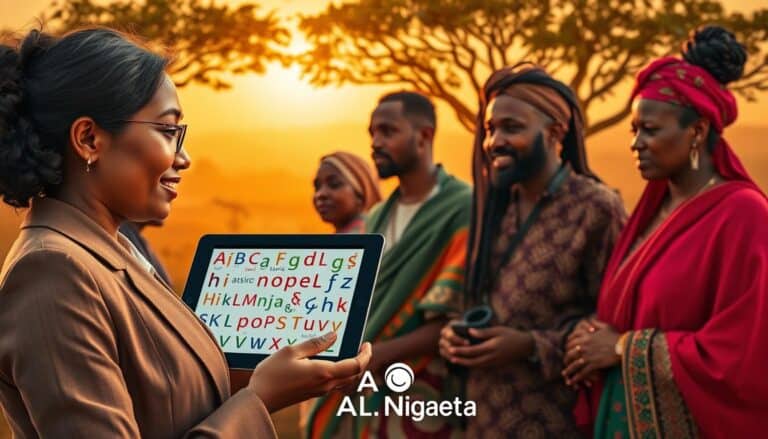
Artificial intelligence (AI) needs lots of language data to grow. But many African languages are missing from this data. Africa has over a quarter of the world’s languages, showing great linguistic diversity.
Currently, AI struggles to include African languages. This leads to a breakdown of democracy in digital inclusivity. Yet, efforts to make multilingual AI models for Nigerian languages are starting to make a difference.
We need more money for language data and multilingual AI. This will help AI systems better reflect the world’s linguistic diversity.
The Challenge of Linguistic Diversity in African AI Development
Linguistic diversity is a big challenge for AI in Africa. The continent has thousands of languages. Many are spoken but not written.
This means there’s little text data for AI models. It’s hard to make AI that can talk and understand African languages.

Many African languages are low-resource. They don’t have enough data or support for AI.
Government Policies and Institutional Neglect
Government policies and neglect add to the problem. Not enough money is spent on language tech. This stops AI models for African languages from being made.
To solve these issues, we need new AI startup ideas. These can help boost innovation in African AI.
Can AI Be Trained on Africa’s Thousands of Languages? Recent Breakthroughs
Recent advances in multilingual AI have opened new doors. They let us include Africa’s many languages in AI systems. Researchers have made an enormous dataset of African languages. This is key for AI progress in Nigeria and elsewhere.
Creating big datasets is a big step. It helps train AI on African languages. This lets researchers develop AI that can understand Africa’s linguistic diversity. New tech is also helping this field grow.
New AI designs are tackling Africa’s language challenges. These include tonal systems and complex grammar. These designs aim to improve AI’s ability to understand and speak like a human. This makes AI more useful for people in Africa.
These advances mean significant changes. Africa can skip over old tech hurdles. It can create new solutions that fit its languages and cultures. The growth in multilingual AI shows how tech can help the region.
As AI gets better, we’ll see it used more in education, healthcare, and business. The recent AI breakthroughs are a big step towards a digital future for Africa.
The Implications of Multilingual AI for Africa’s Digital Future
Multilingual AI is changing Africa’s digital world. It lets AI better talk and understand African languages. This opens up new chances for growth and inclusion.
The Nigeria National AI Strategy is a big step forward. It shows how AI can help Africa.
Multilingual AI can help businesses grow by reaching more people. It improves customer service and makes marketing more effective. In Africa, this means more people can use money, get better healthcare, and learn more.
It also helps keep African cultures alive by incorporating their languages and traditions into AI.
But there are challenges to overcome. We need more data, strict rules, and partnerships between the public and private sectors. With these steps, Africa can make the most of multilingual AI. This will make the digital economy fairer and more prosperous for everyone.

AI Writer
Bio: Joseph Michael is an MBA graduate in Marketing from Ladoke Akintola University of Technology and a passionate tech enthusiast. As a professional writer and author at AIbase.ng, he simplifies complex AI concepts, explores digital innovation, and creates practical guides for Nigerian learners and businesses. With a background in marketing and brand communication, Joseph brings clarity, insight, and real-world relevance to every article he writes.