


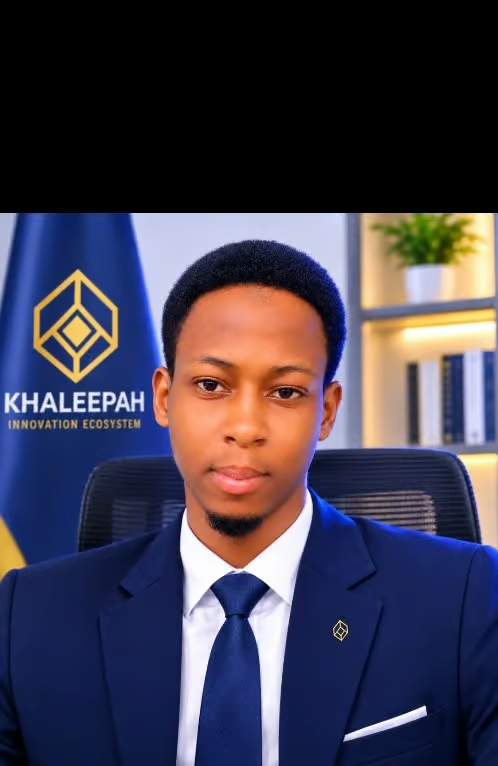
Africa must move beyond consuming artificial intelligence technologies and begin building AI systems tailored to its own languages, cultures and local challenges, according to Ali Sagiru Ringim, founder of Khaleepah Innovation Ecosystem.
In an exclusive interview with AIBase reporter Ahmad Ibrahim, Ringim outlined his vision for building a technology ecosystem focused on accessibility, local innovation and practical digital solutions, particularly in Northern Nigeria.
He said Khaleepah was established after he identified a widening gap between the pace of global technological advancement and access to locally relevant digital solutions and innovation opportunities across Africa.
“I saw an opportunity to contribute to closing that gap by building practical technology solutions that respond to real problems within our communities, while also helping connect local talent to the wider digital economy,” Ringim said.
Building an accessible digital ecosystem
Khaleepah Innovation Ecosystem serves young people, students, small businesses, innovators and communities.
Rather than concentrating on one industry, Ringim said the hub deliberately adopted an ecosystem model because many of the challenges faced by its target users are interconnected.
“Our goal is to provide different digital solutions that support learning, entrepreneurship, productivity, access to technology, and community development,” he said.
Accessibility is central to the organisation’s approach.
“One of the things that makes Khaleepah different is our focus on accessibility and simplicity,” Ringim said.
The organisation aims to develop products that can be understood and used by people who may have limited experience with technology.
Language inclusion is another major component of the strategy.
“We have incorporated Hausa because we believe language should not prevent people from benefiting from digital innovation,” he said.
Ringim said the ecosystem intends to expand its language offering to include French and selected indigenous languages from other parts of Nigeria.
AI sits at the centre of Khaleepah’s strategy
Artificial intelligence is already central to Khaleepah’s product development, with the organisation working on several AI-focused platforms, including NUR AI, NUR Sentinel AI, NUR Game Hub and NUR Crypto Academy.
According to Ringim, the objective is not to build AI products simply because the technology is attracting global attention.
“Our goal is not simply to build AI tools, but to use AI to solve practical problems and make digital technology more accessible to ordinary people,” he said.
NUR AI is being developed as a practical AI assistant capable of understanding users’ needs and providing guidance across areas including business, agriculture, health, education and everyday decision-making.
The platform can also assist with tasks such as CV creation, proposal writing, translation, image generation and other digital productivity activities.
NUR Sentinel AI, meanwhile, focuses on defensive cybersecurity and threat intelligence, while NUR Game Hub combines gaming with learning and engagement.
NUR Crypto Academy is designed to make cryptocurrency and blockchain education easier to understand, particularly for beginners.
Ringim said Khaleepah is continuing to research additional applications for AI as it develops the wider ecosystem.
Repeat users offer early signal of demand
Ringim was cautious about putting an unverified figure on the number of people or innovators supported by the ecosystem.
“We are still at an early growth stage, so I would not want to give an estimated number that we cannot properly verify,” he said.
However, he said the organisation is already seeing users engage with its products and return to use them.
“For me, that repeat usage is an important early indicator that we are addressing real needs rather than simply building technology for the sake of it,” Ringim said.
The current priority, he added, is to improve the products, understand user behaviour, measure usage more systematically and expand access.
“As our platforms mature, we intend to publish more concrete user and impact metrics,” he said.
Funding and mentorship remain major obstacles
Despite growing interest in technology entrepreneurship, Ringim identified funding, mentorship and institutional support as some of the biggest challenges facing startup founders in his ecosystem.
“Many young founders have the ideas, talent, and determination to build, but they often struggle to access the resources, experienced guidance, and opportunities needed to move from an idea or early product to a sustainable business,” he said.
He also called for stronger collaboration between government and the private sector.
“When young innovators do not have access to these opportunities, some eventually lose motivation or abandon promising ideas despite having the talent and determination to succeed,” Ringim said.
For him, improving the support system is about more than helping individual startups.
“Strengthening this support system is important not only for individual startups, but also for retaining talent and building a stronger African innovation ecosystem,” he said.
Khaleepah plans multiple revenue streams
The ecosystem is developing several potential revenue streams, including premium AI services, paid platform features, educational programmes through NUR Crypto Academy, services around NUR Sentinel AI and other digital products under development.
For now, however, the organisation is prioritising adoption and community growth over aggressive monetisation.
“At the moment, we are prioritising community growth, product adoption, and improving the user experience before aggressively monetising the platforms,” Ringim said.
“We believe it is important to build trust and demonstrate value first, particularly for the communities we serve.”
Khaleepah is also open to strategic investment and partnerships with government institutions, corporations and other organisations aligned with its objectives.
“The right partnerships can help us accelerate product development, reach more users, and build sustainable revenue streams,” he said.
AI and no-code tools are lowering the barrier to entrepreneurship
Ringim believes the emergence of AI and no-code development tools is fundamentally changing who can participate in technology entrepreneurship.
He described the transformation as personal as well as technological.
“Since secondary school, I have always wanted to build a game application, but at the time, the technical process was much more difficult,” he said.
He recalled working with tools such as Godot, which required substantial learning, experimentation and technical problem-solving.
Related:
- Ways to Leverage ChatGPT for Skills Development in Nigeria
- Nigerian AI Startups Face New Compliance Challenges Under EU AI Act
- GREE Showcases 130 Products at Canton Fair, With Over 80% Featuring AI Integration
- Minister Urges Youths to Harness AI and Robotics for Innovation and National Growth
“Today, AI and no-code tools provide a very different experience,” Ringim said.
“With a well-structured prompt and a clear idea, these tools can help a founder build, test, improve, and iterate on a product much faster.”
He added that AI can sometimes refine an idea or suggest alternative approaches.
“For me, this has been a major advantage in building Khaleepah Innovation Ecosystem,” he said.
Ringim stressed that AI and no-code tools do not eliminate the need for technical knowledge, but they can enable more people to transform ideas into prototypes and potentially into commercial products.
“I believe this will create a new generation of technology entrepreneurs, particularly among young people who previously lacked access to technical resources,” he said.
Khaleepah seeks strategic partnerships and expansion
Looking ahead, one of Khaleepah’s key priorities is establishing strategic partnerships with investors, government institutions and organisations that share its vision for technology-driven development in Africa.
“We believe the right partnerships can help us accelerate product development, expand our reach, strengthen our infrastructure, and bring more of our solutions to the people who need them,” Ringim said.
The organisation is also continuing to develop AI-powered products while expanding its ecosystem into additional areas and languages.
“Our ambition is to build Khaleepah into a sustainable technology ecosystem that can create long-term value for users, partners, and investors,” he said.
Africa must become a builder of AI
Ringim’s biggest prediction for the next five years is that Africa will increasingly transition from being a consumer of AI technologies to becoming a creator of its own.
“Over the next five years, I believe Africa will move from primarily consuming AI technologies to becoming a much stronger builder of its own AI solutions,” he said.
One of his biggest aspirations is for African developers and innovators to create AI-powered robotics and intelligent systems capable of understanding and communicating in local languages while assisting people with everyday tasks.
“African languages, cultures, and local realities should be part of the future of AI rather than being left behind,” Ringim said.
With countries around the world investing heavily in AI and robotics, he believes Africa must participate not merely as a user but as a creator.
“Africa needs to be part of that journey — not only as a user, but as a creator and innovator,” he said.
His ambition is that the coming five years will bring more African-built AI products, robotics, digital infrastructure and technology companies capable of addressing local problems while competing internationally.
“My hope is that within the next five years, we will see more African-built AI products, robotics, digital infrastructure, and technology companies solving African problems and competing globally,” Ringim said.
For Khaleepah Innovation Ecosystem, that vision begins with making technology more accessible today — through practical products, local-language inclusion and tools that enable more Africans to participate in the digital economy.
As AI continues to reshape global technology and entrepreneurship, Ringim’s argument is that Africa’s opportunity lies not simply in adopting what others build, but in developing solutions that reflect the continent’s own people, languages, markets and challenges.
