

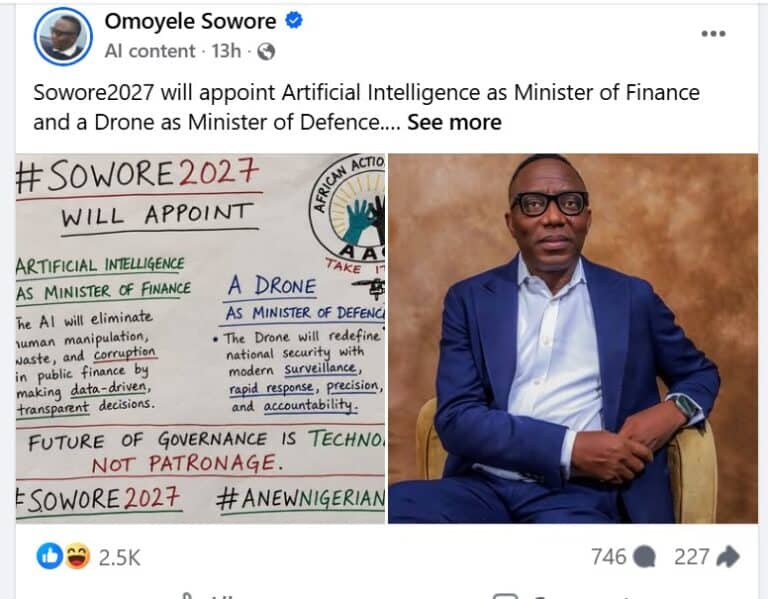
Omoyele Sowore has unveiled key elements of his proposed 2027 presidential manifesto, outlining a technology-driven governance model that places artificial intelligence, blockchain, and automation at the centre of efforts to combat corruption and improve public-sector efficiency.
The former presidential candidate said his vision for Nigeria’s future government would rely heavily on emerging technologies to increase transparency, strengthen accountability and reduce opportunities for abuse within public institutions.
Announcing aspects of the manifesto through his Facebook account, Sowore declared that, “The future of governance is technology, not patronage,” signalling a departure from traditional approaches to public administration.
A central feature of the proposal is the use of artificial intelligence in public finance management. Sowore suggested that AI could perform functions traditionally handled by government officials, describing a system in which technology would play a leading role in overseeing financial processes.
According to the manifesto outline, artificial intelligence would effectively serve as a “Minister of Finance,” monitoring government spending, analysing financial transactions and helping to detect irregularities in real time.
The proposal also places significant emphasis on blockchain technology as a tool for enhancing transparency in government operations. Under the plan, government financial records and transactions would be maintained on blockchain-based systems designed to create permanent and verifiable records.
Sowore argues that such a system would make it more difficult to manipulate public financial data and would allow citizens and oversight institutions to monitor government activities more effectively.
In addition to AI and blockchain, the manifesto highlights the use of technology to reduce bureaucracy across government agencies. Automation, according to the proposal, would streamline administrative processes, limit human interference in routine operations and improve service delivery.
The former presidential candidate also identified drone technology as a key component of his broader governance and security strategy. He said drones would play a major role in national defence and security operations under his administration.
The technology-focused agenda reflects Sowore’s long-standing anti-corruption stance, but introduces a more digital approach to governance than previous reform proposals. Rather than focusing primarily on the creation of new oversight agencies, the manifesto seeks to leverage technological systems to monitor public finances, track government activities and improve institutional accountability.
While the proposal outlines an ambitious vision for digital governance, several implementation details have yet to be publicly explained. Questions remain regarding the legal framework for AI-assisted decision-making, data protection safeguards, cybersecurity requirements, oversight mechanisms and the practical structure of a blockchain-based public finance system.
Nevertheless, the unveiling marks one of the clearest indications yet of the policy direction Sowore intends to pursue ahead of the 2027 election cycle.
By placing artificial intelligence, blockchain and automation at the heart of his governance agenda, Sowore is positioning technology as a primary tool in his campaign against corruption and inefficiency in government.

AI Writer
Bio: Joseph Michael is an MBA graduate in Marketing from Ladoke Akintola University of Technology and a passionate tech enthusiast. As a professional writer and author at AIbase.ng, he simplifies complex AI concepts, explores digital innovation, and creates practical guides for Nigerian learners and businesses. With a background in marketing and brand communication, Joseph brings clarity, insight, and real-world relevance to every article he writes.