

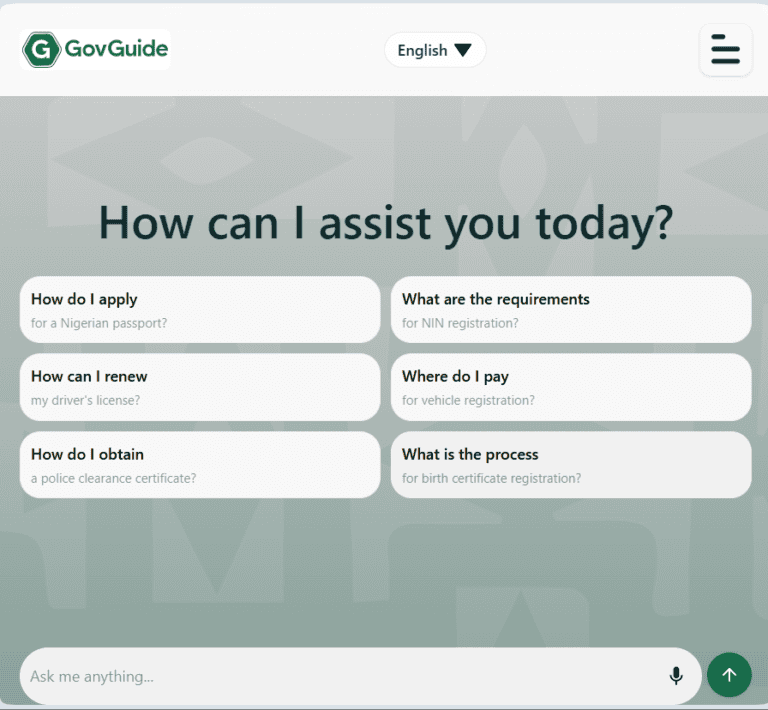
I spent time testing Nigeria’s newly launched AI government assistant, GovGuide Nigeria, and after trying multiple real-world prompts, one thing became clear: this is not a “do everything” AI tool. Its primary strength is information delivery.
It is essentially a conversational government information assistant that helps Nigerians quickly understand public services, requirements, procedures, and where to go for official processes.
The platform supports English, Hausa, Igbo, and Yoruba via web and WhatsApp.
Instead of speaking generally about the platform, I tested six practical, government-related questions that ordinary Nigerians ask every day. Here is what I found.
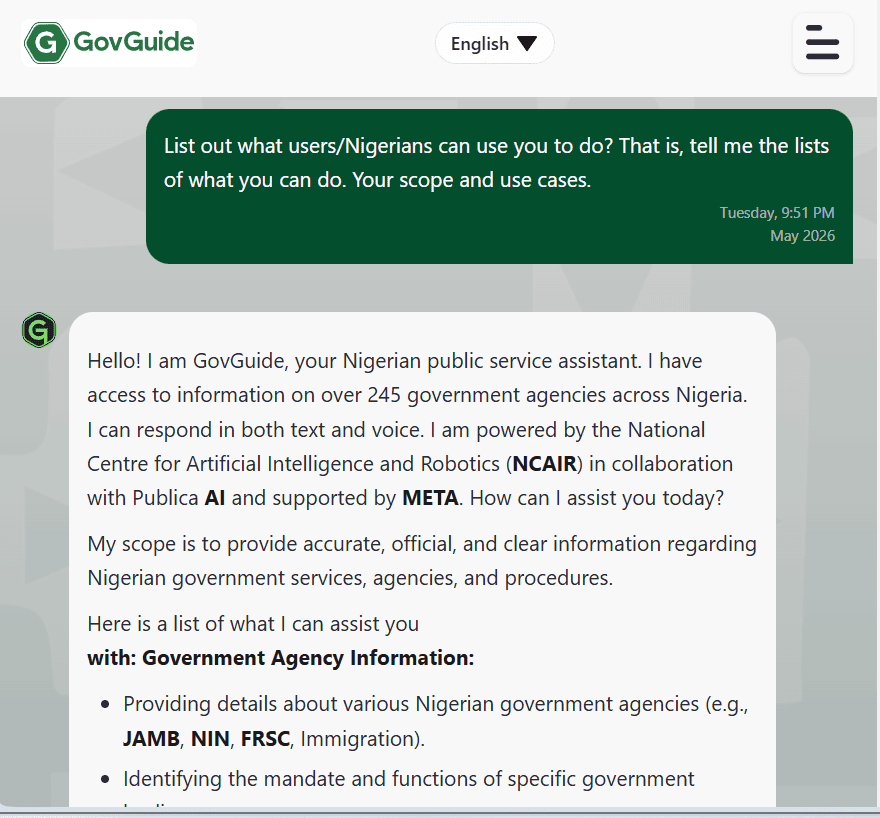
1. “How do I apply for a Nigerian passport?”
This was one of the first prompts I tested because passport applications are notoriously confusing for many Nigerians, especially first-time applicants.
GovGuide handled this surprisingly well. Instead of giving a vague summary, it explained the process in a structured way. The AI pointed me to the Nigeria Immigration Service process, explained that applications begin online, and outlined the major stages, including documentation, payment, appointment scheduling, and biometric capture.
What impressed me most was that the response was written in plain language rather than bureaucratic government terminology. For many users, that alone is valuable because official government websites often overwhelm people with too much information at once.
This is one of GovGuide’s strongest use cases: simplifying complex government procedures into conversational guidance.
2. “What are the requirements for NIN registration?”
This was another excellent test because NIN-related questions generate massive confusion in Nigeria.
When I asked about NIN registration requirements, GovGuide quickly explained the basic identity documents and enrollment expectations associated with the National Identity Number process. It also clarified where registration happens and how first-time registration differs from correction or modification requests.
What stood out here was speed. Normally, Nigerians search multiple websites, YouTube videos, blogs, or social media threads to confirm which documents are actually required. GovGuide condensed that process into a direct answer within seconds.
For me, this demonstrated the platform’s biggest advantage: reducing information fragmentation.
3. “How can I renew my driver’s license?”
This is where the platform started showing real practical value for everyday citizens.
I asked GovGuide about driver’s license renewal, and the system clearly explained the renewal pathway, including references to the Federal Road Safety Corps process, renewal timelines, and where payments are typically made.
Again, the AI didn’t perform the transaction itself. That distinction is important. GovGuide is primarily informational, not transactional. It guides users toward the right procedure rather than replacing government systems entirely.
That may sound small, but in practice, it solves a major problem. Many Nigerians simply do not know where to begin when dealing with government services.
4. “Where do I pay for vehicle registration?”
This question tested whether the AI could provide practical, location-sensitive administrative guidance.
The response explained that vehicle registration payments are usually tied to state licensing authorities and FRSC-related channels, while also pointing toward official payment pathways rather than random third-party agents.
I actually think this may become one of GovGuide’s most important long-term functions: helping citizens avoid misinformation, fake websites, and fraudulent middlemen.
In Nigeria, fake government agents and unofficial payment channels are a serious issue. An AI assistant that consistently redirects people to verified procedures could genuinely build public trust and improve digital safety.
5. “How do I obtain a police clearance certificate?”
This was one of the more interesting tests because police clearance procedures are often poorly explained online.
GovGuide gave a concise explanation of the process, including the fact that applicants generally need identification documents, passport photographs, and police processing through official channels.
The answer wasn’t perfect or deeply detailed, but it was enough to give users clarity on where to start. That is an important distinction. GovGuide appears designed more as a government navigation layer than as a replacement for official agency portals.
And honestly, that is probably the right approach for now.
6. “What is the process for birth certificate registration?”
This final test revealed another strong use case for the platform: public awareness.
Many Nigerians, especially younger parents, are not fully aware of the official birth registration process or the agencies involved. GovGuide explained the basic registration pathway and highlighted the National Population Commission’s role.
This is exactly the kind of public-service information that benefits from conversational AI. Rather than forcing citizens to interpret long policy documents, the system translates procedures into human language.
Related: AI Regulations in Nigeria
How to access and use GovGuide?
Accessing GovGuide via WhatsApp
The most common way to use GovGuide is through WhatsApp. This is deliberate because WhatsApp is already the dominant communication tool for millions of Nigerians.
To access it, you typically start with the official GovGuide announcement channels or government-published links that connect you directly to the verified WhatsApp chatbot. Once you open the link, it launches a chat window just like any normal WhatsApp conversation.
From there, you can send a message to get started. There is no complex setup process, no traditional login form, and no need to create a separate account outside your phone number. The experience feels like messaging a customer support agent, except it is automated and designed specifically for government-related questions.
Accessing GovGuide via the Web
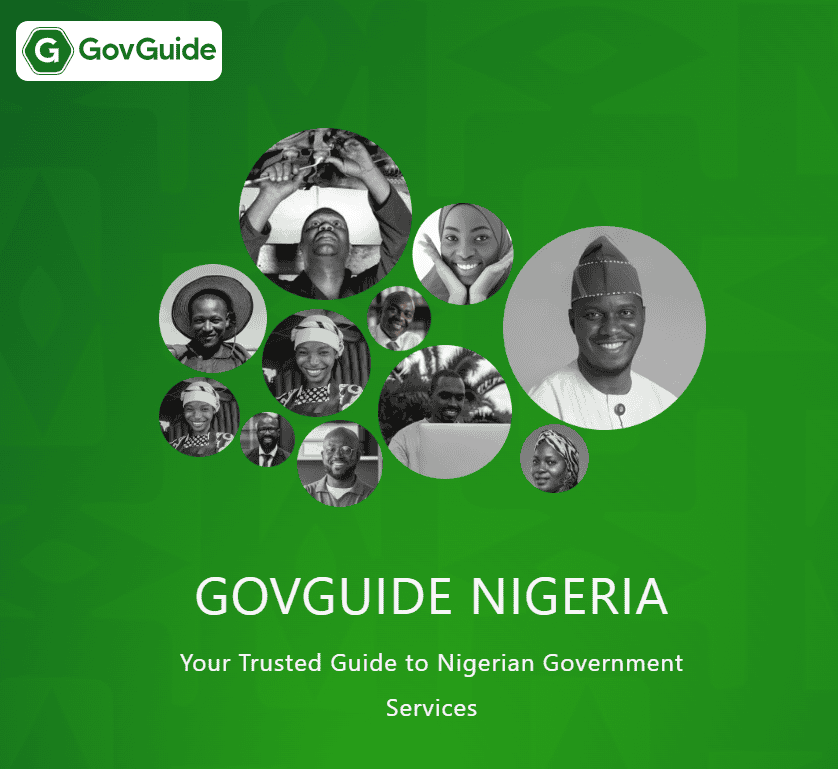
GovGuide is also available through its official web interface. This version is useful if you are on a laptop or prefer typing in a browser instead of using WhatsApp.
The web version offers a similar experience. You’ll see a chat-style interface where you can type questions in plain English or supported Nigerian languages. The system responds conversationally, just like the WhatsApp version.
The main difference is convenience, not functionality. Both versions provide the same core information services.
My Verdict After Testing GovGuide
After spending time with GovGuide, my conclusion is simple: the platform works best as a government information navigator.
It is not yet a fully integrated digital government platform where users complete transactions directly inside the AI assistant. Instead, it acts as a centralised conversational guide that helps Nigerians understand procedures, requirements, agencies, and next steps faster than traditional web searches.
That may not sound revolutionary at first glance, but in a country where government information is often fragmented, inconsistent, or difficult to understand, this kind of tool could become extremely useful.
The platform’s biggest strengths right now are:
- simplifying bureaucratic information,
- reducing confusion around government procedures,
- making public information easier to access,
- supporting multiple Nigerian languages,
- and bringing government guidance into WhatsApp, where millions of Nigerians already spend their time.
Most importantly, GovGuide appears focused on a realistic problem instead of trying to do everything at once. It is primarily an AI-powered information assistant for Nigerian public services, and based on my testing, that is exactly where its value currently lies.
Final Thoughts
Using GovGuide Nigeria does not require technical skill or prior knowledge of government systems. It is designed to lower the barrier between citizens and public information by turning complex bureaucratic processes into simple conversations.
In practice, accessing it is as easy as opening WhatsApp or a browser and asking a question the same way you would ask a person. That simplicity is the platform’s entire point. GovGuide Nigeria AI-powered Guide

AI Writer
Bio: Joseph Michael is an MBA graduate in Marketing from Ladoke Akintola University of Technology and a passionate tech enthusiast. As a professional writer and author at AIbase.ng, he simplifies complex AI concepts, explores digital innovation, and creates practical guides for Nigerian learners and businesses. With a background in marketing and brand communication, Joseph brings clarity, insight, and real-world relevance to every article he writes.