

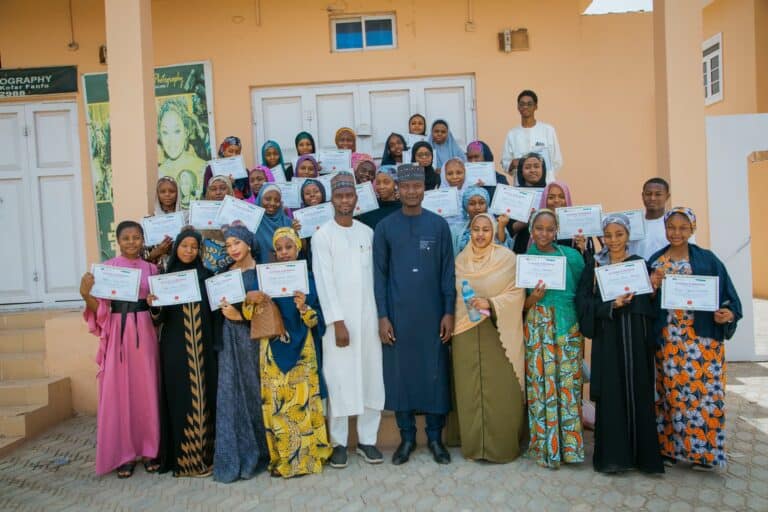
Thirty-five students at Maryam Abacha American University of Nigeria (MAAUN) have completed a media capacity-building programme focused on fact-checking, artificial intelligence (AI) tools in journalism, and solutions journalism, aimed at strengthening digital media literacy and improving information integrity among young reporters.
The training, organised by the Public Relations of Nigeria (PRON), Kano Chapter, in association with the university’s Department of Mass Communication, brought together undergraduate students from media- and communication-related disciplines. It was designed to equip participants with practical skills to identify misinformation, apply AI-driven newsroom tools responsibly, and produce journalism that highlights responses to social challenges.
According to a statement from the programme’s organisers, the initiative is part of a broader effort to prepare students for the evolving demands of modern journalism in the digital age.
“The goal is to ensure that young journalists are not only consumers of information but also responsible gatekeepers who can verify facts and use emerging technologies ethically,” the statement read.
Participants were introduced to verification techniques used in digital investigations, including reverse image searches, metadata analysis, and source triangulation. Facilitators also demonstrated how AI tools can support newsroom workflows, such as summarisation, transcription, and data analysis, while emphasising the risks of over-reliance on automated outputs.
One of the facilitators, quoted in materials shared during the programme, noted that misinformation has become a major challenge in African media ecosystems. “Fact-checking is no longer optional; it is a core journalistic skill. Without it, the credibility of the media collapses,” the facilitator said.
A participant, reflecting on the training experience, said the sessions changed their approach to verifying online content. “Before now, I rarely questioned where information came from. Now I understand how easily false content spreads and how important it is to verify before sharing,” the student said.
The programme also included modules on solutions journalism, encouraging students to move beyond problem-focused reporting and highlight evidence-based responses to social issues such as education gaps, unemployment, and public health challenges.
Organisers said the training aligns with the growing global demand for journalists who can combine traditional reporting skills with digital verification tools and the responsible use of AI, particularly in environments where misinformation spreads rapidly across social media platforms.
Consider Reading:
- 10 Fact‑Checking Tools for AI‑Enhanced Disinformation
- AI in Journalism: Opportunities, Risks, and the Future of Newsrooms
- Safer Media Warns Nigerian Newsrooms on AI Skills Gap

Senior Reporter/Editor
Bio: Ugochukwu is a freelance journalist and Editor at AIbase.ng, with a strong professional focus on investigative reporting. He holds a degree in Mass Communication and brings extensive experience in news gathering, reporting, and editorial writing. With over a decade of active engagement across diverse news outlets, he contributes in-depth analytical, practical, and expository articles exploring artificial intelligence and its real-world impact. His seasoned newsroom experience and well-established information networks provide AIbase.ng with credible, timely, and high-quality coverage of emerging AI developments.