

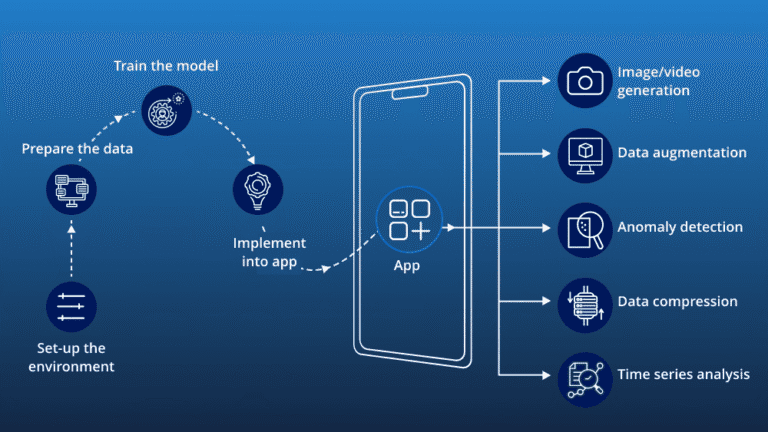
Stable Diffusion is an advanced text-to-image generative AI system that transforms written descriptions into detailed visual outputs. It belongs to a class of models called diffusion models, which generate images by gradually refining random noise into coherent visuals.
It was developed by Stability AI in collaboration with academic researchers from institutions such as LMU Munich and supported by contributions from open-source communities and companies like Runway ML.
What makes it especially important is its open-source nature, which allows developers, artists, and researchers to modify, fine-tune, and deploy it freely, a feature that accelerated its global adoption.
How Stable Diffusion Works
Stable Diffusion uses a latent diffusion process, meaning it does not generate images pixel-by-pixel directly. Instead, it operates on a compressed image representation, making it faster and more efficient.
- Text Encoding (Understanding the Prompt)
When you type a prompt like “a futuristic city at sunset”, the model first converts your words into mathematical representations called embeddings.
This is done using a language-image model such as CLIP.
These embeddings help the AI understand:
- Objects in the scene (city, buildings)
- Style (futuristic)
- Lighting (sunset)
- Mood and composition
Without this step, the model would not understand human language meaningfully.
- Forward Diffusion (Learning Noise Patterns)
During training, real images are gradually corrupted with noise until they become pure static.
This process teaches the model how images break down when information is lost.
Think of it like:
- A clear image → slightly blurry → heavily distorted → complete noise
This helps the AI learn what “image structure” looks like at every stage of degradation.
- Reverse Diffusion (Image Generation Process)
When generating an image, the process is reversed:
- The model starts with pure random noise
- It repeatedly removes noise step-by-step
- Each step is guided by your text prompt
Over many iterations, a meaningful image emerges from randomness, like sculpting a statue from a block of marble.
- Latent Space Processing (Efficiency Layer)
Instead of working with full-resolution images, Stable Diffusion operates in a latent space, which is a compressed version of image data.
This means:
- Less memory usage
- Faster generation
- Ability to run on consumer GPUs
A separate decoder later converts this latent representation into a high-quality image.
Key Features of Stable Diffusion
- Open Source Flexibility
Unlike closed systems like DALL·E, Stable Diffusion’s code is publicly available.
This allows developers to:
- Modify the architecture
- Train custom models
- Build commercial applications
- Integrate into creative pipelines
This openness has created a massive ecosystem of plugins, forks, and improved versions.
- Local Deployment Capability
Stable Diffusion can run directly on personal hardware instead of requiring cloud servers.
This means:
- No subscription dependency
- Offline usage possible
- Full control over generated data
However, performance depends on GPU power—modern NVIDIA GPUs are typically preferred.
- Deep Customisation (LoRA, Fine-Tuning, Embeddings)
Users can personalise outputs using:
- LoRA models (lightweight fine-tuning for styles or characters)
- Custom embeddings (specific concepts or faces)
- Full model fine-tuning for domain-specific tasks
This enables:
- Consistent character generation
- Brand-specific visuals
- Unique artistic styles
- Multi-Modal Image Capabilities
Stable Diffusion supports several image manipulation modes:
- Text-to-image: Generate visuals from prompts
- Image-to-image: Transform existing images while preserving structure
- Inpainting: Edit specific parts of an image (e.g., change a face or object)
- Outpainting: Expand images beyond original boundaries
This makes it a complete creative toolkit, not just a generator.
- Ecosystem and Tooling Support
The model is widely integrated into user-friendly interfaces such as AUTOMATIC1111 Web UI, ComfyUI, and various mobile apps.
These tools provide:
- Prompt builders
- Workflow automation
- Plugin support
- Advanced control over generation parameters
Use Cases of Stable Diffusion
- Digital Art & Illustration
Artists use Stable Diffusion to:
- Generate concept sketches instantly
- Explore multiple art styles quickly
- Build character sheets and environments
It reduces the time from idea to visual prototype from hours to seconds.
- Marketing & Advertising
Businesses use it to:
- Create social media visuals
- Design ad creatives at scale
- Test multiple campaign variations quickly
This reduces reliance on stock images and external designers for early-stage ideas.
- Game Development
Game studios use it for:
- Concept art for characters and environments
- Texture generation for 3D models
- Rapid iteration of visual themes
It significantly speeds up early development phases.
- Film Production & Storyboarding
Filmmakers use Stable Diffusion to:
- Visualise scenes before shooting
- Build storyboards quickly
- Experiment with cinematography styles
This helps directors communicate ideas more clearly to production teams.
- E-commerce & Product Design
Companies use it to:
- Generate product mockups
- Visualize packaging designs
- Create lifestyle images without photoshoots
This reduces production costs and speeds up marketing cycles.
- Education & Research
Educators and researchers use it for:
- Teaching AI concepts visually
- Exploring generative design
- Conducting experiments in machine learning creativity
It serves as a practical example of diffusion-based AI systems.
Benefits of Stable Diffusion
- Cost Efficiency
Because it can run locally:
- No per-image API fees
- No cloud dependency
- Scales are cheaply priced for heavy usage
This makes it attractive for startups and independent creators.
- High-Speed Generation
With optimised hardware:
- Images can be generated in seconds
- Batch generation is possible
- Real-time creative workflows become feasible
This enables rapid ideation cycles.
- Creative Freedom
Users are not restricted to preset styles or templates:
- Infinite prompt combinations
- Style blending
- Experimental art generation
This makes it a powerful tool for creativity exploration.
- Privacy and Data Control
Since it can run offline:
- Prompts and images stay local
- No need to upload sensitive content
- Useful for private or commercial work
This is important for enterprises and confidential projects.
- Community-Driven Innovation
The open-source ecosystem means:
- Constant model improvements
- New fine-tuned versions are released regularly
- Thousands of community-built tools and workflows
This keeps the technology evolving rapidly.
Limitations to Consider (Expanded)
- Prompt Sensitivity: Small wording changes can drastically alter outputs
- Hardware Requirements: High-quality generation still benefits from strong GPUs
- Ethical Risks: Potential misuse for deepfakes or misinformation
- Bias Issues: Outputs can reflect biases present in training datasets
- Consistency Challenges: Maintaining the same character across multiple images can require advanced tuning
Final Thoughts
Stable Diffusion has fundamentally changed how visual content is created. By combining open-source accessibility with powerful generative capabilities, it bridges the gap between professional-grade image production and everyday creativity. It is not just a tool-it is a network that continues to reshape design, media, and digital creativity across industries.

Senior Reporter/Editor
Bio: Ugochukwu is a freelance journalist and Editor at AIbase.ng, with a strong professional focus on investigative reporting. He holds a degree in Mass Communication and brings extensive experience in news gathering, reporting, and editorial writing. With over a decade of active engagement across diverse news outlets, he contributes in-depth analytical, practical, and expository articles exploring artificial intelligence and its real-world impact. His seasoned newsroom experience and well-established information networks provide AIbase.ng with credible, timely, and high-quality coverage of emerging AI developments.