


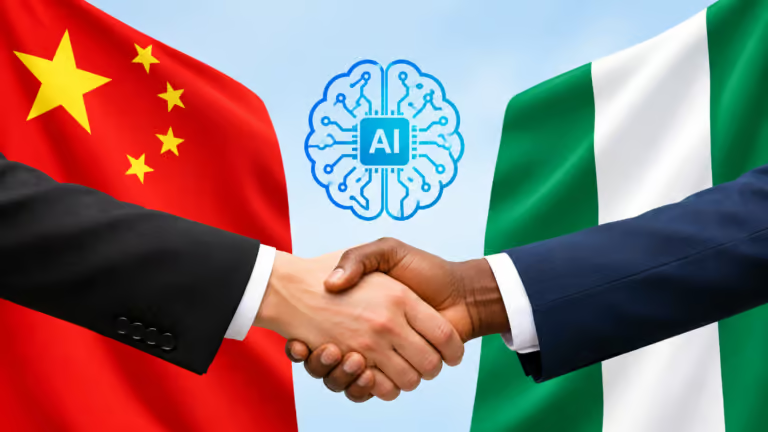
China has invited Nigeria to join a global artificial intelligence cooperation platform as bilateral trade between the two countries rose 35 per cent to $18 billion in the first half of 2026.
Chinese Ambassador to Nigeria Yu Dunhai made the proposal in Abuja on Wednesday at a reception marking the anniversary of the founding of the People’s Republic of China.
Yu said China was prepared to deepen cooperation with Nigeria beyond infrastructure and conventional trade, with artificial intelligence, industrialisation and emerging technologies identified as areas with potential for expanded collaboration.
He specifically invited Nigeria to join the World Artificial Intelligence Cooperation Organisation (WAICO), saying membership could provide opportunities for international technological cooperation.
The proposal follows discussions between Nigerian and Chinese officials in August, when the Federal Ministry of Foreign Affairs said Yu had encouraged Nigeria to consider membership of the Global Artificial Intelligence Organisation. The ministry said participation could support AI research, training, capacity building and the establishment of AI laboratories in Nigeria.
Related:
China Urges Nigeria to Join Global AI Body, Expand Role in AI Governance
Humanoid Robots Set New Benchmarks At Beijing Half-Marathon
Customs Boss Advocates Adoption of AI-Driven Systems
According to Yu, bilateral trade reached $18 billion during the first half of 2026, representing a 35 per cent year-on-year increase. Chinese imports from Nigeria also rose sharply, reaching $2.3 billion, according to figures published by the Chinese Embassy.
Yu also highlighted China’s zero-tariff treatment for 53 African countries as an opportunity for African producers seeking greater access to the Chinese market.
He said Chinese imports from Africa increased by 24 per cent in May and June, while Nigeria’s exports to China recorded significant growth during the period.
The ambassador linked the expanding economic relationship to opportunities for deeper cooperation in technology and industrial development.
China has been promoting WAICO as a mechanism for international cooperation on artificial intelligence. Twenty-nine countries signed an agreement in July to establish the organisation, with its headquarters planned for Shanghai.
The proposed AI cooperation adds to an already broad Nigeria-China partnership covering infrastructure, energy, transport, healthcare and technical development.
Nigeria’s Director-General of the Nigeria-China Comprehensive Strategic Partnership and Minister of Power, Joseph Tegbe, cited the Lekki Deep Sea Port, railway modernisation and the Zungeru Hydroelectric Power Station as examples of Chinese involvement in major Nigerian projects.
The Federal Ministry of Foreign Affairs has also identified digital technology and artificial intelligence among areas where Nigeria and China intend to deepen cooperation.
China has separately announced plans to provide developing countries with 5,000 opportunities for AI training and seminar programmes over the next five years, while promoting international AI application cooperation centres with regional and multilateral organisations.
For Nigeria, the proposed participation in the global AI cooperation platform could therefore extend the existing bilateral relationship into areas including AI research, skills development, technology capacity and infrastructure.
The development comes as Nigeria seeks to expand its own artificial intelligence ecosystem and strengthen its capacity to participate in the global AI economy. The Federal Ministry of Foreign Affairs said in August that Nigerian authorities would follow up on the proposed participation and assess its potential contribution to the country’s technological development.
With bilateral trade reaching $18 billion in the first half of 2026, the invitation signals that artificial intelligence is becoming an increasingly prominent part of Nigeria-China cooperation, alongside established areas such as infrastructure, energy and trade.

Lawrence Orjime is an AI and technology writer at AIBase.ng, covering the latest developments in artificial intelligence, emerging technologies, and the companies shaping the future of AI.
With a background in content strategy, SEO, and digital media, Lawrence Orjime combines technology reporting with a strong understanding of what makes information useful and easy to find online.