

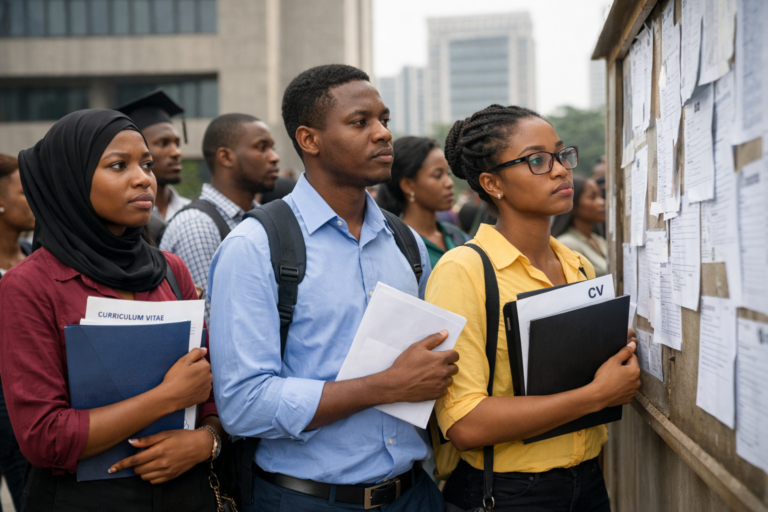
As artificial intelligence reshapes workplaces worldwide, many Nigerian graduates worry that machines will take their jobs. But experts say the AI era may offer as many opportunities as challenges for young professionals willing to adapt
Growing Anxiety Over AI and Jobs
Roles that once served as stepping stones for fresh graduates-administrative support, content creation, customer service, and data processing-are increasingly being assisted or replaced by AI. For a country grappling with high unemployment and underemployment, this shift has intensified concerns about career prospects.
New Career Pathways Emerging
- Data Annotation and AI Training: Helping label and organise data to train AI systems; an entry-level opportunity requiring minimal programming knowledge.
- Prompt Engineering: Crafting precise prompts to guide AI outputs in research, content creation, and business insights.
- AI-Assisted Marketing and Content Strategy: Using AI to analyse consumer behaviour, personalise campaigns, and enhance creative output.
- AI Product Development and Management: Integrating AI into products and services, bridging technical teams and business strategy.
- Data Analysis and Decision Support: Extracting insights from AI-generated data to inform decision-making in sectors such as finance, healthcare, and logistics.
- AI Governance and Ethics: Ensuring responsible AI use, regulatory compliance, and bias mitigation, requiring expertise in law, social sciences, or policy.
These pathways illustrate that AI is not just replacing jobs-it is transforming roles and creating entirely new opportunities for graduates equipped with the right skills.
Read Also:
- 8 Essential AI Skills Nigerians Need to Launch a Career in AI
- 6 Safest Jobs From AI, According to Anthropic
Nigeria’s Growing AI Ecosystem
Tech hubs, incubators, and research communities in Lagos, Abuja, and Ibadan are exploring AI applications in healthcare, fintech, agriculture, logistics, and language processing. Startups are attracting investment while creating demand for professionals in research, product development, and data management.
Global tech firms and local training initiatives are also expanding AI education programs, helping students and early-career professionals develop skills that increase employability in the global AI economy.
Challenges Remain
- Job Displacement: Automation threatens routine entry-level roles.
- Skills Gap: Many graduates lack the technical knowledge to work effectively with AI.
- Unequal Access to Training: Students outside urban centres or without financial resources may be left behind.
- Regulatory Uncertainty: Limited ethical and legal frameworks add complexity to AI adoption.
Government and Policy Interventions
Policymakers play a key role in preparing graduates for the AI era:
- Integrating AI literacy, digital skills, and data analysis into curricula.
- Expanding access to AI training and supporting young innovators.
- Establishing ethical and regulatory frameworks for responsible AI use.
- Fostering public-private partnerships to strengthen Nigeria’s AI ecosystem.
AI Literacy and Upskilling
AI literacy is becoming a core competency across sectors like journalism, law, finance, marketing, and healthcare. Graduates who can work alongside AI to automate tasks, improve productivity, and generate insights will have a distinct advantage. Short courses, practical experiences, and continuous learning are essential to staying competitive.
Humans and AI: Collaboration Over Competition
While AI will reshape industries, human skills-creativity, emotional intelligence, ethical reasoning, and complex problem-solving-remain irreplaceable. Graduates who embrace AI and develop complementary skills can transform potential disruption into opportunity.
The AI era in Nigeria is not all doom and gloom; for adaptable and skilled graduates, it opens doors to new careers, innovation, and professional growth.

Senior Reporter/Editor
Bio: Ugochukwu is a freelance journalist and Editor at AIbase.ng, with a strong professional focus on investigative reporting. He holds a degree in Mass Communication and brings extensive experience in news gathering, reporting, and editorial writing. With over a decade of active engagement across diverse news outlets, he contributes in-depth analytical, practical, and expository articles exploring artificial intelligence and its real-world impact. His seasoned newsroom experience and well-established information networks provide AIbase.ng with credible, timely, and high-quality coverage of emerging AI developments.