

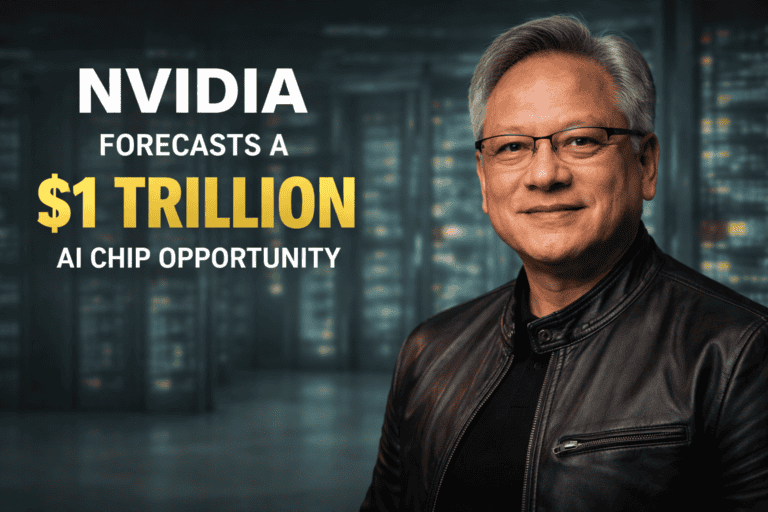
NVIDIA has projected that the global market for artificial intelligence (AI) chips could reach a staggering $1 trillion, underscoring the scale and speed of AI adoption, transforming the global technology landscape.
The forecast, delivered by NVIDIA executives during recent investor briefings and industry discussions, highlights a surge in demand for high-performance computing infrastructure, particularly in data centres that power generative AI models, large language models (LLMs), and advanced machine learning systems.
Explosive Growth in AI Infrastructure
At the centre of NVIDIA’s projection is the rapid expansion of AI-driven workloads. From enterprise automation to consumer-facing AI tools, organisations are increasingly investing in specialised chips capable of handling complex computations at scale.
NVIDIA’s Graphics Processing Units (GPUs), particularly its latest AI-focused architectures, have become the backbone of modern AI infrastructure. These chips are widely used by major technology firms, cloud providers, and research institutions to train and deploy sophisticated AI systems.
According to the company, the transition from traditional computing to accelerated computing — where GPUs and AI accelerators replace conventional CPUs for demanding tasks — is driving unprecedented capital expenditure across the tech industry.
Data Centres Leading the Surge
A significant portion of the projected $1 trillion opportunity lies within data centre transformation. Hyperscalers such as Amazon Web Services, Microsoft Azure, and Google Cloud are investing heavily in AI-ready infrastructure to meet growing demand from enterprises and developers.
NVIDIA estimates that global data centres will undergo a fundamental shift towards AI-centric architectures over the coming decade. This includes upgrades to networking, memory, and energy systems to support increasingly powerful AI models.
The company’s AI chips, including its flagship H100 and next-generation platforms, are already in high demand, with supply constrained by overwhelming orders.
Generative AI Driving Demand
The rise of generative AI, including tools capable of producing text, images, video, and code, has significantly accelerated the need for advanced semiconductors. Businesses across industries are integrating AI into their operations, from customer service automation to drug discovery and financial modelling.
NVIDIA’s leadership emphasised that generative AI represents just the beginning of a broader shift towards AI-native computing, where intelligent systems are embedded across all digital services.
Competitive Landscape Intensifies
While NVIDIA currently dominates the AI chip market, competition is intensifying. Companies such as AMD, Intel, and several emerging AI chip startups are developing alternative solutions to capture a share of the rapidly expanding market.
In addition, major cloud providers are investing in custom silicon, seeking to reduce reliance on third-party chipmakers and optimise performance for their own AI workloads.
Despite this, NVIDIA maintains a strong competitive edge through its integrated ecosystem, including the CUDA software platform, which has become a standard for AI development.
Economic and Industry Implications
A $1 trillion AI chip market would represent one of the largest technology shifts in modern history, with far-reaching implications for global supply chains, energy consumption, and workforce dynamics.
Industry analysts note that such growth could reshape semiconductor manufacturing priorities, accelerate geopolitical competition over chip production, and intensify investments in advanced fabrication facilities.
Looking Ahead
NVIDIA’s forecast signals a clear message: AI is no longer an emerging trend but a foundational technology driving the next era of computing. As businesses, governments, and institutions race to adopt AI capabilities, the demand for powerful, efficient, and scalable chips is expected to continue rising sharply.
If realised, the $1 trillion AI chip opportunity would not only cement NVIDIA’s position at the forefront of the AI revolution but also redefine the future of the global technology economy.

Bio: An (HND, BA, MBA, MSc) is a tech-savvy digital marketing professional, writing on artificial intelligence, digital tools, and emerging technologies. He holds an HND in Marketing, is a Chartered Marketer, earned an MBA in Marketing Management from LAUTECH, a BA in Marketing Management and Web Technologies from York St John University, and an MSc in Social Business and Marketing Management from the University of Salford, Manchester.
He has professional experience across sales, hospitality, healthcare, digital marketing, and business development, and has worked with Sheraton Hotels, A24 Group, and Kendal Nutricare. A skilled editor and web designer, He focuses on simplifying complex technologies and highlighting AI-driven opportunities for businesses and professionals.
LinkedIn