

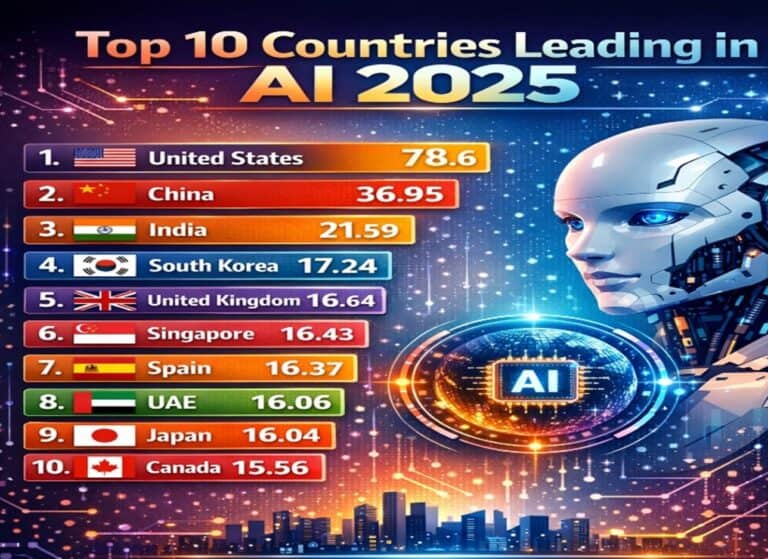
The United States has emerged as the world’s leading country in artificial intelligence in 2025, according to data from Stanford University’s Global AI Vibrancy Tool. The latest assessment places the U.S. firmly at the top of global AI rankings, reflecting its continued dominance across research, innovation, investment, talent, and technological deployment.
With an overall AI vibrancy score of 78.6, the United States significantly outperforms all other nations, underscoring its role as the central hub of global AI development. Stanford’s Global AI Vibrancy Tool evaluates countries using a comprehensive set of indicators that measure the strength and maturity of national AI ecosystems, including academic research output, private investment, startup activity, computing infrastructure, and policy environment.
China ranks second with a score of 36.95, maintaining a strong position driven by large-scale government support and rapid industrial adoption of AI technologies. India follows in third place with 21.59, highlighting its growing influence fueled by a vast talent pool, expanding digital economy, and increased AI research activity.
Other leading countries include South Korea (17.24), the United Kingdom (16.64), Singapore (16.43), and Spain (16.37), each demonstrating competitive strengths in innovation, regulation, and AI integration across sectors. The United Arab Emirates (16.06) and Japan (16.04) also feature prominently, reflecting strategic national investments in AI infrastructure and governance. Canada (15.56) completes the top ten, supported by its strong academic research base and long-standing commitment to AI development.
Stanford University’s findings highlight a widening gap between the United States and other nations, particularly in terms of private-sector investment, advanced AI research, and commercialisation. The report also emphasises that while several countries are rapidly improving their AI capabilities, sustained leadership requires long-term investment, skilled talent, and supportive policy frameworks.
Consider reading:
- Artificial Intelligence in Nigerian Agriculture
- How is AI transforming Nigeria’s creator economy
- Google Veo 3 AI Video Creation for Nigerian Content Creators
- Artificial Intelligence in Africa
Global AI Vibrancy Rankings (2025) – Regional Grouping according to Stanford University Report
| Rank | Country | Region | AI Vibrancy Score |
| 1 | 🇺🇸 United States | North America | 78.60 |
| 2 | 🇨🇳 China | East Asia | 36.95 |
| 3 | 🇮🇳 India | South Asia | 21.59 |
| 4 | 🇰🇷 South Korea | East Asia | 17.24 |
| 5 | 🇬🇧 United Kingdom | Europe | 16.64 |
| 6 | 🇸🇬 Singapore | Southeast Asia | 16.43 |
| 7 | 🇪🇸 Spain | Europe | 16.37 |
| 8 | 🇦🇪 United Arab Emirates | Middle East | 16.06 |
| 9 | 🇯🇵 Japan | East Asia | 16.04 |
| 10 | 🇨🇦 Canada | North America | 15.56 |
| 11 | 🇨🇭 Switzerland | Europe | 14.86 |
| 12 | 🇱🇺 Luxembourg | Europe | 14.73 |
| 13 | 🇫🇷 France | Europe | 14.63 |
| 14 | 🇮🇱 Israel | Middle East | 14.26 |
| 15 | 🇩🇪 Germany | Europe | 13.15 |
| 16 | 🇧🇷 Brazil | Latin America | 12.74 |
| 17 | 🇮🇪 Ireland | Europe | 12.49 |
| 18 | 🇫🇮 Finland | Europe | 12.27 |
| 19 | 🇸🇦 Saudi Arabia | Middle East | 12.10 |
| 20 | 🇵🇹 Portugal | Europe | 12.07 |
| 21 | 🇩🇰 Denmark | Europe | 11.97 |
| 22 | 🇳🇱 Netherlands | Europe | 11.58 |
| 23 | 🇧🇪 Belgium | Europe | 11.36 |
| 24 | 🇦🇺 Australia | Oceania | 11.21 |
| 25 | 🇸🇪 Sweden | Europe | 11.11 |
| 26 | 🇲🇾 Malaysia | Southeast Asia | 11.05 |
| 27 | 🇮🇹 Italy | Europe | 10.68 |
| 28 | 🇷🇺 Russia | Eastern Europe / Eurasia | 10.67 |
| 29 | 🇦🇹 Austria | Europe | 10.62 |
| 30 | 🇳🇴 Norway | Europe | 10.19 |
As artificial intelligence continues to shape global economic growth, national security, and technological competitiveness, the 2025 rankings reinforce the United States’ position at the forefront of the AI revolution.
U.S. Tops Global AI Rankings in 2025

AI Writer
Bio: Joseph Michael is an MBA graduate in Marketing from Ladoke Akintola University of Technology and a passionate tech enthusiast. As a professional writer and author at AIbase.ng, he simplifies complex AI concepts, explores digital innovation, and creates practical guides for Nigerian learners and businesses. With a background in marketing and brand communication, Joseph brings clarity, insight, and real-world relevance to every article he writes.