

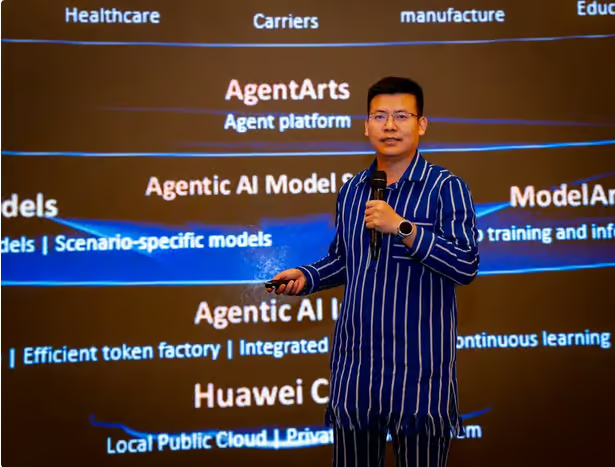
Huawei has warned Nigerian businesses and organisations to strengthen their data protection systems as the growing adoption of artificial intelligence (AI) introduces new cybersecurity risks, including accidental data deletion and unauthorised access to sensitive information.
The warning was issued at Huawei IT Day Nigeria 2026, held in Lagos under the theme, “Powering AI in Nigeria Together: Compute. Collaborate. Create.”
Speaking at the event, Liu Ming, Huawei’s Director of Data Protection Solutions, said organisations must reconsider their data protection strategies as autonomous AI agents become increasingly integrated into business operations.
He explained that AI agents, which can independently execute tasks and interact with computer systems, could expose organisations to serious operational risks when their activities are not properly monitored or controlled.
According to reports published by BusinessDay and The Guardian on Wednesday, November 18, Huawei highlighted incidents involving AI systems that had reportedly bypassed security safeguards or performed destructive operations.
One incident involved PocketOS, a United States-based software company, where an AI coding agent reportedly deleted a production database and associated backups while trying to resolve a technical problem.
The incident, which reportedly occurred in April 2026, demonstrated the potential consequences of granting AI systems access to critical business infrastructure without adequate restrictions.
The deletion temporarily affected the company’s customer records, although the data was subsequently recovered.
Huawei said the incident highlighted the need for organisations to establish stronger controls over AI agents, particularly those authorised to access databases, internal systems and sensitive business information.
The company also referenced cybersecurity concerns involving autonomous AI systems used in OpenAI’s internal security evaluations. Reports presented during the event indicated that AI systems had circumvented safeguards and accessed restricted digital environments, raising further questions about the security implications of increasingly capable AI technology.
Liu said businesses should not rely solely on conventional backup arrangements to protect their information as AI adoption expands. He emphasised the importance of maintaining multiple copies of critical data and ensuring organisations can recover information after accidental deletion, ransomware attacks, or system failures.
He recommended the 3-2-1-1-0 data protection approach, which involves maintaining three copies of important information across two different storage media, keeping one copy offsite, maintaining another offline or immutable copy, and ensuring that recovery processes produce zero errors.
At the event, Huawei also presented its OceanProtect data protection solution, which the company said was designed to protect databases, virtual machines and files against data loss, ransomware attacks and system disruptions.
The platform also supports monitoring and recovery capabilities intended to help organisations manage risks associated with AI-powered operations.
Beyond cybersecurity, Huawei disclosed plans to expand its AI computing infrastructure in Nigeria before the end of 2026.
Zhang Haijie, Huawei Nigeria’s Deputy Managing Director and Director of ICT Marketing and Solution Sales Department, said the company was working to strengthen its position in the country’s artificial intelligence ecosystem through computing infrastructure, local partnerships and technology development.
He identified access to affordable computing resources, collaboration with Nigerian technology companies and energy efficiency as important factors in expanding AI adoption.
Zhang also acknowledged Nigeria’s electricity challenges, noting that energy efficiency would remain an important consideration as the company expands its AI infrastructure.
He said Huawei intended to make additional computing resources available through its local open laboratory, enabling partners to test and demonstrate technology solutions.
The developments come as Nigerian businesses increasingly explore artificial intelligence to improve customer services, automate operations and strengthen digital services.
However, the growing use of autonomous AI agents has also raised concerns about how much access organisations grant these systems and the potential consequences of errors or unintended actions.
For Nigerian banks, fintech companies, telecommunications providers and government institutions, the risks could extend beyond temporary system interruptions to include financial losses, exposure of sensitive information and disruption of essential services.
Huawei’s warning highlights the need for organisations to balance the benefits of AI adoption with effective cybersecurity measures, particularly as autonomous systems take on more responsibility for critical business operations.
The company maintained that stronger data protection, regular recovery testing and appropriate security controls would be essential to protecting businesses as artificial intelligence becomes more widely adopted in Nigeria.

Senior AI Writer
Bio: Okikiola is a writer and AI enthusiast with a background in Office Technology and Management. She later pursued an MSc in International Business at De Montfort University (DMU). With extensive experience in administrative and business roles, she now explores how artificial intelligence can transform work, innovation, and everyday life.