


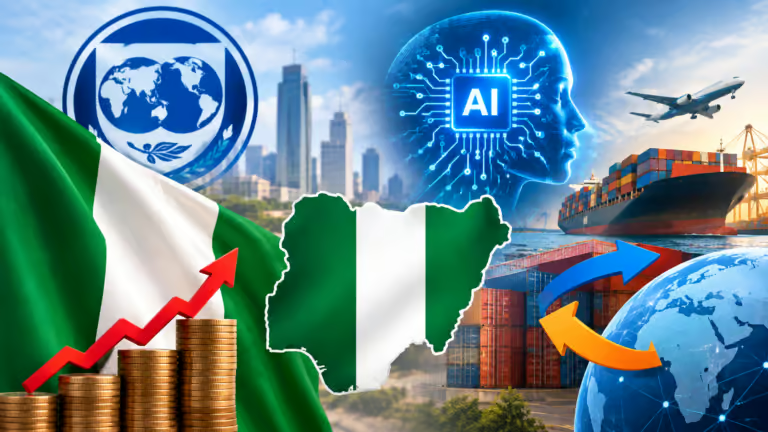
The International Monetary Fund’s 2026 Annual Report has identified rising public debt, rapid artificial intelligence investment and shifts in global trade as major forces reshaping the world economy, with implications for Nigeria as it navigates a changing global environment.
The report, titled “Navigating a Precarious World”, says the global economy has shown resilience despite geopolitical tensions, supply-chain disruptions and major changes in international trade. However, it warns that growing fiscal pressures, technological disruption and trade fragmentation are creating new risks for governments and businesses.
For Nigeria, the IMF’s concerns come as the country continues to manage high financing costs and significant debt-servicing pressures. In its June 2026 Article IV assessment, the IMF estimated Nigeria’s consolidated government deficit at 4.4 per cent of GDP in 2025, while Federal Government interest payments were equivalent to 53.2 per cent of revenue in 2025.
The IMF also projected Nigeria’s economic growth at 4.1 per cent for 2026, while warning that higher global food and fuel prices could increase inflationary pressures and worsen existing economic difficulties for households.
Related:
IMF: AI Could Boost Sub-Saharan Africa’s GDP by Up to 4%
IMF Warns Global South Lags in AI Readiness
China Invites Nigeria to AI Cooperation Body as Trade Climbs 35%
Globally, the IMF said public debt was already on track to reach levels comparable with the period around the Second World War by 2028, even before the latest geopolitical and energy shocks. Rising interest payments are putting additional pressure on government budgets and limiting the resources available for infrastructure, education and other priorities.
The IMF 2026 report also places AI at the centre of the changing economic landscape. It said private-sector investment in AI could exceed $2 trillion globally in 2026, making the technology one of the fastest-growing drivers of investment and economic activity. In the United States, technology investment related to AI contributed an estimated 0.5 percentage point to GDP growth in 2025.
However, the IMF warned that the AI boom carries financial and labour-market risks. Heavy investment in AI infrastructure, particularly where projects are increasingly financed through debt, could create problems if expected returns fail to materialise. The Fund said a sharp reversal in valuations could result in wealth losses and layoffs, while interconnected financing arrangements among technology companies could amplify financial stress.
The impact on employment is another concern. According to the IMF, AI could increase productivity across industries but may also displace some workers and put pressure on wages in certain occupations. Its research indicates that workers with AI-related skills can benefit from higher wages, while middle-skilled workers whose roles are more exposed to automation could face greater disruption.
For Nigeria, the development presents both an opportunity and a risk. Greater adoption of AI could support productivity and create new economic activity, but the country’s ability to benefit will depend partly on digital infrastructure, skills development, investment and policy capacity.
The IMF said countries can strengthen their ability to benefit from AI by investing in digital infrastructure and education while helping workers develop new skills. It also warned governments to account for the potential financial and fiscal consequences of an AI investment downturn, particularly in countries already facing high debt levels.
The report also highlighted changes in global trade. Geopolitical tensions, shifting trade relationships and supply-chain disruptions are prompting countries to diversify their trading partners and sources of supply. The IMF said trade volumes increased by nearly 5 per cent in 2025, helped by continued growth in technology-related goods, but warned that trade growth is expected to slow in 2026.
These shifts could affect Nigeria through changes in commodity prices, foreign investment, supply chains and demand for Nigerian exports. The IMF’s June assessment said Nigeria’s outlook remained exposed to the uncertain global environment, particularly developments affecting fuel and food prices.
The IMF 2026 report therefore presents AI alongside debt and trade restructuring as part of a broader transformation of the global economy. For Nigeria, the combination of fiscal pressures, technological change and an increasingly fragmented trading environment creates both opportunities for growth and additional risks that policymakers will need to manage.

Lawrence Orjime is an AI and technology writer at AIBase.ng, covering the latest developments in artificial intelligence, emerging technologies, and the companies shaping the future of AI.
With a background in content strategy, SEO, and digital media, Lawrence Orjime combines technology reporting with a strong understanding of what makes information useful and easy to find online.