

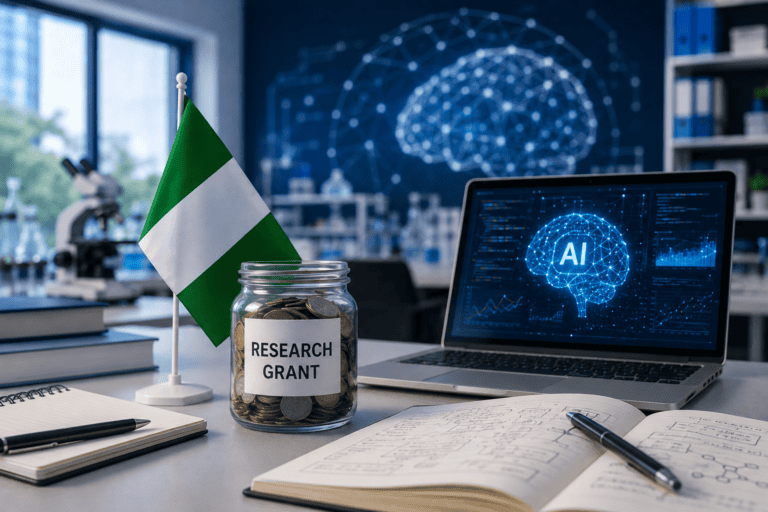
Believe it or not, artificial intelligence (AI) is increasingly a key driver of innovation, economic growth, and scientific research worldwide. In Nigeria, interest in AI has grown rapidly as universities, research institutes, startups, and technology companies explore how the technology can solve challenges in healthcare, agriculture, education, financial services, manufacturing, and public administration.
However, turning innovative AI ideas into practical solutions requires funding. Research grants play a vital role in helping researchers develop new technologies, conduct experiments, build datasets, publish findings, and commercialise innovations.
If you are looking for AI research funding in Nigeria, this guide explains the major grant opportunities currently available, who can apply, how the application process typically works, and practical tips for submitting a competitive proposal.
What Are AI Research Grants?
AI research grants are financial awards provided by governments, educational institutions, international organisations, foundations, or private companies to support research involving artificial intelligence.
Unlike loans, grants generally do not require repayment, provided recipients comply with the funding conditions and complete their approved projects.
Funding may cover:
- Research activities
- Software development
- Computing resources
- Data collection
- Equipment
- Research assistants
- Conferences and dissemination
- Prototype development
- Collaboration between universities and industry
Some grants support basic scientific research, while others focus on solving real-world problems through AI applications.
Why AI Research Funding Matters in Nigeria
Nigeria has one of Africa’s largest technology ecosystems and a growing pool of AI researchers, software developers, academics, and entrepreneurs. Despite this potential, access to research funding remains one of the biggest barriers to innovation.
Research grants help to:
- Encourage cutting-edge research
- Build local AI expertise
- Promote collaboration between academia and industry
- Develop solutions to national challenges
- Support commercialisation of research
- Strengthen Nigeria’s digital economy
- Improve the country’s global research competitiveness
As Nigeria continues implementing its digital transformation agenda, AI research funding is expected to become increasingly important.
Major AI Research Grant Opportunities in Nigeria
Although Nigeria does not yet have many AI-specific grant programmes, researchers can access funding through broader science, technology, engineering, innovation, and digital economy initiatives.
1. NITDA Artificial Intelligence Research Scheme
One of Nigeria’s first dedicated AI funding initiatives was introduced by the National Information Technology Development Agency (NITDA) under the Federal Ministry responsible for digital innovation.
The Artificial Intelligence Application Research Grant Scheme was designed to support collaborative AI research involving academia, startups, and industry.
The scheme aimed to:
- Accelerate AI research and development
- Encourage collaboration between researchers and technology companies
- Support practical AI applications
- Strengthen Nigeria’s AI ecosystem
Under the initial programme, successful applicants could receive grants of up to ₦5 million per project. Eligible applications generally required a consortium involving a Nigerian academic researcher and a local startup or technology company, with international collaborators encouraged where appropriate. Recipients were also expected to produce measurable research outputs, including peer-reviewed publications.
Although application windows open periodically rather than continuously, researchers should monitor NITDA announcements for future funding rounds.
2. TETFund National Research Fund (NRF)
The National Research Fund (NRF), administered by the Tertiary Education Trust Fund (TETFund), is Nigeria’s largest government-funded competitive research grant programme.
Although it is not exclusively dedicated to artificial intelligence, AI projects frequently qualify under thematic areas such as:
- Information Technology, Computing and Telecommunications
- Industry and Innovation
- Science and Engineering
- Health
- Agriculture
- Transport
- Power and Energy
- National System of Innovation
The NRF was established to promote applied research that contributes to Nigeria’s socio-economic development. Researchers submit concept notes, and shortlisted applicants are invited to develop full proposals before presenting them for assessment.
Funding
Funding varies depending on the project and approved budget. In recent grant cycles, TETFund has allocated billions of naira to support hundreds of research projects across priority sectors. For example, the 2025 NRF Grant Cycle approved ₦7.5 billion for research projects, while the 2026 awards supported 174 research teams with grants ranging from approximately ₦13.7 million to ₦49.98 million per project.
Eligibility
Eligibility requirements generally include:
- Academic staff in Nigerian public universities, polytechnics, or colleges of education
- A Principal Investigator meeting the required academic rank for the relevant grant cycle
- Institution-based research teams
- Research aligned with the published thematic priorities
- Strong multidisciplinary or interdisciplinary collaboration, where appropriate
Application Process
The process usually involves:
- Creating an account on the National Research Fund portal.
- Submitting a concept note.
- Invitation to submit a full proposal if shortlisted.
- Proposal evaluation and oral defence.
- Approval by TETFund’s Board of Trustees.
- Grant award and project implementation.
3. NCAIR AI Fund
The National Centre for Artificial Intelligence and Robotics (NCAIR), in collaboration with Google, launched an AI Fund to support Nigerian startups developing AI-powered products.
The programme provides:
- Grant funding of up to ₦10 million per startup
- Technical support
- Access to Google AI tools
- Mentorship
- Networking opportunities
Unlike traditional academic grants, this initiative focuses primarily on AI-driven startups and innovation rather than university research alone. Nevertheless, it represents an important funding pathway for researchers seeking to commercialise AI technologies.
University-Based Research Grants
Many Nigerian universities administer internal research grants funded by TETFund or their own research budgets.
These grants may support:
- AI research
- Machine learning
- Robotics
- Data science
- Computer vision
- Natural language processing
- Digital innovation
The availability, funding limits, and eligibility criteria vary by institution. Researchers should consult their university’s research office or directorate of research for current opportunities.
International Funding Opportunities
Nigerian AI researchers may also be eligible for international funding programmes, depending on each scheme’s eligibility criteria.
Examples include:
- Horizon Europe collaborative research programmes
- International development research grants
- AI-focused philanthropic foundations
- Research partnerships funded by international organisations
- Bilateral research collaboration programmes
Many of these opportunities require collaboration with foreign universities or research institutions.
Who Can Apply?
Eligibility depends on the specific grant programme.
Typical applicants include:
- University lecturers
- Academic researchers
- Research institutes
- Postgraduate researchers (where permitted)
- Technology startups
- Innovation hubs
- Industry-academic partnerships
- Multidisciplinary research teams
Some grants accept only public tertiary institutions, while others encourage private-sector participation.
Always review the official guidelines before applying.
Related
How to Prepare a Strong Grant Application
Securing a competitive research grant requires more than an interesting idea.
Successful proposals typically demonstrate:
A Clearly Defined Problem
Explain the challenge your research seeks to solve and why it matters.
Practical Impact
Show how your AI solution could benefit Nigeria’s economy, public services, businesses, or communities.
Technical Soundness
Present a robust methodology supported by existing scientific literature.
Realistic Budget
Your proposed budget should be justified and directly linked to project activities.
Strong Research Team
Highlight the qualifications, expertise, and previous achievements of team members.
Measurable Outputs
Funding organisations often expect deliverables such as:
- Peer-reviewed publications
- Software tools
- Datasets
- Patents
- Prototypes
- Policy recommendations
- Commercial products
Common Reasons Grant Applications Are Rejected
Many proposals fail because they:
- Do not align with the funding priorities
- Lack a clear research methodology
- Present unrealistic budgets
- Offer weak evidence of impact
- Fail to demonstrate innovation
- Miss application deadlines
- Ignore submission guidelines
Carefully reading the grant documentation is one of the simplest ways to improve your chances of success.
Where to Find New AI Research Grants
Researchers should regularly monitor announcements from:
- TETFund
- National Information Technology Development Agency (NITDA)
- National Centre for Artificial Intelligence and Robotics (NCAIR)
- Nigerian universities
- Federal Ministry responsible for science and technology
- International research funding organisations
- Professional research networks
Many funding opportunities have fixed application windows, making early preparation essential.
Frequently Asked Questions
Are there AI-specific grants in Nigeria?
Yes. Nigeria has introduced dedicated AI funding initiatives, including NITDA’s Artificial Intelligence Application Research Grant Scheme and the NCAIR AI Fund for startups.
Can postgraduate students apply?
Eligibility depends on the individual programme. Some grants are designed for academic staff or principal investigators, while others allow participation through research teams or institutional collaborations.
Is TETFund only for AI research?
No. TETFund supports research across multiple priority disciplines. AI projects may qualify where they align with relevant thematic areas, particularly those involving information technology, computing, engineering, innovation, and related fields.
Do startups qualify for AI grants?
Yes. Certain programmes, such as the NCAIR AI Fund, are specifically designed to support Nigerian startups developing AI-powered products and services.
How often are grant calls announced?
There is no single annual timetable. Funding organisations publish calls according to their own schedules, so applicants should regularly check official websites for updates.
Final bit
Nigeria’s AI research ecosystem is expanding, and funding opportunities are gradually increasing alongside the country’s investment in digital innovation.
While dedicated AI grant programmes remain relatively limited, researchers can access meaningful support through initiatives such as the NITDA Artificial Intelligence Application Research Grant Scheme, the TETFund National Research Fund, the NCAIR AI Fund, university research grants, and international collaborative programmes.
Competition for research funding is strong, but applicants who develop well-designed, impactful, and collaborative proposals stand a better chance of success.
By monitoring official funding announcements, aligning projects with national priorities, and preparing evidence-based applications, Nigerian researchers can secure financial support to advance AI research that contributes to scientific knowledge, technological innovation, and national development.

AI Writer
Bio: Joseph Michael is an MBA graduate in Marketing from Ladoke Akintola University of Technology and a passionate tech enthusiast. As a professional writer and author at AIbase.ng, he simplifies complex AI concepts, explores digital innovation, and creates practical guides for Nigerian learners and businesses. With a background in marketing and brand communication, Joseph brings clarity, insight, and real-world relevance to every article he writes.