


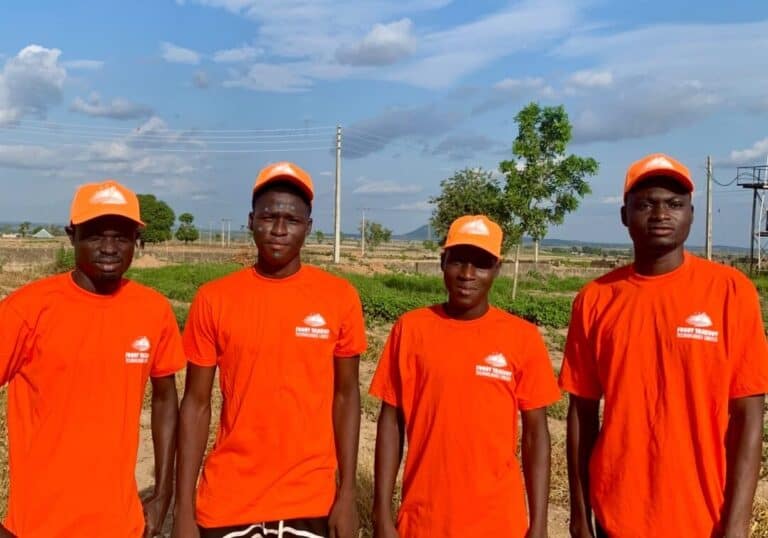
While Nigeria’s food delivery market is dominated by large players focused on major cities such as Lagos and Abuja, a student entrepreneur in Minna believes some of the biggest opportunities lie in underserved university communities.
That belief led to the creation of Foody Takeout, a food delivery startup founded by a student who experienced firsthand the challenges of accessing affordable, reliable food delivery services in the Gidan Kwano community near the Federal University of Technology, Minna (FUTMINNA).
In an exclusive interview with AIBase Nig reporter Ahmad Ibrahim, the founder said the company was born not from market research reports or investor presentations, but from a problem he personally encountered as a student.
“I’m a student myself, so this wasn’t a problem I discovered from sitting somewhere and trying to build a business around it,” he said.
“I personally experience the food accessibility problem in our community.”
According to him, students often struggle to access decent meals despite being willing to pay for delivery services.
“As a student, you can be hungry and still have difficulty getting decent food delivered to you, especially when you’re in an area where food delivery services aren’t really focused,” he explained.
“I kept looking at the problem and thinking, if other people aren’t solving it here, why can’t I try to solve it?”
Why Foody Takeout started in Gidan Kwano
Rather than launching in Nigeria’s largest commercial centres, Foody Takeout chose to begin operations in Gidan Kwano, a decision the founder says was driven by opportunity rather than market size.
“Lagos and Abuja are obviously much bigger markets, but they’re also very competitive,” he said. “There are already major players concentrating heavily on food logistics in those cities.”
The startup instead identified student communities as an underserved segment where delivery services remain limited despite strong demand.
“We looked at Gidan Kwano differently,” he said. “It’s a student community with a real need for food delivery, but it’s still an underserved market. For us, that’s where the opportunity is.”
The company views Gidan Kwano as a testing ground to understand customer behaviour, logistics challenges, and operational realities before expanding into additional markets.
“It allows us to operate closely with our customers, understand their behaviour, understand the logistics challenges and validate our model before taking it into other underserved communities and cities,” he said.
Early traction shows growing demand
Although Foody Takeout remains in its early stages, the startup has begun generating measurable traction.
According to the founder, the platform had 469 registered customers and 316 completed deliveries as of August 16.
However, he says the numbers alone do not tell the full story.
“We’re still in the validation stage, so I’m more interested in what we’re learning from those customers and orders than just the numbers themselves,” he said.
“Every order is helping us understand the market, the restaurants, the delivery process and what we need to improve before scaling.”
Growth has also accelerated since launch.
The startup recorded 120 customers and 80 successful deliveries during its first 30 days. By day 60, that figure had increased to 400 registered customers and 260 successful deliveries.
“As of August 16, we’re at 469 registered customers and 316 successful deliveries,” he said.
According to the founder, the customer base more than tripled between the first and second 30-day periods, while successful deliveries increased by approximately 225%.
“The important thing is that we’re not just acquiring users; we’re seeing people actually use the platform to place orders,” he added.
A different business model for restaurants
Unlike many food delivery platforms that charge restaurants commissions on every order, Foody Takeout is currently pursuing a different approach.
The company’s revenue model is built around customer-paid delivery fees and future restaurant membership plans.
“One of the things we deliberately did differently is that we don’t charge restaurants commission on their orders,” the founder said.
“We currently offer restaurants a 0% commission rate and free membership while we’re validating the model.”
As a result, delivery fees paid by customers currently represent the startup’s primary source of revenue.
When asked whether each delivery is profitable, he said the answer varies.
“Some deliveries are profitable while others aren’t,” he said.
“We’re still learning the economics of different routes and locations, and that’s one of the reasons we’re taking the validation stage seriously before scaling.”
How AI helped build the company
Artificial intelligence has played a significant role in Foody Takeout’s development, according to the founder.
Rather than being limited to customer-facing features, AI has been integrated throughout the company’s product development process.
“AI has made a massive contribution to Foody Takeout, especially on the technology side,” he said.
“The interesting thing is that Foody Takeout was built with AI involved throughout the process, from planning and prototyping to development, debugging, testing and launching.”
The startup relies heavily on Google AI Studio and Gemini to support software development, planning, troubleshooting, and operational decision-making.
“We use Google AI Studio extensively for writing and developing the application, while Gemini serves as a major part of our planning, prototyping, debugging and problem-solving workflow,” he explained.
According to him, AI has effectively acted as a development partner, enabling the startup to move faster despite operating with limited resources.
“Instead of needing a large technical team for every stage of development, I can use AI as a development partner to build, test, identify problems and iterate much faster,” he said.
The company also uses AI to support content creation, marketing materials, and video production.
“For me, AI isn’t just a feature inside Foody Takeout,” he added. “It has become part of the way we build the company.”
Betting on electric delivery infrastructure
Beyond software and logistics, Foody Takeout is also exploring electric vehicle technology as part of its long-term strategy.
The founder believes transportation costs remain one of the biggest challenges facing delivery businesses and sees electric bikes as a potential solution.
“Electric bikes are central to our long-term strategy because logistics is one of the biggest cost components of a delivery business,” he said.
“Our goal is to reduce delivery and maintenance costs over time while also introducing a cleaner and more sustainable way of moving food around the community.”
He described electric bikes as more than just an alternative mode of transportation.
“We don’t just see electric bikes as a vehicle choice,” he said. “We see them as part of the infrastructure that can make our delivery model more efficient as we scale.”
The company is currently evaluating the economics of electric delivery operations within Gidan Kwano.
While a definitive comparison has not yet been established, Foody Takeout estimates that electric delivery could potentially reduce operating costs by approximately 60% compared with petrol-powered alternatives.
However, the founder cautioned that the figure remains a working estimate rather than a validated result.
“We want our eventual EV strategy to be based on our own operating data, not just assumptions,” he said.
Related
- AI-Powered Electric Tricycle Delivery Platform Launched by YABATECH Students
- Ogun State Unveils AI-Driven Learning Platform to Enhance Education
Expansion plans beyond Minna
For now, the startup’s immediate focus remains on validating its model in Gidan Kwano.
Once that process is complete, Foody Takeout plans to expand into nearby student communities including Gidan Mangoro, Bosso, and other areas with significant FUTMINNA student populations.
“From there, we see opportunities in other university communities, before eventually expanding beyond Minna into other parts of Northern Nigeria,” the founder said.
Rather than pursuing rapid expansion for its own sake, he says the company wants to prove that its approach can be replicated successfully in underserved student markets.
“We want to build a repeatable model that works in underserved student communities and then take that model to similar markets,” he said.
Building for the long term
Although the company is still in its early stages and has no major announcements to make, the founder believes the long-term opportunity extends far beyond food delivery in Gidan Kwano.
“What I can say is that we’re moving Foody Takeout from an idea into a real-world operation,” he told AIBase.
“We’ve started in Gidan Kwano, we’re learning from our customers and restaurants, and we’re continuously improving the platform with AI.”
Looking ahead, the startup aims to become a technology-driven logistics company serving underserved student communities, supported by AI-powered systems and eventually an electric delivery infrastructure.
“There may not be a big announcement today,” he said. “We’re still early, but we’re building something we believe can become much bigger than Gidan Kwano.”
