


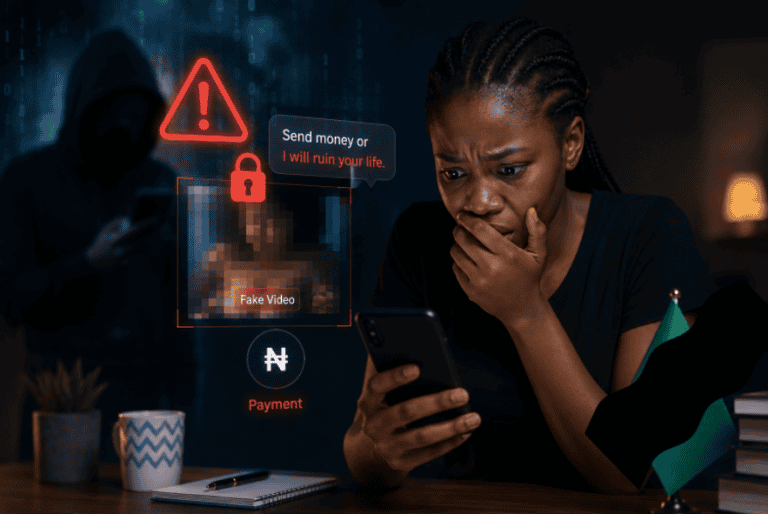
What this scam is
A Deepfake Sextortion Scam in Nigeria is a highly targeted form of digital blackmail where cybercriminals use artificial intelligence software to manipulate ordinary, innocent photographs into sexually explicit images or videos.
Unlike traditional sextortion schemes where perpetrators actively manipulate a victim into willingly sending private explicit content over time, deepfake-driven extortion requires no prior intimacy or mutual exchange of images.
Scammers steal publicly visible profile pictures or casual photos from social media platforms and run them through AI face-swapping algorithms.
The resulting media looks disturbingly authentic, creating the false impression that the victim engaged in explicit acts.
The threat actors then contact the victim, threatening to broadcast the fabricated explicit files to their family, colleagues, and church members unless a substantial emergency ransom is paid immediately.
This setup allows criminal networks to scale their extortion efforts rapidly against thousands of accounts simultaneously.
How it works
-
Criminal syndicates actively scrape public social media profiles on platforms like Instagram, Facebook, and TikTok to download clear facial images of potential targets.
-
The perpetrators feed these casual images into advanced generative AI tools to seamlessly map the victim’s face onto pre-existing explicit photos or adult video clips.
-
The scammers create temporary or burner profiles on messaging apps like WhatsApp or Telegram to launch extortion demands.
-
The victim receives an unsolicited message containing the highly realistic, AI-generated explicit media along with a written ultimatum.
-
To prove their malicious capabilities, the blackmailer includes accurate screenshots of the victim’s real follower lists, family relations, or employer directory details.
-
The criminals demand an immediate emergency fund transfer, giving a very tight deadline of a few hours to force the victim into emotional panic.
-
If the victim pays out of fear, the syndicate immediately violates their promises and demands even larger subsequent payments.
Why this scam works
This extortion method works effectively because it capitalises on the profound social stigma, public embarrassment, and potential reputational ruin associated with explicit content exposure.
Victims face instant, intense panic at the thought of their loved ones or professional networks seeing such damaging materials, clouding their ability to recognise that the media is entirely fabricated.
Furthermore, consumer-grade artificial intelligence tools have advanced to a point where face-swapping and digital body synthesis look incredibly authentic to the naked eye.
The sharp visual rendering eliminates the typical indicators of manual photo editing, convincing the victim that trying to explain the images are “fake” to their community will be impossible, which drives them to comply with the ransom demands.
Real-life Context in Nigeria
In Nigeria, this threat is driven largely by specialised cybercriminals, colloquially referred to as “Yahoo Boys,” who exploit social media networks to harvest identities.
In recent crackdowns, major tech platforms like Meta have proactively removed over 60,000 malicious accounts originating from Nigeria that were actively linked to organised financial sextortion rings.
These threat actors frequently target both domestic citizens and international individuals, capitalising on the high speed of peer-to-peer banking networks to move extortion funds before security flags can be raised.
The strict cultural conservative values in many Nigerian communities make local targets particularly vulnerable, as victims go to extreme lengths to avoid family or religious banishment over public scandals.
A typical pattern
A young professional based in Lagos maintains active public profiles on LinkedIn and Instagram to share career updates and casual lifestyle photos.
Out of nowhere, an anonymous account sends them a direct message on WhatsApp containing a highly explicit video clip clearly showing the professional’s face.
The blackmailer writes a threatening message, stating that if ₦500,000 is not paid into a provided digital wallet within two hours, the video will be blasted to their boss and corporate clients.
The victim instantly panics upon seeing the terrifyingly realistic footage and immediately transfers the requested money to protect their hard-earned career. Instead of deleting the file as promised, the extortionist demands an additional ₦1,000,000 the following morning.
Realising the loop will never end, the victim finally pauses, carefully examines the video frame by frame, and spots tiny AI rendering distortions around the neckline, confirming that the entire video was built using generative software.
Common red flags
-
An anonymous or unfamiliar profile sends you highly explicit imagery out of nowhere, claiming it features you.
-
The blackmailer exerts intense psychological pressure, demanding immediate financial settlement within a strict countdown deadline.
-
The perpetrator sends screenshots of your private family members’ contact cards or corporate directories to prove their target list.
-
The extortionist aggressively insists on keeping the entire interaction secret, threatening immediate exposure if you tell anyone else.
-
The requested payment destination involves anonymous cryptocurrency wallets, digital point-of-sale proxy accounts, or virtual gift cards.
Sanitised example messages
“Look at what I found of you online. If you don’t want this video sent to your father and all the workers at your company office, you have exactly two hours to pay ₦450,000 to this account.” “I have already compiled your full social media contact list. Your career and reputation will be completely destroyed by midnight unless you settle this balance right now.”
How to verify before you act
-
Do not pay the blackmailer: Giving in to financial demands proves that you can be manipulated and guarantees the criminals will demand more money.
-
Stop all communication: Immediately block the extortionist on all messaging applications and social media channels without engaging in further arguments.
-
Examine the media carefully: Look closely for classic AI deepfake artefacts, such as unnatural blinking, mismatched skin tones at the neck boundary, or strange background blurring around the hairline.
-
Check your privacy controls: Verify who has access to your friend lists and photos, and instantly switch your public social media profiles to strict private settings.
What to do immediately
-
Preserve the evidence: Take high-quality screenshots of the extortionist’s messages, phone numbers, profile layouts, and the specific payment details provided.
-
Do not delete the chat history: Keep the raw conversation stream intact on your device, as law enforcement units require digital metadata to track the actors.
-
Deactivate, do not delete accounts: If the pressure becomes overwhelming, temporarily deactivate your social platforms to cut off the scammer’s access rather than permanently wiping the account data.
-
Deploy proactive defence tools: Use the secure, free digital platform StopNCII.org to upload a digital hash fingerprint of the explicit image, preventing it from being uploaded across participating global tech platforms.
Where to report it
-
Nigeria Police Force National Cybercrime Centre (NPF-NCCC): File an immediate criminal report for digital blackmail and AI-driven identity abuse via the NPF-NCCC e-Reporting Portal.
-
Economic and Financial Crimes Commission (EFCC): Report financial extortion demands and proxy banking details used by cybercriminals via the EFCC Official Portal.
-
StopNCII.org: Proactively stop the viral spread or hosting of non-consensual intimate deepfakes by generating protective digital hashes directly via StopNCII.
-
Social Media Help Desks: Report the blackmailer’s active accounts directly to the safety teams of the platform where they first initiated contact or gathered your information.
Warning: Following a deepfake extortion event, you may be approached by fraudulent online profiles claiming to be “private cyber investigators” or “hackers” who promise to delete the media from the dark web for a fee. Real law enforcement agencies, cybercrime centers, and non-profit victim helplines in Nigeria will never demand upfront fees or cryptocurrency payments to process an active safety report.
Frequently asked questions
What should I do first if I receive this kind of threat?
Do not pay any money and immediately stop all communications with the extortionist. Take clean screenshots of the messages, the blackmailer’s profile handles, and the phone numbers used, then block the account. Do not delete the chat history, as law enforcement requires digital metadata for tracking purposes.
Will paying make the threats stop?
No. Paying a “Yahoo Boy” or cyber syndicate will never make the threats stop. It tells the criminal that their manipulation is working, which immediately prompts them to demand even larger sums of money. We will continue to escalate until you respond.
Could the images be real even though I have never shared any?
No, the images were created using advanced generative AI face-swapping technology. Scammers take your regular, innocent pictures from public profiles on Instagram, Facebook, or LinkedIn and convincingly map your face onto explicit materials. You did not make a mistake; the media is completely synthetic.
Should I be ashamed or embarrassed about this?
Absolutely not. You are the victim of an aggressive cybercrime. The shame and fear you feel are exactly what the scammer relies on to extort money from you. Since the images are entirely AI-generated fabrications, you have nothing to be ashamed of.
Is this a criminal offence in Nigeria?
Yes. Under the Cybercrimes (Prohibition, Prevention, etc.) Act of Nigeria, manufacturing, distributing, or using AI to generate non-consensual explicit media for blackmail and financial extortion carries severe criminal penalties, including lengthy prison sentences.
Where can I get help?
You can report the case immediately to the Nigeria Police Force National Cybercrime Centre (NPF-NCCC) or the Economic and Financial Crimes Commission (EFCC). To prevent the images from spreading across global social platforms, please use the free digital protection tool at StopNCII.org right away.
What if a young person I know has received this kind of threat?
If a teenager or student encounters this, reassure them completely that they are not at fault and that the images are fake. Do not scold or shame them, as extreme panic can lead to dangerous personal decisions. Assist them in taking screenshots, blocking the extortionist, and notifying school authorities or law enforcement.
Can the images be removed from the internet?
If the images were sent privately via chat, blocking the attacker cuts off their loop. If they attempt to upload them to major social networks, platforms like Facebook, Instagram, and TikTok can automatically detect and block the files if you have already registered the image fingerprints with StopNCII.org.
