

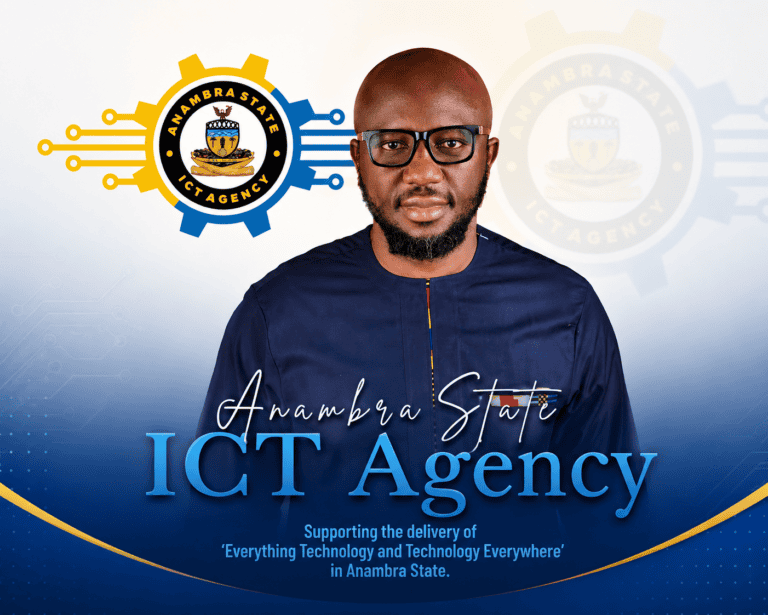
The Anambra State ICT Agency has announced plans to transform itself into what officials describe as Nigeria’s first fully AI-driven government institution, as the state intensifies efforts to deepen digital governance and modernise public service delivery.
The initiative forms part of Governor Charles Soludo’s broader technology-driven governance agenda to reposition Anambra as a leading digital economy hub in Nigeria.
Managing Director and Chief Executive Officer of the Anambra State ICT Agency, Chukwuemeka Fred Agbata, said the agency is working to integrate artificial intelligence into major government operations, citizen engagement systems, and public service platforms.
Agbata said the vision is to create “a smarter, faster and more responsive government powered by innovation and data-driven systems.”
According to him, the agency is already deploying AI-powered solutions to simplify how residents interact with government institutions and access public services.
“We are building systems where citizens can communicate with government seamlessly using conversational AI tools, including indigenous language capabilities,” Agbata said.
He explained that the agency’s digital governance strategy would leverage artificial intelligence to improve decision-making, automate repetitive processes, and enhance efficiency across ministries, departments and agencies.
The state government recently introduced the beta version of “SmartGov,” a digital platform designed to provide residents with easier access to government services through AI-enabled interfaces.
Officials said the platform allows users to process services related to taxation, business registration, healthcare, transportation, education and land administration through a centralised digital system.
The platform is powered by an AI assistant named “NORA,” which has reportedly been trained on government service data and public sector information relevant to Anambra State.
Agbata noted that the government’s long-term objective is to build a fully integrated digital framework that supports predictive governance and data-driven policymaking.
“We sit on large volumes of public sector data today, and artificial intelligence helps us analyse those datasets to understand citizens’ needs better and improve service delivery,” he said.
The ICT Agency also identified the expansion of broadband infrastructure as a critical component of its AI-driven transformation agenda.
According to the agency, the Soludo administration’s Right-of-Way reforms and infrastructure-friendly policies have encouraged increased fibre-optic deployment across the state.
“When service providers begin to see Anambra as an attractive destination for investment, it reflects the strength of our digital policies and our commitment to innovation,” Agbata stated.
Consider Reading:
- Nigeria’s E-Governance Bill 2025: What It Means for AI and for You
- FG Launches AI-Driven Civil Service Reform for Digital Transformation
- YABATECH Freshers Adopt Self-Taught AI Skills to Improve Career Prospects
Industry experts say Anambra’s approach represents one of the most ambitious AI-focused governance initiatives currently being pursued by any Nigerian state government.
Analysts, however, cautioned that successful implementation would depend on sustained investment in digital infrastructure, cybersecurity, data protection frameworks, and digital literacy programmes.
Founded in 2019, the Anambra State ICT Agency coordinates the state’s digital transformation initiatives and drives technology adoption across government institutions.
Since its establishment, the agency has implemented several digitisation programmes, including electronic governance systems, digital tax administration platforms, online recruitment processes, and public sector technology training initiatives.
Observers believe the state’s latest AI-driven ambitions could position Anambra as a model for digital governance innovation in Nigeria if successfully implemented.
“There is a new generation that expects government to be digital-first,” Agbata said. “Our responsibility is to build systems that are ready for the future,” he concluded.

Senior Reporter/Editor
Bio: Ugochukwu is a freelance journalist and Editor at AIbase.ng, with a strong professional focus on investigative reporting. He holds a degree in Mass Communication and brings extensive experience in news gathering, reporting, and editorial writing. With over a decade of active engagement across diverse news outlets, he contributes in-depth analytical, practical, and expository articles exploring artificial intelligence and its real-world impact. His seasoned newsroom experience and well-established information networks provide AIbase.ng with credible, timely, and high-quality coverage of emerging AI developments.