

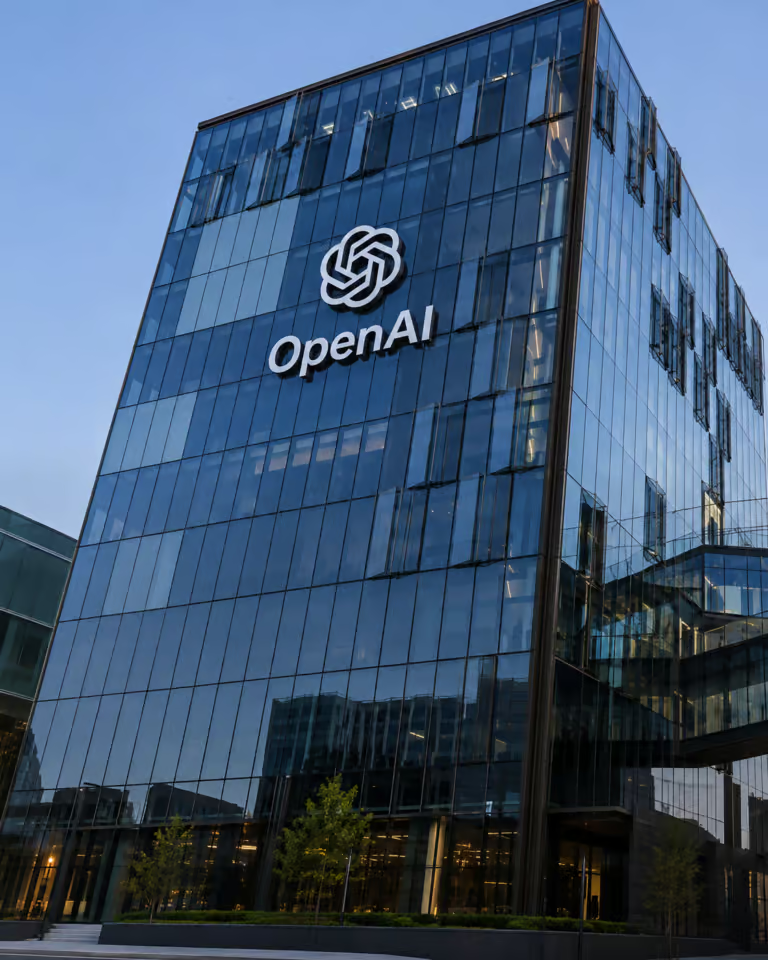
OpenAI has announced the creation of a new enterprise-focused unit designed to accelerate how businesses deploy artificial intelligence systems in real operational environments, marking a shift from model provision to hands-on implementation services.
The new unit, often described as a deployment-oriented subsidiary, will embed technical teams directly within client organisations to help redesign workflows, integrate AI tools into production systems, and scale usage across core business functions.
According to OpenAI, the initiative aims to help companies move beyond experimentation and into the sustained deployment of AI systems. The company stated that its goal is to support organisations, “our goal is to build and deploy AI systems they can rely on every day across their most important work.”
OpenAI Chief Revenue Officer Denise Dresser said the development reflects the growing need for deeper integration between AI systems and enterprise operations. She noted that AI is now capable of performing increasingly meaningful work inside organisations, adding that the challenge is ensuring companies can successfully integrate these capabilities into their existing infrastructure and workflows.
The deployment unit will rely heavily on forward-deployed engineers who will work directly with enterprise clients. These engineers are expected to identify high-value use cases, develop production-ready AI applications, and assist in embedding AI models into internal systems and processes.
As part of the initiative, OpenAI is also acquiring an applied AI consulting firm, bringing in experienced engineers with prior enterprise deployment experience and an established client base. The company says this will strengthen its ability to deliver immediate implementation capacity from the outset.
The structure of the new unit involves majority ownership by OpenAI and participation from multiple global investment and enterprise partners. Reports indicate that the initiative is backed by significant funding and values the new entity in the multi-billion-dollar range.
Industry observers say the move reflects a broader trend in the AI sector, where companies are increasingly shifting from providing standalone models and APIs to offering end-to-end deployment services. Analysts also note that this positions OpenAI more directly in competition with consulting and systems integration firms that traditionally handle enterprise transformation projects.
The development highlights a growing emphasis on practical AI adoption, as businesses seek not only access to advanced models but also guidance and engineering support to integrate those systems into daily operations at scale.

Senior Reporter/Editor
Bio: Ugochukwu is a freelance journalist and Editor at AIbase.ng, with a strong professional focus on investigative reporting. He holds a degree in Mass Communication and brings extensive experience in news gathering, reporting, and editorial writing. With over a decade of active engagement across diverse news outlets, he contributes in-depth analytical, practical, and expository articles exploring artificial intelligence and its real-world impact. His seasoned newsroom experience and well-established information networks provide AIbase.ng with credible, timely, and high-quality coverage of emerging AI developments.