

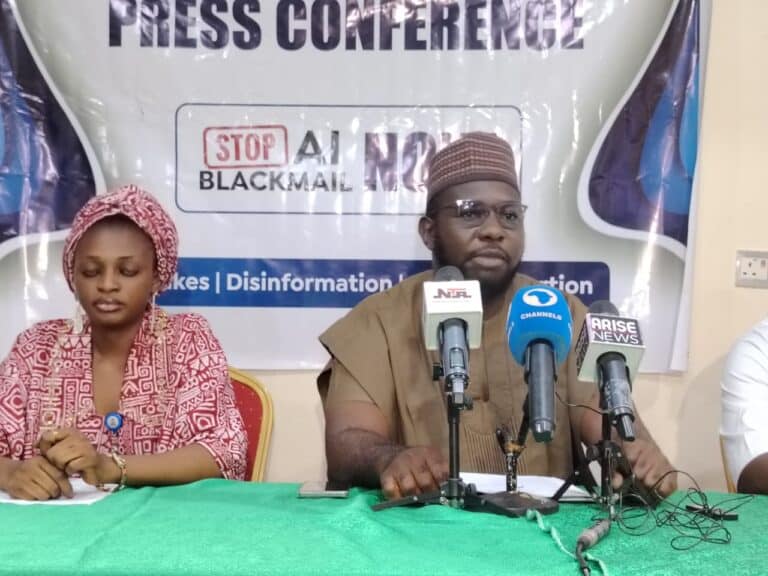
A Nigerian civil society advocate, Abdullahi Haruna Haruspice, has called on the Federal Government to criminalise the creation and spread of fake artificial intelligence (AI)-generated content, warning that deepfakes could undermine trust in Nigeria’s 2027 general elections.
Haruspice, convener of the Coalition for Ethical Technology and Democratic Integrity (CETDI), made the appeal during a press briefing in Abuja, where he raised concerns about the increasing misuse of AI tools for political manipulation, defamation, and blackmail.
He said the rapid advancement of generative AI has made it easier to produce highly realistic fake videos, audio, and images that can mislead the public and damage reputations.
“What was once considered science fiction has now become a credible and immediate threat to Nigeria’s democratic stability, especially as the nation approaches the 2027 general elections,” Haruspice said.
He further warned that emerging patterns suggest the coordinated use of AI-generated content to target political actors and institutions.
“The Coalition has received credible intelligence and observed troubling patterns suggesting that both local and foreign actors are deploying AI-generated content to blackmail, defame, and destabilise prominent individuals in Nigeria’s political and governance space,” he added.
Haruspice urged the government to introduce specific legislation targeting malicious deepfakes, arguing that existing cybercrime provisions are insufficient to address the evolving threat.
He also called for greater investment in AI detection systems and public awareness campaigns to help citizens identify manipulated media.
The coalition maintained that the spread of synthetic media poses a growing risk to electoral integrity and democratic stability as Nigeria moves toward the 2027 general elections.
Read Also:
- The Invisible AI Threat to Nigeria’s 2027 Elections
- Assessing the Threat of AI Misuse to Nigeria’s Electoral Integrity

Senior Reporter/Editor
Bio: Ugochukwu is a freelance journalist and Editor at AIbase.ng, with a strong professional focus on investigative reporting. He holds a degree in Mass Communication and brings extensive experience in news gathering, reporting, and editorial writing. With over a decade of active engagement across diverse news outlets, he contributes in-depth analytical, practical, and expository articles exploring artificial intelligence and its real-world impact. His seasoned newsroom experience and well-established information networks provide AIbase.ng with credible, timely, and high-quality coverage of emerging AI developments.