

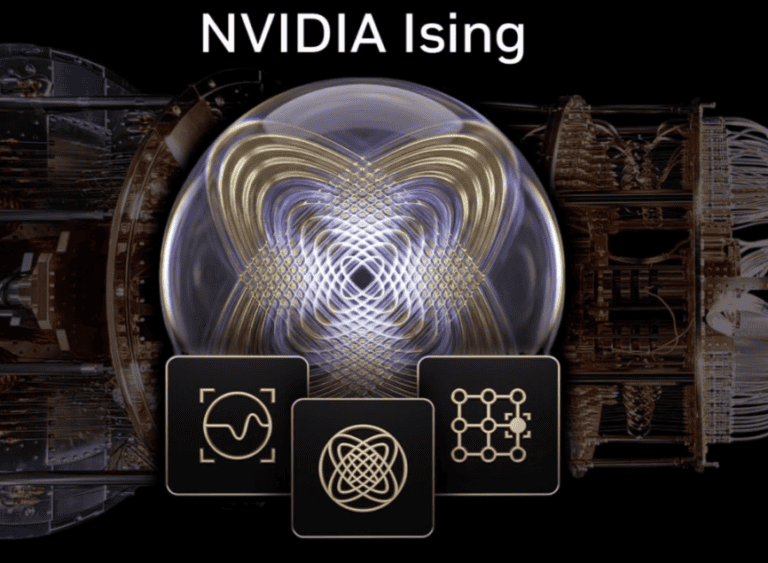
NVIDIA has launched a new set of open artificial intelligence models called Ising, aimed at accelerating progress in quantum computing by improving how quantum systems are calibrated and how errors are corrected.
The company says the new models are designed to help researchers and developers address some of the most persistent challenges in quantum computing, particularly qubit instability and high error rates during computation.
NVIDIA described the Ising system as a toolset that applies AI to both the setup and real-time operation of quantum hardware, enabling more efficient tuning of quantum processors and faster correction of computational errors.
NVIDIA CEO Jensen Huang highlighted the role of AI in enabling the next phase of quantum development.
“AI is essential to making quantum computing practical,” Huang said.
“With Ising, AI becomes the control plane-the operating system of quantum machines.”
The company claims the system significantly improves performance in quantum error correction and reduces the time required to calibrate quantum processors, potentially cutting processes that previously took days down to hours.
Industry analysts say the move reflects a growing convergence between artificial intelligence and quantum computing, with AI increasingly being used to stabilise and optimise early-stage quantum hardware.
The announcement has drawn attention across the technology sector, with experts suggesting it could accelerate efforts to build scalable, fault-tolerant quantum computers in the coming years.

Senior Reporter/Editor
Bio: Ugochukwu is a freelance journalist and Editor at AIbase.ng, with a strong professional focus on investigative reporting. He holds a degree in Mass Communication and brings extensive experience in news gathering, reporting, and editorial writing. With over a decade of active engagement across diverse news outlets, he contributes in-depth analytical, practical, and expository articles exploring artificial intelligence and its real-world impact. His seasoned newsroom experience and well-established information networks provide AIbase.ng with credible, timely, and high-quality coverage of emerging AI developments.