

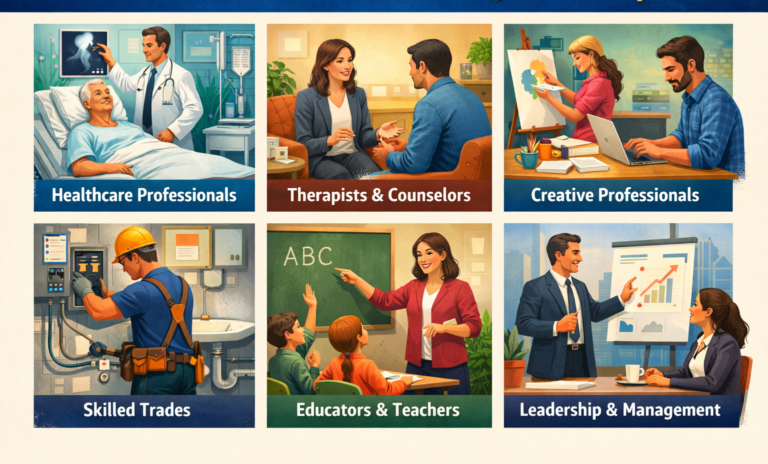
As AI continues to transform workplaces, certain professions remain far less vulnerable to automation, according to Anthropic. These roles rely solely on human skills such as judgment, creativity, and empathy to thrive.
For instance;
Healthcare Professionals
Healthcare professionals, including doctors and nurses, provide medical care, diagnose illnesses, and guide treatment plans for patients. They interact directly with people, adapt to unpredictable situations, and make ethical decisions daily.
Why is it safe? AI can assist with data and diagnostics, but cannot replicate the human empathy, judgment, and ethical reasoning required in real-time patient care.
Mental Health Specialists / Therapists
Therapists and counsellors help patients navigate mental health challenges through personalised therapy sessions, emotional support, and guidance. They build trust and respond to subtle emotional cues.
Why is it safe? Emotional intelligence and the therapeutic relationship, which plays an important role in this profession, cannot be automated, making a human connection essential in mental health care.
Creative Professionals (Writers, Artists, Designers)
Creative professionals generate original content, art, and design by combining imagination, cultural knowledge, and personal perspective. Their work communicates ideas, evokes emotion, and inspires audiences.
Why is it safe? AI lacks true creativity and the ability to understand cultural differences, meaning human originality remains irreplaceable.
Skilled Trades (Electricians, Plumbers, Carpenters)
Skilled tradespeople perform hands-on work to install, repair, or maintain infrastructure and equipment in unpredictable environments. Each project often requires on-the-spot problem-solving.
Why is it safe? The combination of manual dexterity, adaptability, and situational judgment makes these tasks difficult for AI or robots to fully replicate.
Education Professionals (Teachers, Trainers)
Teachers and trainers design lessons, mentor students, and foster learning in classrooms or training environments. They motivate, inspire, and adapt teaching methods to individual needs.
Why is it safe?AI can provide information, but the mentoring, social interaction, and personalised guidance provided by educators cannot be replaced.
Leadership & Strategy Roles
Executives, managers, and strategists make high-level decisions, develop plans, and guide teams toward organisational goals. They weigh complex trade-offs and consider ethical, social, and economic factors.
Why is it safe? These roles require judgment, intuition, and human experience to navigate uncertainty, skills AI cannot fully replicate.
Read:
As AI continues to advance, the future of work will inevitably change-but not all jobs are equally vulnerable. By focusing on professions that demand empathy, creativity, critical thinking, and human judgment, individuals can safeguard their careers and remain indispensable. The key takeaway is clear: in an AI-driven world, cultivating uniquely human skills is not just an advantage-it is the ultimate form of job security.
Credited Source: Research insights (Anthropic)
Senior Reporter/Editor
Bio: Ugochukwu is a freelance journalist and Editor at AIbase.ng, with a strong professional focus on investigative reporting. He holds a degree in Mass Communication and brings extensive experience in news gathering, reporting, and editorial writing. With over a decade of active engagement across diverse news outlets, he contributes in-depth analytical, practical, and expository articles exploring artificial intelligence and its real-world impact. His seasoned newsroom experience and well-established information networks provide AIbase.ng with credible, timely, and high-quality coverage of emerging AI developments.